Basic Critical Thinking Skills

Upper-intermediate (B2) 40 minutes
ESL critical thinking worksheet for B2 upper-intermediate: reading, writing, presenting, group problem solving, class discussion

ESL Critical Thinking Worksheet - Reading and Writing Exercises: Writing a Paragraph - Speaking Activity: Presenting, Asking and Answering Questions - Group Work

Here is a useful critical thinking and problem-solving worksheet and activity to help students learn and apply basic critical thinking and problem-solving concepts...

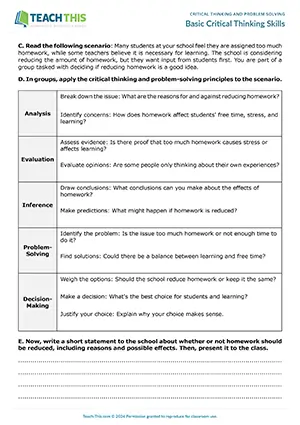
ESL Critical Thinking Worksheet - Reading and Writing Exercises: Writing a Paragraph - Speaking Activity: Presenting, Asking and Answering Questions - Group Work Here is a useful critical thinking and problem-solving worksheet and activity to help students learn and apply basic critical thinking and problem-solving concepts and principles. First, students complete sentences about critical thinking and problem solving with related words from a box. Students then write the sentence number next to the feature of critical thinking or problem solving it is describing. Next, in groups, students read a scenario that outlines an issue regarding homework at a school. In their groups, students apply the critical thinking and problem-solving principles to the issue and make notes on their answers in a chart. After that, each group prepares a short statement that communicates their recommendation for addressing the homework issue and then presents it to the class. After hearing each statement, the class asks the group follow-up questions. Finally, the class votes on which group's recommendation they think would be most effective and discusses why that solution stood out and what makes it particularly compelling.

My Ideal Partner

Upper-intermediate (B2) 25 minutes
ESL critical thinking activity for B2 upper-intermediate: ranking, expressing opinions, negotiating, ideal partner qualities

ESL Critical Thinking Activity - Speaking: Ranking, Expressing Opinions, Negotiating, Communicative Practice - Pair Work

In this interesting critical thinking activity, students prioritise and discuss the most important qualities of an ideal partner. First, students read a list of qualities that an ideal partner might have and...

ESL Critical Thinking Activity - Speaking: Ranking, Expressing Opinions, Negotiating, Communicative Practice - Pair Work In this interesting critical thinking activity, students prioritise and discuss the most important qualities of an ideal partner. First, students read a list of qualities that an ideal partner might have and mark the ten most important ones with a tick. Next, in pairs, students find out which ten qualities their partner chose and mark down their answers. After that, students discuss the answers with their partner and explain the reasons for their choices. Then, from the items they have both ticked, students compromise and choose the five most important qualities, arranging them from 1 to 5, with number 1 being the most important. Each pair then joins with another pair and compares their five most important qualities. Finally, each group gives feedback to the class on their most popular qualities for an ideal partner.

Stress

Upper-intermediate (B2) 60 minutes
ESL critical thinking activity for B2 upper-intermediate: vocabulary, gap-fill, guided discussion, survey, group work on stress

ESL Critical Thinking Activity - Vocabulary and Reading Exercise: Gap-fill - Speaking Activity: Discussion, Survey, Communicative Practice - Pair and Group Work

In this insightful critical thinking activity, students use a framework to look at the topic of stress and evaluate stress reduction and relaxation methods...

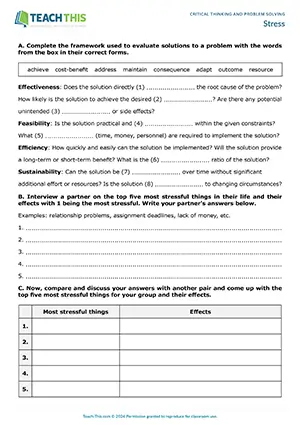
ESL Critical Thinking Activity - Vocabulary and Reading Exercise: Gap-fill - Speaking Activity: Discussion, Survey, Communicative Practice - Pair and Group Work In this insightful critical thinking activity, students use a framework to look at the topic of stress and evaluate stress reduction and relaxation methods. Students begin by completing a framework that can be used to evaluate solutions with words from a box. Students then interview a partner about the top five most stressful things in their life and their effects with 1 being the most stressful. Next, students compare and discuss their answers with another pair, come up with the top five most stressful things for their group, and write down the effects of each stressful thing. After that, students conduct a survey to find out what stress reduction and relaxation methods their classmates use. Students then move on to read the responses and score each stress reduction and relaxation method according to the four criteria from the framework, effectiveness, feasibility, efficiency and sustainability. Finally, students rejoin their group and discuss their three highest-scoring methods and questions related to the framework.

What's the Criterion?

Upper-intermediate (B2) 30 minutes
ESL critical thinking game for B2 upper-intermediate: ranking, discussion, guessing criteria, group work

ESL Critical Thinking Game - Speaking: Ranking, Discussion, Guessing, Communicative Practice - Group Work

In this fun critical thinking game, students guess what criterion their classmates used to put a list of ten jobs in order. Working alone, students order jobs on their card, according to the given criterion with...

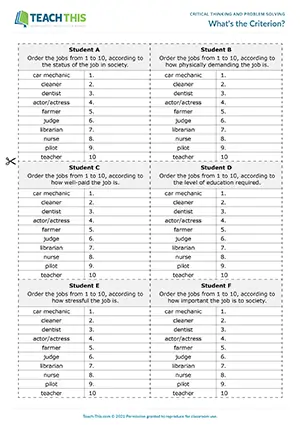
ESL Critical Thinking Game - Speaking: Ranking, Guided Discussion, Guessing, Communicative Practice - Group Work In this fun critical thinking game, students guess what criterion their classmates used to put a list of ten jobs in order. Working alone, students order jobs on their card, according to the given criterion with 1 being the most important. Next, students use their critical thinking and analysing skills to guess what criterion other students used to put their list of ten jobs in order. Students then take turns reading out their job order from 1 to 10. The other students in the group analyse the list and discuss the possible criterion, explaining their reasoning for guessing a specific criterion and thinking critically about their assumptions and logic. After that, each student gives their answer to the student who read out the order. The student then reveals the correct criterion. Students who guessed correctly each score one point. The student with the most points at the end of the game wins. Finally, discuss the job order for each criterion with the class and see if the students can agree on a ranking for each.

Your Views

Upper-intermediate (B2) 30 minutes
ESL critical thinking activity for B2 upper-intermediate: guided discussion, controversial questions, group practice

ESL Critical Thinking Activity - Speaking: Discussion, Communicative Practice - Group Work

This intriguing critical thinking activity provides an opportunity for students to use their critical thinking skills to discuss a set of controversial questions. In groups of four, students read a set of...

ESL Critical Thinking Activity - Speaking: Guided Discussion, Communicative Practice - Group Work This intriguing critical thinking activity provides an opportunity for students to use their critical thinking skills to discuss a set of controversial questions. In groups of four, students read a set of question strips and choose three to discuss. Students then have ten minutes to brainstorm different perspectives on the selected questions by exploring arguments for and against each question. Next, students discuss each question for five minutes, supporting their opinions with evidence and reasoning using credible sources or personal examples, drawing a conclusion at the end. After discussing all three questions, each group presents their conclusions to the class. After each group has presented, the class asks questions that challenge the group's assumptions. Afterwards, students give feedback on which group they thought came up with the best conclusions.

Island Adventure

Advanced (C1) 50 minutes
ESL desert island survival game for C1 advanced: reading, writing, presenting, group problem-solving, critical thinking

ESL Desert Island Survival Game - Reading, Writing, Listening and Speaking Activity: Writing Sentences, Preparing and Delivering a Presentation - Group Work

In this free desert island survival game, students use their critical thinking and problem-solving skills to survive being stranded on a desert island...

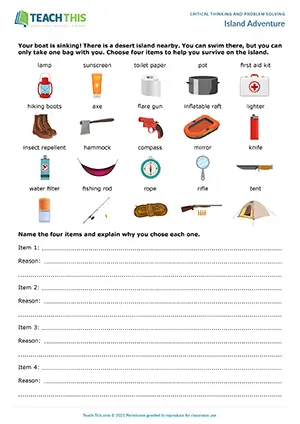
ESL Desert Island Survival Game - Reading, Writing, Listening and Speaking Activity: Writing Sentences, Preparing and Delivering a Presentation - Group Work In this free desert island survival game, students use their critical thinking and problem-solving skills to survive being stranded on a desert island. Students imagine that their boat is sinking and that there is a desert island nearby. In groups, students choose four items from the worksheet to help them survive on the island and explain why they chose each one. Next, groups find out what challenge they face on the island by choosing a card. Groups then read the challenge and make a plan on how they are going to survive on the island using the four items to help them. Afterwards, groups take turns reading their challenge and presenting their ideas to the class. Assess each group's chances of survival and score each group between one and three points according to their ideas. After each group has presented, they roll a dice and the awarded points are combined with the number on the dice. Groups need to score four or more to survive. A score of six or more is needed to thrive on the island.

Survivor

Advanced (C1) 30 minutes
ESL problem solving activity for C1 advanced: guided discussion, writing, presenting, role-play, survival scenario

ESL Problem Solving Activity - Speaking: Guided Discussion, Writing Sentences, Presenting, Role-Play, Communicative Practice - Group Work

In this communicative problem-solving activity, students use their critical thinking and problem-solving skills in order to survive an imaginary emergency...

ESL Problem Solving Activity - Speaking: Guided Discussion, Writing Sentences, Presenting, Role-Play, Communicative Practice - Group Work In this communicative problem-solving activity, students use their critical thinking and problem-solving skills in order to survive an imaginary emergency. To start, students read a background story about a plane crash. In groups, students then discuss the ways they would face the emergency situation in the story and pick five items to help them survive, writing down the reasons for their five choices, e.g. a mirror for signalling rescuers by day. Groups then take turns explaining their choices to the class, who give feedback on their ideas. The class then votes to see if the group could survive using the items or not. Next, the class discusses their solutions and comes up with a list of the five best survival items from the worksheet. Afterwards, groups practice conveying important information in an SOS emergency call in the most effective way possible. The students' task is to call a rescue team and explain where they are and the situation in one minute. Students practice the emergency call first in their groups and then perform it to the class.

Zero Sum Negotiations

Advanced (C1) 40 minutes
ESL zero sum negotiations activity for C1 advanced: negotiating, discussion, pair work, writing answers

ESL Zero Sum Negotiations Activity - Speaking: Negotiating, Discussion, Communicative Practice - Pair Work - Writing Exercise: Answering Questions

In this engaging critical thinking activity, students practice and reflect on zero-sum negotiations. Students imagine they have been given $100 that...

ESL Zero Sum Negotiations Activity - Speaking: Negotiating, Discussion, Communicative Practice - Pair Work - Writing Exercise: Answering Questions In this engaging critical thinking activity, students practice and reflect on zero-sum negotiations. Students imagine they have been given $100 that they must divide with their partner, but they must aim to secure at least the amount indicated on their goal card. This is a zero-sum negotiation, meaning any gain for one student is a loss for the other. Students then have five minutes to negotiate with their partner for a share of the money with each student using their own story or tactic to justify why they need the money. When the time is up, students reveal their goal cards to their partners. Students then share their goals and the results of their negotiation with the class. Next, students change partners and repeat the zero-sum negotiations as before using the instructions on a new card to influence how the negotiation goes. After an agreement has been reached, students reveal their role and goal card to their partner. Lastly, students answer discussion questions, reflecting on their experiences and then discuss them as a class.

What Is Critical Thinking and Problem Solving?

Critical thinking is the ability to question assumptions, weigh evidence, and reason through a problem before drawing a conclusion. Problem solving is the structured process of identifying a challenge and working through possible solutions to reach the best one. Students who skip both skills tend to jump to the first available answer, and in academic writing or workplace discussions that makes their arguments easy to dismiss.

This page covers critical thinking and problem solving across B2 and C1 levels, with eight activities and games ranging from group scenario analysis to negotiation role-plays, including one free download.

When to Use Critical Thinking & Problem Solving Language

Challenging an Unsupported Claim: When a speaker or writer makes an assertion without evidence, critical thinking gives you the tools to question the reasoning behind it rather than accept it at face value, as a manager might ask 'What data supports that projection?' before approving a budget.

Choosing Between Competing Solutions: Problem solving comes into its own when there is no single obvious answer and you need to compare options against clear criteria, the way a team might weigh up 'Do we cut costs, reduce hours, or restructure the team?' before deciding on a course of action.

Presenting a Reasoned Recommendation: When you need to persuade others to act on your conclusion, pairing a clear problem statement with structured reasoning makes your case far more convincing, as in 'We identified three root causes and tested two solutions before recommending this one.'

3-Step Framework for Teaching Critical Thinking & Problem Solving

1. Build a Shared Framework: Start by giving students a set of core concepts and principles to match and define before applying them to a real scenario. The payoff comes when each group prepares a short statement that communicates their recommendation for addressing the issue and presents it to the class, who then vote on which solution would be most effective.

2. Apply a Scoring Framework to a Real Topic: Move students into applied evaluation by having them collect real data through a peer survey, then rate each solution against four named criteria: effectiveness, feasibility, efficiency, and sustainability. Scoring options against this framework pushes students beyond opinion and into structured, evidence-based reasoning.

3. Sharpen Analytical Thinking with a Guessing Challenge: Each student secretly ranks a list of ten jobs using a hidden criterion, then reads their order aloud while classmates analyze the pattern and try to identify the reasoning behind it. Students who guess the criterion correctly score a point, which keeps everyone engaged and thinking critically right to the end.

Common Mistakes with Critical Thinking & Problem Solving

Confusing Opinion with Evidence: Students often state a personal belief as if it were a reasoned conclusion, without providing supporting logic or evidence to back it up. Wrong: 'I think social media is bad, so companies should ban it.' Correct: 'Studies show social media reduces productivity by 13%, which suggests companies should limit its use during work hours.'

Ignoring the Other Side: Students often argue from only one perspective, failing to acknowledge counterarguments, which makes their reasoning appear one-sided and unconvincing. Wrong: 'Remote work is always better because employees are happier.' Correct: 'While remote work increases employee satisfaction, it can reduce collaboration, so a hybrid model may offer the best balance.'

Common Questions About Teaching Critical Thinking & Problem Solving

What is a fun game for practicing critical thinking and problem solving?

The free game Island Adventure puts students in a survival scenario where groups choose four items to help them survive on a desert island and plan how to use them. After presenting their plan to the class, each group rolls a dice combined with points the teacher awards. Groups need to score four or more to survive.

What is a good speaking activity for practicing critical thinking?

The activity Your Views gets students thinking critically by having them choose three controversial questions to discuss, brainstorm arguments for and against each one, then defend their conclusions to the class. Other groups challenge their reasoning and assumptions after each presentation, pushing everyone to support their views with evidence rather than just opinion.

What is a useful worksheet for teaching critical thinking and problem solving?

The worksheet Basic Critical Thinking Skills introduces key concepts and principles through sentence-completion exercises before moving into a group scenario. Students apply what they have learned by analyzing a real issue, preparing a recommendation, and presenting it to the class, who then vote on which solution would be most effective.

Become a Teach This Member

  • 3,000+ ESL activities, games and worksheets
  • Online teaching platform with unlimited student access
  • Full access to Game Maker, Worksheet Maker and Slide Maker
View Membership Plans

Here’s What Our Members Are Saying

Jose Pinto

★★★★★

ESL Teacher, Timor-Leste

"There are a lot of resources that are useful for teaching English. I downloaded the games which are handy and use them in my classes. With the games, my students never skip class or feel tired to learn English. The resources for teaching English helped my students progress in grammar, vocabulary, writing and comprehension. They also helped me a lot to guide my students to learn in a practical way."

Julia Lohla

★★★★★

English Instructor, United States

"Thank you for providing these incredible resources. Teach-This.com is always my go-to site for class activities, and I recommend it often. I love how it is organized. I can find resources for a specific grammar concept or language function by level and type of activity. Every time I visit your site, I discover a new classroom interaction strategy that's perfect for teaching the concept I'm focusing on! When I return after the holidays, yours will be the first subscription I restart."

Carrie Brooke-Mellor

★★★★★

ESOL Teacher, United Kingdom

"I am an ESOL teacher, and the resources have helped my classes enormously. In particular, the speaking activities were a great help for my intermediate students before their exam. The website is user-friendly, and I will continue to utilise the resources - next term is reading and comprehension, so I will be looking for more resources from you. Thank you for such helpful activities and worksheets. They save me a lot of time in class preparation."

Charlie Sanders

★★★★★

ESL Teacher, France

"Teach This is an absolutely brilliant website, offering a vast amount of high-quality content, much of it free. Everyone involved in its creation deserves commendation. The leadership's vision has my deepest respect and gratitude. It's undoubtedly the best resource for English teachers, with its clear layout, easy navigation, concise messaging, and lack of invasive advertising - rare qualities that Teach This has perfected."

Joy Tebow

★★★★★

English Teacher, Laos

"When I need to add or change an activity from my school's curriculum, I always turn to TeachThis. While our curriculum is usually very good, it sometimes doesn't fit well with my students. With TeachThis, I can easily find activities that match my topic and level, and the resources make my classes more interesting and varied. I look forward to the monthly newsletter and exploring new materials for inspiration. Please keep it up!"

Mina Zolfaghari

★★★★★

English Tutor, Australia

"I like the efficiency and organization of the website. The resources cater to various levels with topic-based options for higher levels. The worksheets are very engaging and the answer keys are particularly helpful for teacher. The resources are also highly specific to levels and outcomes, making planning much easier. Finding what I need is simple and time-saving with the keyword search feature. Everything is clear and straightforward."

Karin Kiss

★★★★★

ESL Teacher, Switzerland

"The easy and ready-to-go materials have helped me a lot during the last few years. Most of all I like the grammar games that activate my pupils and keep them engaged. My lessons have become way more playful and varied. Additionally, I like the grammar worksheets which I use to consolidate what I have worked on during class. The website is very user-friendly, and I have never had any difficulties finding what I was looking for."

David-Wonbae Lee

★★★★★

Business English Teacher, Canada

"A friend told me about the site, and it's awesome. I have found the Business English resources especially engaging and relevant for my students as the materials help them understand business writing and terms. My teaching experience has also improved from using the games on the site as they allow me to teach in a fun way. The user experience is outstanding. Great job!"

Daniela Garcia

★★★★★

English Teacher, Mexico

"I found Teach-This a long time ago when I started teaching. It's always had great resources. I really appreciate the grammar materials, board games, and group activities. They've saved me lots of time on lesson planning. The materials are easy to use and understand, making my job much simpler. The best thing is that many resources can be downloaded for free. I've used it for around 8 years, and it consistently offers great content."

Thomas Wilson

★★★★★

Primary School Teacher, United Kingdom

"I use the resources from the Games Section as part of my daily 30-minute morning warm-up activities, and I've received rave reviews for using them. The games help me maintain student interest and participation and leave the students feeling happy and awake. I like everything about the site, and customer support is very effective as they respond in time."

Eugenia Fernandez

★★★★★

EFL Teacher, Argentina

"Teach-This is one of the best EFL websites I've found. It's extremely user-friendly, and I always find what I need quickly. I like the design, and the content is fun, engaging and original. I am very thankful for all your work and generosity by making some resources free. I always recommend this website to my fellow teachers. Your work is really helpful, and I value it enormously."

Jakub Havlk

★★★★★

Language School Teacher, Czechia

"I like the grammar-focused resources the most as they save me time. The resources also inspire me. If I see an interesting grammar activity, I often rework it for other grammar rules. I like the fact that I simply pay a flat fee, and I can download whatever I want. Teach-This really is a great timesaver. I know that if I am in need of resources for my students, I can go to Teach-This and find something interesting."

Alice Dimpz

★★★★★

English Teacher, Kenya

"Getting familiar with the site and how to use the resources is not difficult. I found the writing skills resources to be the most valuable as they have enhanced my teaching of this skill. The website is elaborate and full of all types of resources to help me teach English. When I contacted customer support, they were super-fast to deal with my enquiry. So overall, I recommend it."

Ikrram Badaoui

★★★★★

ESL Teacher, Morocco

"I have found the grammar and vocabulary resources the most valuable. They have improved my teaching experience because they are easy to use and well-organized. The materials are very engaging for my students. The website is also very user-friendly. The best thing about Teach-This is that it offers ready-made worksheets for busy teachers, and the content is well-organized and full of information."

Tania Ahmed

★★★★★

High School Teacher, Kurdistan

"I'm really glad I found the Teach-This website. The materials in the General English section have proven to be really helpful and made my classes more engaging. The materials are well-structured and cover a wide range of topics, making it easy to keep my students interested and motivated. Overall, my experience using your resources has been great."

Khawla Orq

★★★★★

EFL Teacher, Yemen

"My first impression of the website was that it was amazing. The games and activities have really improved my teaching. The resources are engaging and relevant to my students' needs, and I find the website easy to use and navigate. Thanks."

Anika Yadav

★★★★★

English Teacher, India

"I would like to thank you for making a fantastic website. I particularly enjoy teaching the functional language materials, which have been very helpful in my classes. The resources have significantly improved my students' communication skills in daily life, so it was rewarding to see them benefit in this way. It feels great to be able to make a difference in my students' lives. Please keep up the good work."

Dr. Elena Petrov

★★★★★

Academic English Coordinator, Spain

"I've been teaching Academic English for over eight years, and Teach-This.com has become my go-to resource for university preparation classes. The academic vocabulary exercises and speaking test preparation activities are exceptionally well-designed for advanced learners. My students particularly appreciate the study skills resources and paragraph writing materials, which have significantly boosted their confidence and exam scores."

Suzanne Coleman

★★★★★

Volunteer English Teacher, England

"I like your resources because they are so interesting and attractive. Your resources help to maintain student interest. Your resources have helped with the planning and preparation of my lessons because I have often been able to find resources focusing on specific topics, grammar or vocabulary. I am particularly grateful for your free resources, which I use at the English Club where I am a volunteer and help to support internationals in the community who are learning English."