Daily Routine Detectives

Elementary (A1-A2) 30 minutes
ESL Present Simple Game worksheet preview for Elementary A1-A2 showing sentence completion and classmate guessing activities

ESL Present Simple Game - Grammar and Speaking: Sentence Completion, Guessing

In this fun present simple game, students practice base and third person singular verb forms by completing present simple sentences about their classmates' daily routines and then checking if their guesses are right or wrong...

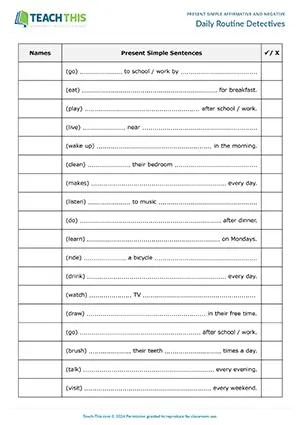
ESL Present Simple Game - Grammar and Speaking: Sentence Completion, Guessing In this fun present simple game, students practice base and third person singular verb forms by completing present simple sentences about their classmates' daily routines and then checking if their guesses are right or wrong. First, students complete present simple sentences using the verbs in brackets in the third person singular. Students then read each sentence and think about who in the class the sentence could be true for. Next, students write the name of the person in the 'Names' column next to each sentence, e.g. 'Hana goes to school by bus.' After that, students go around the class reading the sentences to the people on their worksheet to see if their guesses are right or wrong using 'I think you' + the base form of the verb, e.g. 'I think you go to school by bus.' If the person says 'Yes, I do', students put a tick in the last column. If the person says 'No, I don't', students put a cross. The student with the most correct guesses at the end of the game wins.

During the Week

Elementary (A1-A2) 25 minutes
ESL Present Simple Game worksheet preview for Elementary A1-A2 with vocabulary and sentence forming group activities

ESL Present Simple Game - Vocabulary, Grammar and Speaking: Matching, Forming Sentences, Freer Practice - Group Work

In this engaging present simple game, students practice making present simple affirmative and negative sentences about their daily routines. In groups, students take turns turning over a verb card...

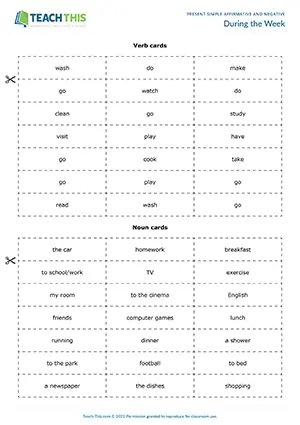
ESL Present Simple Game - Vocabulary, Grammar and Speaking: Matching, Forming Sentences, Freer Practice - Group Work In this engaging present simple game, students practice making present simple affirmative and negative sentences about their daily routines. In groups, students take turns turning over a verb card on a weekly schedule. If the verb matches one of the word cards in their hand, the student makes a true present simple affirmative or negative sentence about what they do or don't do at that time and day. For example, a student turns over the verb 'make' on the 'Wednesday afternoon' square, matches it with 'breakfast' and says, 'I don't make breakfast on Wednesday morning.' If the group agrees that the sentence is grammatically correct and appropriate, the student puts their word card on top of the verb card. The next student then turns over a verb card, and so on. If a student cannot match one of their word cards with the verb on the chart, the verb card is turned back over and play passes to the next student. The first student to get rid of all their word cards wins the game.

Habits Battleships

Elementary (A1-A2) 25 minutes
ESL Present Simple Game preview for Elementary (A1-A2): forming sentences, guessing, pair work

ESL Present Simple Game - Grammar and Speaking: Forming Sentences, Guessing - Pair Work

In this enjoyable present simple game, students play Battleships by trying to find six habits on a partner’s timetable. First, students secretly write six habits from the Habit Bank in different squares on their own...

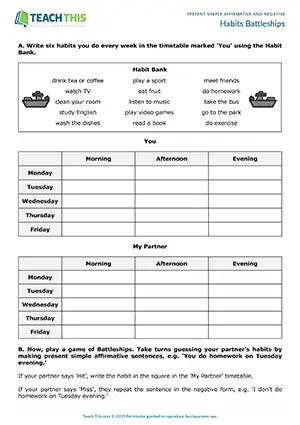
ESL Present Simple Game - Grammar and Speaking: Forming Sentences, Guessing - Pair Work In this enjoyable present simple game, students play Battleships by trying to find six habits on a partner’s timetable. First, students secretly write six habits from the Habit Bank in different squares on their own timetable. Next, students take turns guessing their partner's habits by making present simple affirmative sentences, e.g. 'You do homework on Tuesday evening.' If the guess is correct, their partner says 'Hit', and the student writes the habit in the same square on the timetable marked 'My Partner'. If the guess is wrong, their partner says 'Miss' and repeats the present simple sentence in the negative form, e.g. 'I don't do homework on Tuesday evening.' Play then passes to the other student. The first student to find all six of their partner’s habits wins the game.

Isn't or Doesn't?

Elementary (A1-A2) 30 minutes
ESL Present Simple Negative Worksheet preview for Elementary A1-A2 focusing isn't and doesn't

ESL Present Simple Negative Worksheet - Grammar Exercises: Sorting, Gap-fill, Writing sentences - Speaking Activity: Asking and Answering Questions

In this useful present simple worksheet, students practice using 'isn't' and 'doesn't' in present simple negative sentences. First, students put words from a box...

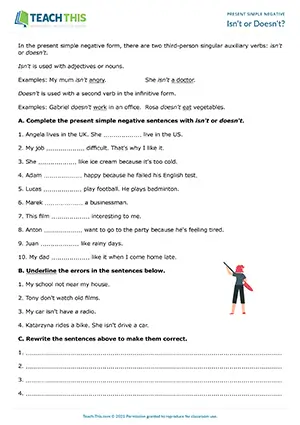
ESL Present Simple Negative Worksheet - Grammar Exercises: Sorting, Gap-fill, Error Correction, Writing and Rewriting sentences - Speaking Activity: Asking and Answering Questions In this useful present simple worksheet, students practice using 'isn't' and 'doesn't' in present simple negative sentences. First, students put words from a box in the correct 'isn't' or 'doesn't' group. Students then complete present simple negative sentences with 'isn't' or 'doesn't'. Next, students draw a line under the wrong word in each sentence, and then rewrite the sentences to make them correct. After that, students use prompts to write present simple negative sentences with 'isn't' or 'doesn't'. Students then match sentence halves to form sentences with 'isn't' and 'doesn't'. Finally, students go around the class, asking their classmates present simple yes/no questions. When a classmate answers 'No', students write their name at the start of the negative sentence.

Monday to Friday

Elementary (A1-A2) 25 minutes
ESL Present Simple Game preview for Elementary A1-A2 with sentence completion and routine guessing

ESL Present Simple Game - Grammar and Speaking: Guessing, Completing and Forming Sentences - Pair Work

In this free present simple game, students complete sentences about a partner's Monday to Friday routine and then find out if the information is right or wrong using present simple affirmative and...

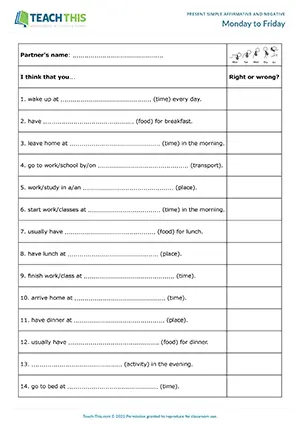
ESL Present Simple Game - Grammar and Speaking: Guessing, Completing and Forming Sentences, Controlled and Freer Practice - Pair Work In this free present simple game, students complete sentences about a partner's Monday to Friday routine and then find out if the information is right or wrong using present simple affirmative and negative sentences. First, students complete sentences about their partner's Monday to Friday routine by guessing the information and writing it in the spaces. Next, students take turns reading each sentence to their partner, e.g. 'I think that you wake up at 7 o'clock.' Their partner tells them if the sentence is right or wrong. If the student's guess is wrong, their partner gives the correct information by first making a present simple negative sentence, followed by an affirmative sentence, e.g. 'I don't wake up at 7 o'clock. I wake up at 6 o'clock.' If the student guesses correctly, they put 'right' in the last column. If their guess is incorrect, they put 'wrong'. The student with the most correct guesses at the end of the game wins.

Pick Up Two

Elementary (A1-A2) 20 minutes
ESL Present Simple Game worksheet preview for Elementary (A1-A2): matching sentence halves and pelmanism game

ESL Present Simple Game - Grammar: Matching - Pair Work

In this rewarding present simple game, students match sentence halves together to form basic present simple sentences. In pairs, students start by matching the beginning of each sentence with its correct ending to make a grammatically correct...

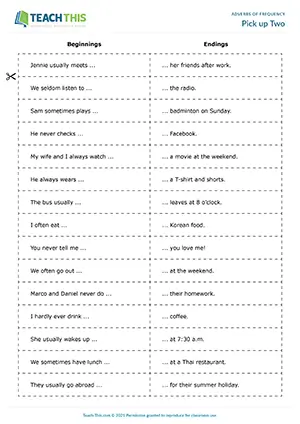
ESL Present Simple Game - Grammar: Matching - Pair Work In this rewarding present simple game, students match sentence halves together to form basic present simple sentences. In pairs, students start by matching the beginning of each sentence with its correct ending to make a grammatically correct present simple sentence. Afterwards, check the answers with the class by asking students to read each sentence aloud. Pairs score one point for each correct sentence. The pair with the most points wins the game. Next, pairs play a pelmanism game with the cards. Students take turns turning over one card from each set. If the two halves make a grammatically correct present simple sentence, the student keeps the two cards and has another turn. The student with the most cards at the end of the game wins.

Positive or Negative?

Elementary (A1-A2) 25 minutes
ESL Present Simple Board Game worksheet preview for Elementary (A1-A2): board game forming affirmative and negative sentences

ESL Present Simple Board Game - Grammar: Forming Sentences - Group Work

In this fun present simple board game, students practice making present simple affirmative or negative sentences from prompts. In groups, players take turns rolling the dice and moving their counters along the board. When a player...

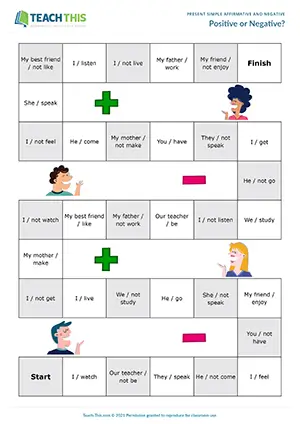
ESL Present Simple Board Game - Grammar: Forming Sentences from Prompts - Group Work In this fun present simple board game, students practice making present simple affirmative or negative sentences from prompts. In groups, players take turns rolling the dice and moving their counters along the board. When a player lands on a square, they make a present simple affirmative sentence using the prompt on the square, adding other words such as an object, place or time, e.g. I watch TV in the evening.' If the prompt includes 'not', the player makes a negative sentence, e.g. ‘Our teacher isn’t late for class.’ If the other group members agree that the sentence is grammatically correct, the player stays on the square. If not, the player goes back two squares. If players land on the same square, they are not allowed to repeat another student's sentence. The first player to reach the finish wins the game.

Present Simple Collocation Challenge

Elementary (A1-A2) 35 minutes
ESL Present Simple worksheet and game preview for Elementary A1-A2 for common verb-noun collocations

ESL Present Simple Worksheet and Game - Grammar Exercises: Gap-fill, Writing Sentences, Odd Word Out - Speaking: True or False, Guessing - Pair Work

In this free present simple worksheet and game, students practice using common verb-noun collocations in present simple affirmative and negative sentences...

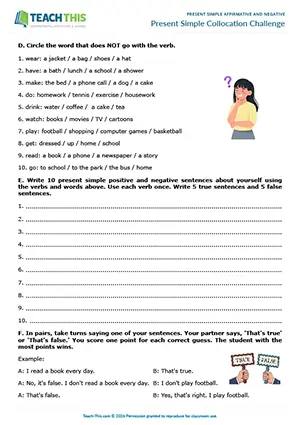
ESL Present Simple Worksheet and Game - Grammar Exercises: Gap-fill, Writing Sentences, Identifying, Odd Word Out - Speaking Game: True or False, Guessing - Pair Work In this free present simple worksheet and game, students practice using common verb-noun collocations in present simple affirmative and negative sentences. First, students complete sentences with verbs from a box in the correct form. Students then write positive and negative sentences using the verbs from the box. Next, students complete each sentence with the correct negative. After that, students circle the nouns that do not go with the verbs. Next, students write ten true present simple positive and negative sentences about themselves using the verb-noun collocations from Exercise D. Five sentences should be true, and five should be false. In pairs, students then take turns reading one of their sentences to their partner, who guesses if it's true or false. Students score one point for each correct guess. The student with the most points at the end of the game is the winner.

Present Simple Dominoes

Elementary (A1-A2) 25 minutes
ESL Present Simple Game worksheet preview for Elementary (A1-A2): dominoes game forming sentences

ESL Present Simple Game - Grammar: Matching, Forming Sentences - Group Work

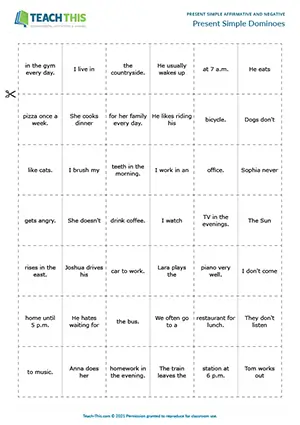
This present simple dominoes game helps students practice forming present simple affirmative and negative sentences. The first player tries to make a present simple affirmative or negative sentence by placing a domino down either before...

ESL Present Simple Game - Grammar: Matching, Forming Sentences - Group Work This present simple dominoes game helps students practice forming present simple affirmative and negative sentences. The first player tries to make a present simple affirmative or negative sentence by placing a domino down either before or after the domino on the table. If the player can match two halves and make a sentence, they read it to the group to show the match is correct. If the group agrees that the two halves match correctly, the domino stays in place. If not, the player picks it back up. The next player then tries to put down one of their dominoes at either end of the domino chain, and so on. The first player to get rid of all their dominoes wins the game.

Present Simple Places

Elementary (A1-A2) 25 minutes
ESL Present Simple Board Game worksheet preview for Elementary (A1-A2): board game with prepositions of place

ESL Present Simple Board Game - Grammar and Speaking: Forming Sentences - Group Work

In this creative present simple board game, students practice making affirmative sentences with prepositions of place. Players take turns rolling the dice and moving their counter along the board...

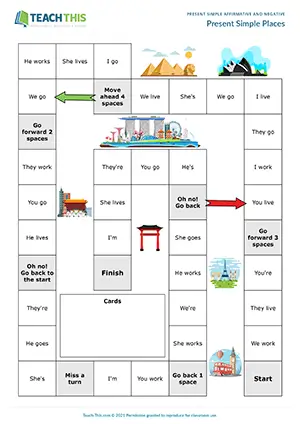
ESL Present Simple Board Game - Grammar and Speaking: Forming Sentences from Prompts - Group Work In this creative present simple board game, students practice making affirmative sentences with prepositions of place. Players take turns rolling the dice and moving their counter along the board. When a player lands on a square, they read the subject pronoun and verb and match it with a place on one of their cards. The player then makes a present simple affirmative sentence, adding in the correct preposition, e.g. 'They work in an office.' If the player's sentence is grammatically correct, they place the card at the bottom of the pile and take one from the top. If the player's sentence is incorrect, they keep the card and go back two squares. The first player to reach the finish wins the game.

Right or Wrong Routines

Elementary (A1-A2) 30 minutes
ESL Present Simple Game worksheet preview for Elementary A1-A2 with habits and lifestyle guessing activities

ESL Present Simple Game - Grammar and Speaking: Guessing, True or False, Forming Sentences, Freer Practice

In this productive present simple game, students find out about their classmates' daily routines using present simple affirmative and negative sentences. First, students write the names of 14 people in the...

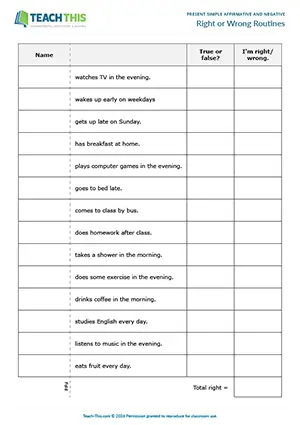
ESL Present Simple Game - Grammar and Speaking: Guessing, True or False, Forming Sentences, Freer Practice In this productive present simple game, students find out about their classmates' daily routines using present simple affirmative and negative sentences. First, students write the names of 14 people in the class in the 'Name' column. Students then unfold the worksheet to reveal present simple affirmative sentences about the people. Next, students read each sentence and decide whether it's true or false for the person at the beginning of the sentence, writing their answer in the 'True or False?' column. Students then find out if their guesses are right or wrong by checking their guess with the person who is the subject of the sentence. If students think a sentence is right, they make a present simple affirmative sentence, e.g. 'Emma, you watch TV in the evening.' If students think a sentence is wrong, they make a present simple negative sentence, e.g. 'Emma, you don't watch TV in the evening.' That person then tells the student if they are right or wrong. Students then put right or wrong in the last column. When the students have checked all the answers, they add up their correct guesses and write the number at the bottom of the worksheet. The student with the most correct guesses wins the game.

Running Routines

Elementary (A1-A2) 30 minutes
ESL Present Simple Activity worksheet preview for Elementary (A1-A2): running dictation, questions, and answers

ESL Present Simple Activity - Grammar and Speaking: Running Dictation, Writing Answers, Asking and Answering Questions - Pair Work

Here is a present simple running dictation activity to help students practice present simple sentences and questions about daily routines in the first and third...

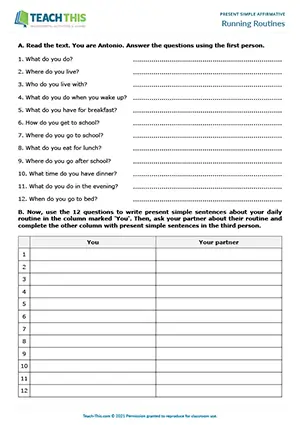
ESL Present Simple Activity - Grammar and Speaking: Running Dictation, Writing Answers, Asking and Answering Questions from Prompts - Pair Work Here is a present simple running dictation activity to help students practice present simple sentences and questions about daily routines in the first and third person. One student is the reader and the other is the writer. The reader runs to the text about Antonio's daily routine, reads the first part, tries to remember as much as they can, runs back and dictates it to their partner who writes it down. This continues until the text has been fully dictated. Next, students read the text about Antonio's daily routine and pretend they are Antonio. Students then answer present simple Wh questions as Antonio, writing their answers in the first person. After that, students use the questions to write present simple sentences about their own daily routine. After that, students ask their partner about their routine and complete present simple sentences in the third person.

Guess My Go-To

Pre-intermediate (A2) 25 minutes
ESL Present Simple Game preview for Pre-intermediate (A2): forming sentences, guessing, pair work

ESL Present Simple Game - Grammar and Speaking: Forming Sentences, Guessing - Pair Work

In this engaging present simple game, students predict a partner's preferences and habits by completing present simple affirmative sentences about them and checking their guesses. First,..

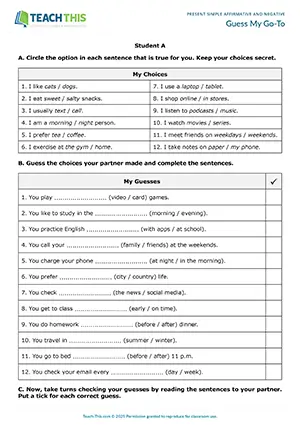
ESL Present Simple Game - Grammar and Speaking: Forming Sentences, Guessing - Pair Work In this engaging present simple game, students predict a partner's preferences and habits by completing present simple affirmative sentences about them and checking their guesses. First, students secretly circle one option in each sentence that is true for them. Students then guess the choices their partner made by completing each sentence with one of the words. Next, students check whether their guesses are right or wrong by taking turns reading each completed sentence to their partner, who tells them if it is correct or not. If a guess is correct, their partner repeats the sentence and gives a short reason, e.g. 'That's right. I like cats more than dogs because I think they are cute.' If a guess is wrong, their partner repeats the sentence in the negative and then gives the correct affirmative sentence, e.g. 'No, that's not right. I don't like dogs more than cats. I like cats more than dogs.' For each correct guess, students put a tick next to the sentence. The student with the most correct guesses at the end of the game wins. Finally, students tell the class about their partner's preferences and habits in the third person, e.g. 'Maria likes cats more than dogs.'

Present Simple Practice

Pre-intermediate (A2) 45 minutes
ESL Present Simple Worksheet preview for Pre-intermediate (A2): grammar exercises and sentence writing

ESL Present Simple Worksheet - Grammar Exercises: Reforming Words, Identifying, Binary Choice, Writing and Rewriting Sentences, Gap-fill

In this free present simple worksheet, students learn and identify the rules and verb forms associated with the present simple tense. First, students add third...

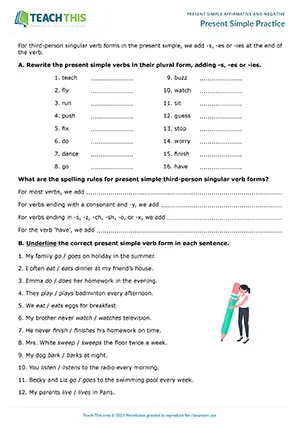
ESL Present Simple Worksheet - Grammar Exercises: Reforming Words, Identifying, Binary Choice, Writing and Rewriting Sentences, Gap-fill In this free present simple worksheet, students learn and identify the rules and verb forms associated with the present simple tense. First, students add third-person singular verb endings to verbs (-s, -es or -ies). Students then use the answers to complete spelling rules for third-person singular verb forms. Next, students underline the correct verb forms in present simple sentences and write what they understand about subject-verb agreement in the present simple. After that, students complete present simple affirmative and negative sentences with verbs in brackets and then write the rules for negative verb forms in the present simple. Finally, students rewrite sentences, adding adverbs of frequency and frequency expressions in the correct position. After which, they complete sentences, explaining the correct position of frequency adverbs and expressions in a sentence.

Simon the Sportsman

Pre-intermediate (A2) 25 minutes
ESL Present Simple Activity preview for Pre-intermediate (A2): information gap and question formation

ESL Present Simple Activity - Grammar and Speaking: Information Gap, Asking and Answering Questions, Matching, Writing Sentences - Pair Work

In this present simple information gap activity, students practice making questions and affirmative sentences in the third-person singular together with adverbs...

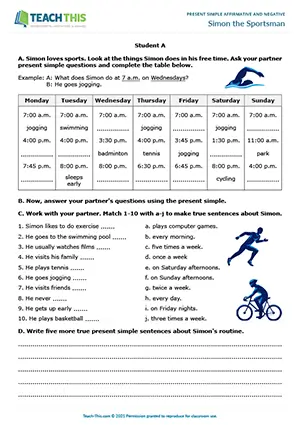
ESL Present Simple Activity - Grammar and Speaking: Information Gap, Asking and Answering Questions, Matching, Writing Sentences - Pair Work In this present simple information gap activity, students practice making questions and affirmative sentences in the third-person singular together with adverbs of frequency, adverbial time expressions and sports vocabulary. First, in pairs, students complete missing information in a chart about Simon's free-time routine by asking and answering present simple questions with their partner. Next, students match sentence halves to make true present simple sentences about Simon. Finally, students create five more true present simple affirmative sentences of their own about Simon's routine using the information in the chart.

Two Artists

Pre-intermediate (A2) 20 minutes
ESL Present Simple Activity preview for Pre-intermediate (A2): comparing similarities and differences with picture prompts

ESL Present Simple Activity - Grammar and Speaking: Forming Sentences - Pair Work

In this imaginative present simple speaking activity, students find out about two people's similarities and differences using picture prompts and the present simple. In pairs, students find out about two artists' similarities and differences. Students...

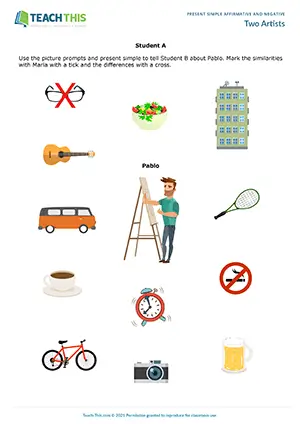
ESL Present Simple Activity - Grammar and Speaking: Forming Sentences from Prompts - Pair Work In this imaginative present simple speaking activity, students find out about two people's similarities and differences using picture prompts and the present simple. In pairs, students find out about two artists' similarities and differences. Students use the picture prompts to describe the artist in their picture to their partner using present simple affirmative and negative statements. Students mark the similarities with a tick and differences with a cross.

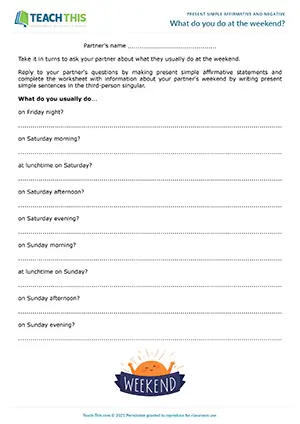
What do you do at the weekend?

Pre-intermediate (A2) 25 minutes
ESL Present Simple Activity preview for Pre-intermediate (A2): asking and answering about weekend routines

ESL Present Simple Activity - Grammar and Speaking: Asking and Answering Questions, Writing Sentences, Discussion, Describing, Freer Practice - Pair Work

In this interesting present simple speaking activity, students discuss what they usually do at the weekend. In pairs, students take turns asking their partner about...

ESL Present Simple Activity - Grammar and Speaking: Asking and Answering Questions, Writing Sentences, Guided Discussion, Describing, Freer Practice - Pair Work In this interesting present simple speaking activity, students discuss what they usually do at the weekend. In pairs, students take turns asking their partner about what they usually do at certain times during the weekend. Their partner replies by making a present simple affirmative statement. The student then writes a present simple sentence in the third-person singular about their partner's answer. When the pairs have finished, they discuss how their weekends are different. Finally, students describe their partner's weekend to the class.

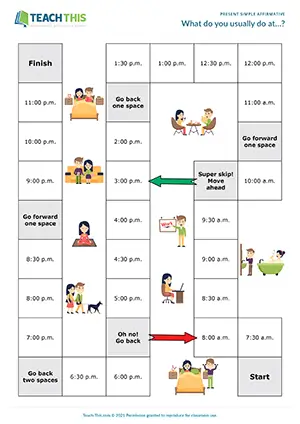
What do you usually do at...?

Pre-intermediate (A2) 25 minutes
ESL Present Simple Board Game preview for Pre-intermediate (A2): describing usual activities at different times

ESL Present Simple Board Game - Grammar and Speaking: Asking and Answering Questions, Forming Sentences - Group work

In this insightful present simple affirmative board game, students use the present simple tense to describe what they usually do at certain times. Students take turns rolling the dice and moving their...

ESL Present Simple Board Game - Grammar and Speaking: Asking and Answering Questions, Forming Sentences - Group work In this insightful present simple affirmative board game, students use the present simple tense to describe what they usually do at certain times. Students take turns rolling the dice and moving their counters along the board. When a student lands on a square, the person to their right asks them a 'What do you usually do at...?' question using the time in the square, e.g. 'What do you usually do at 7:30 a.m.?' The student then uses the present simple to describe what they usually do at that time of day, e.g. 'At 7:30 a.m., I usually have a shower.' If a student can't think of anything to say, repeats a previous sentence, or makes a grammar mistake, they go back two squares. The first student to reach the finish wins the game.

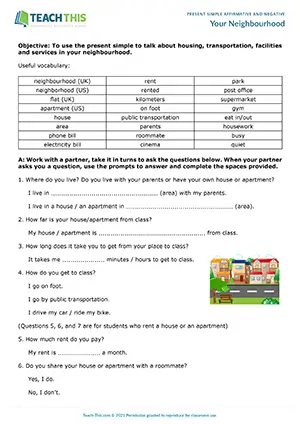
Your Neighbourhood

Pre-intermediate (A2) 50 minutes
ESL Present Simple Activity preview for Pre-intermediate (A2): talking about neighbourhood, facilities, and transport

ESL Present Simple Activity - Grammar and Speaking: Asking and Answering Questions, Gap-fill, Preparing and Presenting a Dialogue - Pair Work

This useful present simple activity helps to teach students how to talk about housing, transport, facilities and services in their neighbourhood. In pairs...

ESL Present Simple Activity - Grammar and Speaking: Asking and Answering Questions, Gap-fill, Preparing and Presenting a Dialogue - Pair Work This useful present simple activity helps to teach students how to talk about housing, transport, facilities and services in their neighbourhood. In pairs, students take turns asking and answering questions on the worksheet using the prompts to guide them. Afterwards, students use the vocabulary, questions and answers to create a conversation about their neighbourhood. Finally, pairs present their conversations to the class.

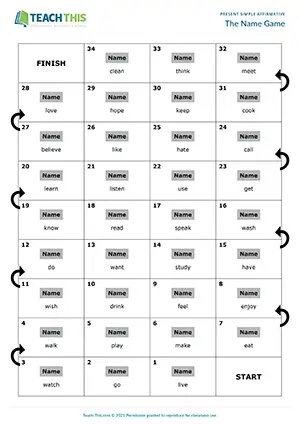
The Name Game

Intermediate (B1) 25 minutes
ESL Present Simple Board Game preview for Intermediate (B1): forming sentences and practicing pronunciation

ESL Present Simple Board Game - Grammar, Pronunciation and Speaking: Forming Sentences - Group Work

In this compelling present simple board game, students make present simple affirmative sentences and practice pronouncing third-person singular verb forms correctly. Players take turns rolling the dice...

ESL Present Simple Board Game - Grammar, Pronunciation and Speaking: Forming Sentences from Prompts - Group Work In this compelling present simple board game, students make present simple affirmative sentences and practice pronouncing third-person singular verb forms correctly. Players take turns rolling the dice and moving their counter along the board. When a player lands on a square, they take a name card from the top of the pile. The player then reads out the name on the card and tries to make a true present simple affirmative sentence about the person using the verb marked on the square, pronouncing the third-person singular verb form correctly. The person whose name is on the card tells the player if their sentence is right or wrong. If the sentence is true, the player stays on the square. If the sentence is untrue or the pronunciation or grammar is incorrect, the player goes back two squares. The first player to reach the finish wins the game.