
Intensifiers & Mitigators ESL Worksheets, Games & Activities
Love is in the air!
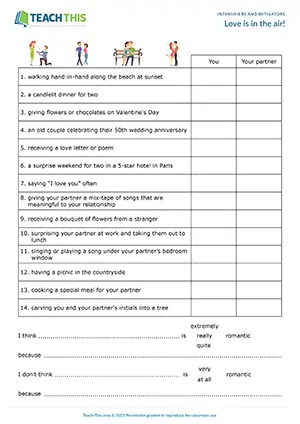
ESL Intensifiers and Mitigators Activity - Speaking: Rating, Sentence Completion, Discussion, Freer Practice - Pair and Group Work
In this enjoyable intensifiers and mitigators speaking activity, students practice intensifiers and mitigators by grading and discussing romantic situations...
Two Things that...
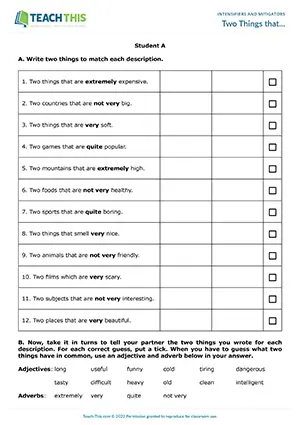
ESL Intensifiers and Mitigators Game - Vocabulary: Guessing, Forming Sentences - Pair Work
In this entertaining intensifiers and mitigators game, students guess what two things have in common using adjectives and adverbs of degree. Students begin by writing two things that match each description...
Extreme Sports
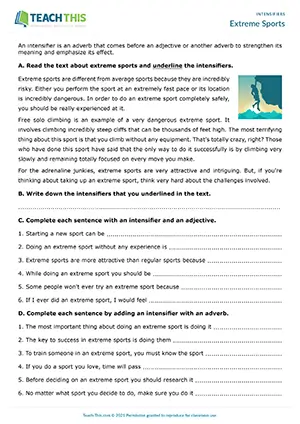
ESL Intensifiers Worksheet - Grammar and Reading Exercises: Scanning, Identifying, Sentence Completion, Rewriting Sentences
In this free intensifiers worksheet, students identify intensifiers and use them to modify language and write about extreme sports. Working alone, students begin by reading a text about extreme sports...
How am I feeling exactly?
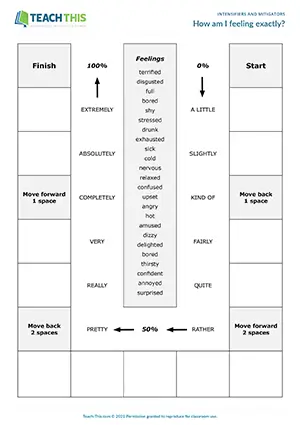
ESL Intensifiers and Mitigators Board Game - Vocabulary: Miming, Guessing, Forming Sentences - Group Work
In this fun intensifiers and mitigators board game, students use intensifiers, mitigators and adjectives to guess how exactly other students are feeling from mimes. The first player picks up a card and...
Intensifiers and Mitigators Practice
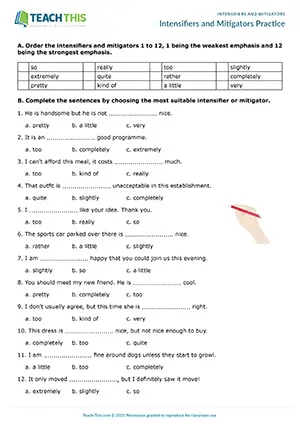
ESL Intensifiers and Mitigators Worksheet - Vocabulary Exercises: Multiple Choice, Unscrambling, Sentence Completion - Speaking Activities: Forming Sentences, Guided Discussion - Pair Work
This comprehensive intensifiers and mitigators worksheet helps students learn and practice how to emphasize words and expressions to make them...
It's rather nice outside!

ESL Intensifiers and Mitigators Worksheet - Grammar and Vocabulary Exercises: Rewriting, Sentence Completion, Identifying
This useful intensifiers and mitigators worksheet uses the context of weather to help students learn how to make words and expressions sound stronger or weaker using intensifiers and mitigators...
Over the Years
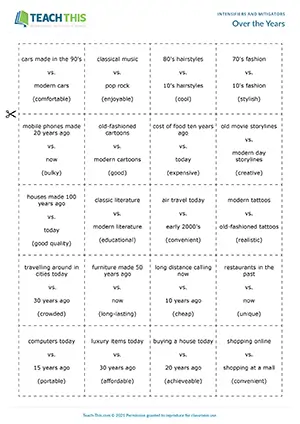
ESL Intensifiers and Mitigators Activity - Grammar Exercises: Categorising, Gap-fill, Sentence Completion - Speaking Activity: Discussion - Group Work
In this productive intensifiers and mitigators activity, students complete a worksheet and then take part in a discussion where they modify comparative sentences...
Understanding Intensifiers and Mitigators
Intensifiers are words like 'very,' 'extremely,' and 'completely' that make an adjective or adverb stronger, while mitigators are words like 'fairly,' 'rather,' and 'slightly' that make the same words weaker. Students who default to 'very' for every situation miss the precision these words give: writing 'I'm slightly disappointed' sends a very different signal from 'I'm extremely disappointed,' and choosing the wrong degree word can affect how a reader interprets the writer's tone entirely.
This page covers intensifiers and mitigators at A2 and B1 levels, with seven activities including speaking activities, worksheets, and a board game, with one free download available.
This scale maps the most common intensifiers and mitigators from weakest to strongest, with each word's type, relative strength on a scale of 1 to 5, and a short example sentence.
| Word | Type | Strength (1 = weakest, 5 = strongest) | Example |
|---|---|---|---|
| slightly | mitigator | 1 | 'It's slightly cold today.' |
| fairly | mitigator | 2 | 'The exam was fairly difficult.' |
| rather | mitigator | 2 | 'She's rather tired.' |
| quite | mitigator / neutral | 3 | 'That was quite good.' |
| pretty | neutral | 3 | 'He's pretty confident.' |
| very | intensifier | 4 | 'The film was very exciting.' |
| really | intensifier | 4 | 'I'm really sorry.' |
| extremely | intensifier | 5 | 'It's extremely hot outside.' |
| incredibly | intensifier | 5 | 'The food was incredibly good.' |
| completely | intensifier | 5 | 'I'm completely exhausted.' |
When to Use Intensifiers and Mitigators
Softening Criticism or Bad News: A writer or speaker chooses a mitigator when they want to deliver negative feedback without sounding harsh, so a manager giving a performance review might say 'Your presentation was slightly disorganized' rather than 'Your presentation was disorganized' to keep the tone constructive.
Expressing Strong Enthusiasm or Emphasis: An intensifier signals genuine strong feeling in a way that plain adjectives cannot, so a customer leaving an online review who wants the praise to land might write 'The service was absolutely outstanding' rather than 'The service was outstanding' to make the feedback feel more convincing.
Modifying Comparisons for Precision: When comparing two things, adding a degree word tells the listener exactly how large or small the difference is, so a speaker weighing up two options might say 'Option A is considerably cheaper than Option B' rather than simply 'Option A is cheaper' to help their audience understand the scale of the difference.
3-Step Framework for Teaching Intensifiers and Mitigators
1. Build the Scale First: Start with a worksheet that gives students a clear mental map of degree before they use these words in speech. Students open by ranking all the intensifiers and mitigators from 1 to 12, with 1 being the weakest emphasis and 12 being the strongest, which forces them to think about the full spectrum before moving into gap-fill and sentence completion tasks.
2. Make Degree Physical with a Board Game: Follow with a board game where one player picks up a card and mimes the feeling shown to the exact degree set by the intensifier or mitigator on the card. The rest of the group has one minute to guess the full sentence, and the first player to say it correctly, for example 'You are completely exhausted,' wins the card and rolls the dice.
3. Push into Opinion with a Discussion Activity: Close with a discussion activity where students form comparative sentences using a card prompt and a degree word of their choice, for example 'In my opinion, modern cars are significantly more comfortable than cars made in the 90's.' Their partner then agrees or disagrees and the pair briefly discuss before moving to the next card.
Common Mistakes with Intensifiers and Mitigators
Using 'Very' with Extreme Adjectives: Students often place 'very' before extreme adjectives that already carry a maximum meaning, when these words need an absolute intensifier like 'absolutely' or 'completely' instead. Wrong: 'The weather was very freezing.' Correct: 'The weather was absolutely freezing.'
Placing the Intensifier in the Wrong Position: Students often put an intensifier after the adjective or at the end of the sentence rather than directly before the word it modifies, which produces an unnatural or unclear sentence. Wrong: 'The weather was hot extremely.' Correct: 'The weather was extremely hot.'
Common Questions About Teaching Intensifiers and Mitigators
What is a fun game for practicing intensifiers and mitigators?
The game Two Things that... gives students a reason to reach for precise degree words. One student names two things linked by a description, and their partner has five guesses to identify the connection using the correct adjective and adverb of degree, for example 'They are two things that are very expensive.' The student with the most correct guesses wins.
What is a good worksheet for teaching intensifiers and mitigators?
The free worksheet Extreme Sports builds students' understanding from recognition to production. Students start by scanning a reading text and underlining every intensifier they find, then work through sentence completion and rewriting exercises that practice adding intensifiers to modify adjectives, adverbs, and underlined words, before finishing with sentences about sports using their own ideas.
What is an engaging speaking activity for teaching intensifiers and mitigators?
In the activity Love is in the air!, students grade romantic situations from 1 to 5, then join another pair to agree on one extremely romantic situation together. Other groups grade each new situation and respond using intensifiers and mitigators to say exactly how romantic they found it. The grading scale makes students choose their degree words with real care.
Become a Teach This Member
Get unlimited access to the full library, plus new resources added every week.
Unlimited Resource Access
Download from 3000+ worksheets, activities, and games.
Save 5+ Hours Weekly
Cut lesson prep time with ready-to-use resources, plus teacher notes and answer keys.
Trusted Professional Quality
Classroom-tested, editable resources created by experienced ESL professionals.
Fresh Content Weekly
Get 5 new resources added to the library each week.
Here's what our members are saying...


