
Past Simple Passive ESL Activities, Worksheets & Games
Famous Inventions and Discoveries

ESL Past Simple Passive Activity - Grammar and Speaking: Information Gap, Asking and Answering Questions - Pair Work
In this free past simple passive activity, students ask and answer Wh questions in the past simple passive about famous inventions and discoveries. In pairs, students take turns asking and answering...
General Knowledge Quiz
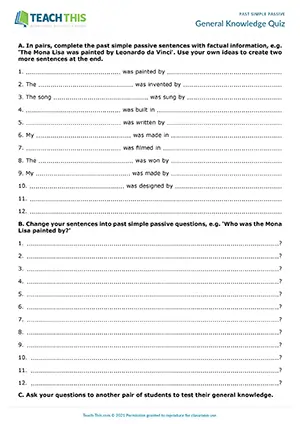
ESL Past Simple Passive Activity - Grammar and Speaking: Sentence Completion, Writing, Asking and Answering Questions, Freer Practice - Pair Work
In this creative past simple passive activity, students create a general knowledge quiz by completing factual sentences, converting them into questions, and...
Here Is the News
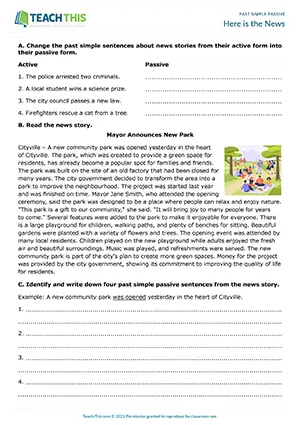
ESL Past Simple Passive Worksheet - Grammar, Reading and Writing Exercises: Rewriting Sentences, Identifying, Gap-fill, Writing an News Report
In this comprehensive past simple passive worksheet, students practice past simple active and passive forms in the context of news reports. Students begin...
Past Simple Passive News
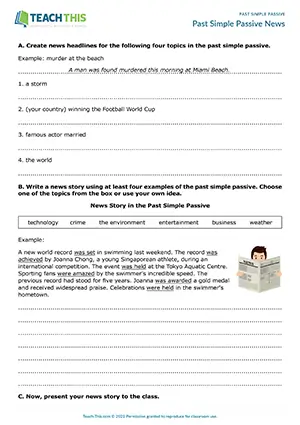
ESL Past Simple Passive Worksheet - Grammar and Writing Exercises: Writing Sentences, Paragraph Writing
In this useful past simple passive worksheet, students write headlines, past simple passive sentences, and a short news story using the past simple passive. First, students write a passive headline and...
Past Simple Passive Quiz

ESL Past Simple Passive Game - Grammar and Speaking: Gap-fill, Asking and Answering Questions, Guessing - Group and Pair Work
In this fun past simple passive game, students practice the past simple passive by completing statements and playing a true or false quiz. First, in two groups...
Past Simple Passive Quiz Time
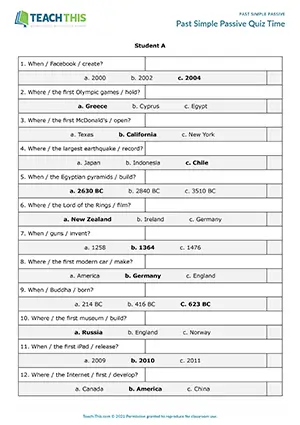
ESL Past Simple Passive Game - Grammar and Speaking: Writing and Asking Questions, Forming Sentences, Guessing - Group and Pair Work
In this free past simple passive game, students write quiz questions from prompts, then ask and answer them in pairs using the past simple passive. In two...
Reporting Past Events with the Passive
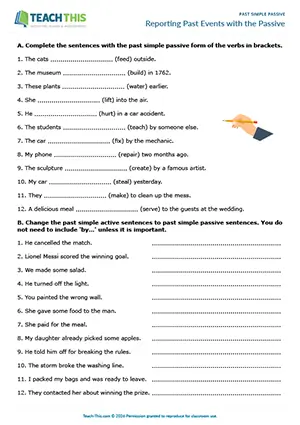
ESL Past Simple Passive Worksheet - Grammar Exercises: Gap-fill, Writing Sentences
In this productive past simple passive worksheet, students learn how to form and use the past simple passive to describe past events in a clear, news-style way. Students start by completing sentences...
Past Beliefs

ESL Past Simple Passive Game - Grammar: Writing Sentences, Changing Verb Forms, True or False, Guessing - Pair Work
In this engaging past simple passive game, students write statements about past beliefs using 'it was' + past participle forms of reporting verbs and then guess whether each statement is true or false...
When I Was a Child...
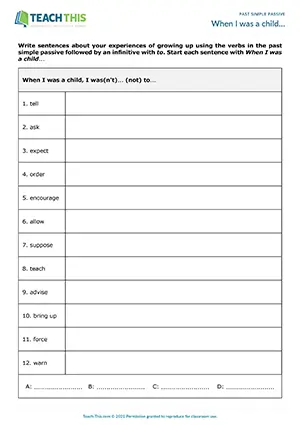
ESL Past Simple Passive Activity - Grammar and Speaking: Writing Sentences, Discussion, Freer Practice - Group Work
In this insightful past simple passive speaking activity, students practice using structures like 'I was told to...' and 'I was allowed to...' to talk about childhood rules, advice, and expectations, and then discuss...
Understanding the Past Simple Passive
The past simple passive describes a completed action where the focus falls on what happened or what was affected, using the structure 'was' or 'were' plus a past participle, as in 'The telephone was invented in 1876.' When students default to the active form in every sentence, they miss the shift in emphasis the passive creates, and their writing can sound unnatural in contexts like news reports or historical accounts where no one knows the actor, the actor does not matter, or the writer chooses to omit them.
This page covers the past simple passive at B1 and B2 levels, with nine resources including activities, worksheets, and games, with two available as free downloads.
The table below shows the key forms of the past simple passive, covering affirmative, negative, and question structures, with an example for each.
| Form | Structure | Example |
|---|---|---|
| Affirmative (with agent) | subject + was/were + past participle + by + agent | 'The radio was invented by Guglielmo Marconi.' |
| Affirmative (no agent) | subject + was/were + past participle | 'The window was broken.' |
| Negative (with agent) | subject + wasn't/weren't + past participle + by + agent | 'The film wasn't directed by Spielberg.' |
| Negative (no agent) | subject + wasn't/weren't + past participle | 'The door wasn't locked.' |
| Yes/No Question | Was/Were + subject + past participle? | 'Was the letter delivered?' |
| Wh Question (about the agent) | Who/What + was/were + subject + past participle + by? | 'Who was Hamlet written by?' |
| Wh Question (about the event) | What/When/Where + was/were + subject + past participle? | 'When was the Eiffel Tower built?' |
When to Use the Past Simple Passive
Keeping Focus on the Result: A writer uses the past simple passive when the outcome of an event matters more than who caused it, placing the affected person or thing at the front of the sentence, as in 'Three people were injured in the accident.'
Maintaining Formal or Official Tone: The past simple passive signals distance and objectivity in official communication, making it the natural choice for formal documents that describe decisions or actions without naming individuals, as in 'The contract was signed on 14 March.'
Avoiding Blame or Responsibility: Speakers and writers sometimes choose the past simple passive to acknowledge that something went wrong without naming the person responsible, as in 'The data was deleted.'
3-Step Framework for Teaching the Past Simple Passive
1. Build the Form on the Page: Start with a worksheet that takes students from recognizing the structure to producing it independently. Students work through gap-fill and active-to-passive transformation exercises before reaching the final task: writing past simple passive sentences for news headlines that match pictures. That last step removes the scaffold and asks students to generate the form from scratch, which is where students consolidate the structure on their own.
2. Activate the Form Through Speaking: Move students into spoken practice with an information gap activity built around famous inventions and discoveries. Working in pairs, each student holds a table with gaps the other can fill, so they must ask and answer past simple passive questions to complete their information, producing questions like 'What was discovered by Alexander Fleming?' The format means students cannot skip the structure, because they need it to get the answer.
3. Push Into Personal, Freer Use: Finish with a speaking activity that makes the past simple passive personal. Students write their own sentences about growing up using passive structures followed by an infinitive with 'to', producing sentences like 'When I was a child, I was told to look both ways while crossing the road.' Because each sentence draws on real experience, students have something genuinely worth saying, which keeps the discussion going beyond the grammar.
Common Mistakes with the Past Simple Passive
Using 'was' with a Plural Subject: Students often use 'was' instead of 'were' with plural subjects in the past simple passive, because they focus on building the passive structure and overlook subject-verb agreement. Wrong: 'The windows was broken by the storm.' Correct: 'The windows were broken by the storm.'
Using the Base Verb Instead of the Past Participle: Students often place the base form of the verb after 'was' or 'were' instead of the past participle, especially with irregular verbs where the past participle differs from the simple past form. Wrong: 'The painting was steal from the museum.' Correct: 'The painting was stolen from the museum.'
Common Questions About Teaching the Past Simple Passive
What is an engaging past simple passive game?
The free game Past Simple Passive Quiz Time gives students practice asking and answering passive questions. Students write questions from prompts, for example 'When was Facebook created?', then ask a partner who replies with a full past simple passive sentence like 'Facebook was created in 2004.' A correct and accurate answer scores two points, keeping grammar in focus.
What is a useful past simple passive worksheet?
The worksheet Here Is the News covers the full range of active-to-passive conversion. Students identify passive sentences in a news report, rewrite them in the active, and then write their own past simple passive news report and read it to the class, making the passive feel purposeful and relevant.
What is a good past simple passive activity for practicing question forms?
The activity General Knowledge Quiz is a productive choice for passive question practice. Students complete factual past simple passive sentences, for example 'The Mona Lisa was painted by Leonardo da Vinci', then convert them into Wh passive questions like 'Who was the Mona Lisa painted by?' and use those questions to test another pair's knowledge.
Become a Teach This Member
Get unlimited access to the full library, plus new resources added every week.
Unlimited Resource Access
Download from 3000+ worksheets, activities, and games.
Save 5+ Hours Weekly
Cut lesson prep time with ready-to-use resources, plus teacher notes and answer keys.
Trusted Professional Quality
Classroom-tested, editable resources created by experienced ESL professionals.
Fresh Content Weekly
Get 5 new resources added to the library each week.
Here's what our members are saying...


