
Noun Clauses ESL Games & Worksheets
Noun Clause Race
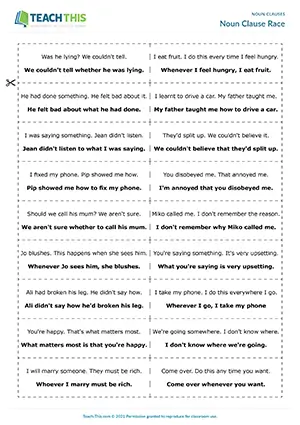
ESL Noun Clauses Game - Speaking: Forming Sentences, Freer Practice - Group Work
In this fun noun clauses game, students listen to sentence pairs and race to change them into single noun clause sentences. In groups, students take turns picking up a card and reading the two sentences...
Noun Clauses Practice
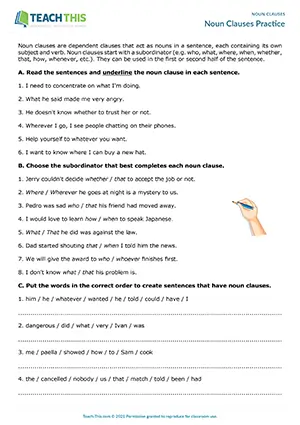
ESL Noun Clauses Worksheet - Grammar Exercises: Identifying, Binary Choice, Matching, Gap-fill, Sentence Completion
This comprehensive noun clauses worksheet helps students become familiar with noun clauses and practice using them in sentences. First, students read about noun clauses and then identify noun clauses...
Do You Know What a Noun Clause Is?

ESL Noun Clauses Worksheet - Grammar Exercises: Identifying, Gap-fill, Unscrambling, Writing Sentences, Matching
In this useful noun clauses worksheet, students identify noun clauses, complete sentences with subordinators, and build noun clause sentences in a range of controlled tasks. First, students identify...
I'm Not Sure
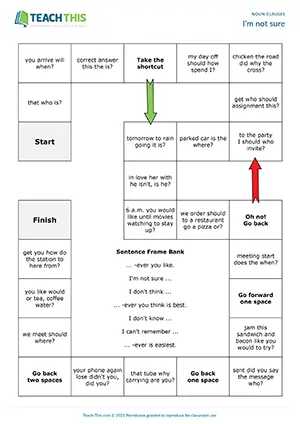
ESL Noun Clauses Board Game - Grammar and Speaking: Unscrambling, Asking and Answering Questions - Group Work
Here is a free noun clauses board game to help students practice forming and using noun clauses to give indirect responses. Students take turns rolling the dice and moving their counters along the board...
Noun Clause Challenge

ESL Noun Clause Games - Grammar: Matching, Gap-fill - Pair Work
Here are two engaging noun clause games to help students practice using and forming noun clauses in sentences. First, in pairs, students play a matching game. Students line up sentence beginning cards in order and then take turns picking up...
Understanding Noun Clauses
A noun clause is a group of words that contains a subject and a verb and functions as a noun inside a larger sentence, taking the place of a subject, an object, or a complement: 'What she said surprised everyone' uses the clause as a subject, while 'I know where she lives' uses it as an object. When students can only produce simple direct sentences and cannot embed a clause as a noun, their English sounds abrupt and limited, and they struggle to report speech, express uncertainty, or ask indirect questions politely, all of which are everyday communication needs.
This page covers noun clauses across B1 and B2 levels with five activities including two worksheets, games, and a board game, with one activity available as a free download.
The table below shows the main functions of noun clauses in a sentence, the subordinators that typically introduce each type, and an example of each.
| Function in Sentence | Common Subordinators | Example |
|---|---|---|
| Subject | that, what, wh-words | 'What she said surprised everyone.' |
| Direct Object | that, whether, if, wh-words | 'I know that she left early.' |
| Object of Preposition | wh-words, whether | 'We argued about where to meet.' |
| Subject Complement | that, what, wh-words | 'The problem is that nobody told him.' |
| Reported Speech | that | 'She said that she would call later.' |
| Indirect Question | whether, if, wh-words | 'I wonder whether he remembered.' |
When to Use Noun Clauses
Making Questions More Polite: In formal or professional situations, a speaker uses a noun clause to turn a direct question into an embedded one, which sounds less demanding and more considerate of the listener, as in 'Could you tell me where the meeting room is?' rather than 'Where is the meeting room?'
Reporting Speech and Thought: When a writer or speaker wants to pass on information from another source without using direct quotation, a noun clause introduced by 'that' carries the content naturally and keeps the text flowing, as in 'The manager confirmed that the deadline had been moved.'
Hedging and Expressing Uncertainty: When speakers want to avoid committing to a strong claim or need to acknowledge what they do not know, a noun clause introduced by 'whether' or 'if' lets them frame the uncertainty clearly, as in 'I am not sure whether the figures are correct' rather than making a direct claim that might be wrong.
3-Step Framework for Teaching Noun Clauses
1. Build from Recognition to Production: Start with a structured worksheet that moves students through noun clauses in stages. Begin with recognition tasks where they underline noun clauses in sentences and choose the correct subordinator for each one. Then raise the challenge by asking students to put scrambled words in the correct order to build sentences that contain noun clauses, which forces them to think about both word order and clause structure at the same time. The final stage asks students to complete sentences with their own noun clauses, which is where the grammar starts to feel personal and usable rather than abstract.
2. Turn Transformation into a Race: Once students can form noun clauses on paper, push them to do it under real-time pressure. In this game, one student reads two short sentences aloud and the rest of the group races to combine them into a single noun clause sentence. The transformation requires genuine grammatical thinking: hearing 'Was he lying?' and 'We couldn't tell.' and producing 'We couldn't tell whether he was lying.' is not a mechanical substitution but a real structural decision about word order and subordinator choice. The first student to say the correct sentence wins the card, which keeps every round competitive and focused.
3. Practice Indirect Responses in Context: At B2, students need to use noun clauses not just accurately but naturally in conversation, particularly when giving indirect or uncertain answers. A board game works well here: when a student lands on a square, they unscramble a question and read it aloud to the group, who race to respond using a sentence frame from the bank and a noun clause, for example turning 'Who is that?' into 'I don't know who that is.' The scoring system rewards variety: a student earns two points the first time they use a particular sentence frame, but only one point if they reach for the same frame again. That rule pushes students to range across multiple noun clause structures rather than falling back on one familiar pattern.
Common Mistakes with Noun Clauses
Question Word Order Inside a Noun Clause: Students often use question word order when a wh-word introduces a noun clause inside a statement, because they transfer the inverted structure directly from a direct question. Wrong: 'I don't know where is the station.' Correct: 'I don't know where the station is.'
Using 'if' Instead of 'whether' in Subject Position: Students often use 'if' to introduce a noun clause that functions as the subject of a sentence, because they know 'if' and 'whether' are interchangeable in some contexts, but 'if' cannot open a noun clause in subject position. Wrong: 'If she comes or not doesn't matter.' Correct: 'Whether she comes or not doesn't matter.'
Common Questions About Teaching Noun Clauses
What is a good worksheet for teaching noun clauses?
A noun clauses worksheet works well when it moves students from identification to sentence building. The worksheet Do You Know What a Noun Clause Is? has students identify noun clauses and decide whether each acts as a subject, an object, or a complement, then complete sentences with subordinators, unscramble noun clause sentences, and combine sentence pairs.
What is a fun game for practicing noun clauses?
The game Noun Clause Challenge builds pressure around a specific structural target by running two activities back to back. Students first match sentence beginning and ending cards to form complete noun clause sentences, then race to complete each noun clause with an appropriate subordinator. The first pair to finish correctly wins each round.
Become a Teach This Member
Get unlimited access to the full library, plus new resources added every week.
Unlimited Resource Access
Download from 3000+ worksheets, activities, and games.
Save 5+ Hours Weekly
Cut lesson prep time with ready-to-use resources, plus teacher notes and answer keys.
Trusted Professional Quality
Classroom-tested, editable resources created by experienced ESL professionals.
Fresh Content Weekly
Get 5 new resources added to the library each week.
Here's what our members are saying...


