
Getting Around ESL Games, Activities & Role-Plays
Let's Take the Subway
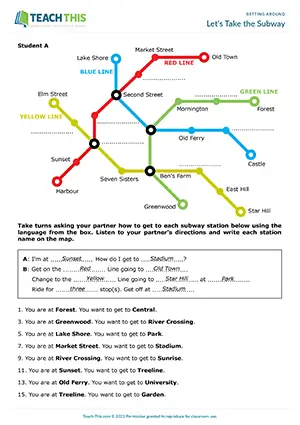
ESL Subway Travel Activity - Speaking: Information Gap, Communicative Practice - Pair Work
In this free subway travel activity, students practice asking for and giving directions using a subway system map to help them learn language for getting around on a train or subway. In pairs, students...
Madrid to Barcelona
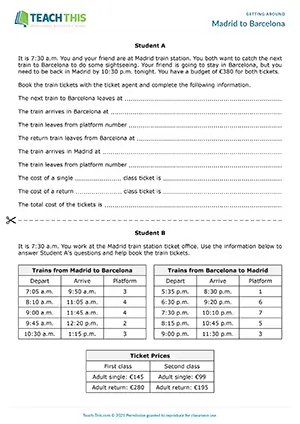
ESL Train Travel Role-Play - Speaking Activity: Asking and Answering Questions, Sentence Completion, Communicative Practice - Pair Work
In this engaging train travel role-play activity, students ask and answer questions about rail travel information and practice booking train tickets. In pairs, one student...
Could you slow down, please?
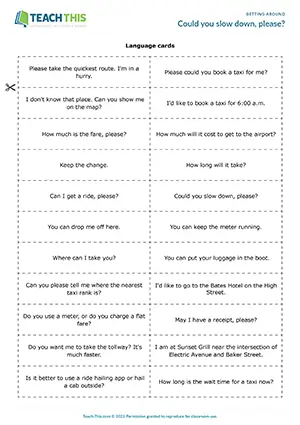
ESL Taxi Language Game - Vocabulary: Matching - Pair Work
In this useful taxi language game, students race to match language with taxi-related situations. In pairs, students take turns turning over a situation card and reading out the taxi-related situation. Both students then race to find the appropriate taxi...
Getting Around Questionnaire

ESL Travel Questions Activity - Speaking: Unscrambling, Asking and Answering Questions - Group and Pair Work
In this insightful travel questionnaire activity, students form travel questions about different forms of local transport and then ask and answer the questions with a partner. First, in two groups, students put...
Taxi for Two
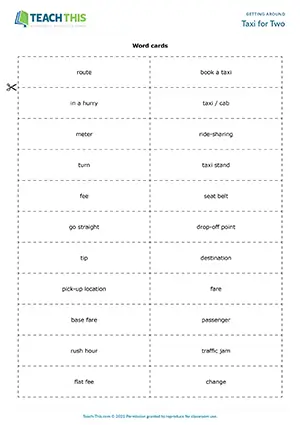
ESL Taxi Vocabulary Game - Vocabulary and Speaking: Matching, Forming Sentences, Communicative Practice - Pair work
In this creative taxi vocabulary game, students match words related to travelling by taxi with their definitions and then try to make a sentence a passenger or taxi driver would say using the word. In pairs...
The Bus Stop

ESL Bus Travel Activity - Speaking: Unscrambling, Asking and Answering Questions, Matching - Pair Work
In this free bus travel activity, students practice asking and answering questions related to taking the bus. First, in two groups, students unscramble words to form bus travel questions. Next, students...
Bus and Train Board Game
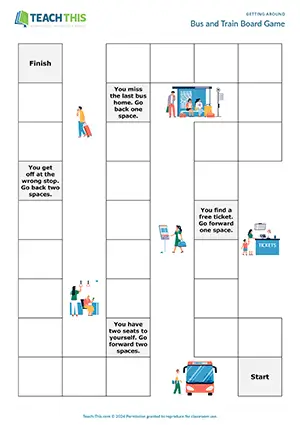
ESL Bus and Train Travel Board Game - Vocabulary: Multiple Choice, Guessing - Group Work
In this productive bus and train board game, students practice vocabulary related to bus and train travel. In groups, students take turns picking up a card and asking the player to their right a bus or train...
On the Road
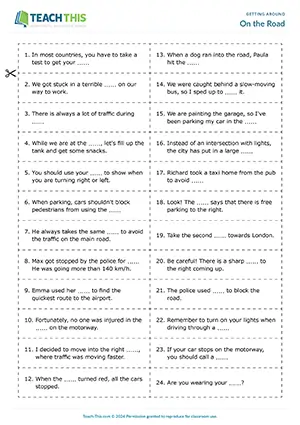
ESL Driving Vocabulary Games - Vocabulary and Speaking: Matching, Pelmanism, Forming Sentences, Controlled and Freer Practice - Pair Work
Here are two useful driving vocabulary games that help students practice words related to driving. Students begin by playing a pelmanism game to practice...
Right on Track
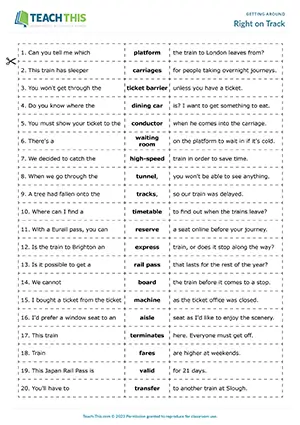
ESL Train Travel Game - Vocabulary: Matching, Forming Sentences - Pair Work
Here is a fast-paced train travel vocabulary game to help students practice language related to travelling by train. In pairs, students race to line up sentence beginning cards and match each one with a suitable ending card. When pairs have lined...
Using Travel and Transport Phrases
Travel and transport phrases are the words and expressions English speakers use to navigate real-world travel situations, whether that means buying a train ticket, hailing a taxi, or asking which bus to take. Students who lack this language can find themselves silent or guessing in situations where they need to act fast, so it is one of the most practical areas of functional English to teach.
This page covers English words and phrases for getting around across four levels from A1 to B2, with nine activities including information gap tasks, role-plays, vocabulary games, and a board game, with two free downloads.
The table below shows common travel and transport situations, the typical speaker, and an example phrase for each.
| Situation | Typical Speaker | Example Phrase |
|---|---|---|
| Asking for subway directions | Traveller | 'Excuse me, which line do I take to get to Central Station?' |
| Buying a train ticket | Passenger | 'I'd like two tickets to Barcelona, please. What time is the next train?' |
| Taking a taxi | Passenger | 'Could you take me to the airport? And could you slow down, please?' |
| Taking a bus | Passenger | 'Does this bus go to the city center? How much is the fare?' |
| Driving or road travel | Driver or passenger | 'Take the second turning on the left and stay on the main road.' |
| Dealing with a travel problem | Traveller | 'I think I got on the wrong train. How do I get back to the main station?' |
How to Use Travel and Transport Phrases
Asking for Directions Clearly: State your destination first and then ask a specific question rather than a general one, since 'Excuse me, does this bus go to the city center?' gets a faster and more useful answer than 'Excuse me, can you help me?'
Explaining a Travel Problem: Describe what happened and then ask what to do next, keeping the message short and specific so the other person can help immediately, as in 'I think I got on the wrong train. How do I get back to the main station?'
Getting Information at a Ticket Office: Ask one question at a time and use indirect question forms to sound polite, as in 'Is there a direct train to the airport, or do I need to change?' rather than firing several questions at once.
3-Step Framework for Teaching Travel and Transport Phrases
1. Start With a Real Navigation Task: Begin with a map-based information gap activity where pairs take turns giving and following subway directions using a subway system map and language from a box. The listening student follows the directions on their map and writes the destination station name on their map. It is a low-pressure way to get students using travel language with a real purpose from the very first minute.
2. Build the Vocabulary Communicatively: Move to a vocabulary game that builds the words students need to talk about travelling by taxi. Students play a matching memory game with taxi-related word and definition cards, and every time they make a match they earn an extra point by making a sentence a passenger or taxi driver would say using that word. That production step is what pushes students from recognizing the vocabulary to actually using it.
3. Put It All Together in a Role-Play: Finish with a role-play that puts the language into a full real-world scenario. One student plays a traveller who needs to book train tickets and the other plays a ticket agent. The traveller explains which train they want to catch, when, and for how many people, then asks for information to complete sentences on their worksheet and book the tickets. Both students swap roles at the end so everyone gets practice on both sides of the conversation.
Common Mistakes with Travel and Transport Phrases
Using the Wrong Preposition for Transport: Students often use 'on' with all forms of transport, including cars and taxis, when English uses 'by' to describe the general means of travel and requires no article before the transport noun. Wrong: 'I came here on taxi.' Correct: 'I came here by taxi.'
Confusing Ticket Collocations: Students often say 'do a ticket' or 'make a ticket' when talking about purchasing one, transferring a general-purpose verb from their first language instead of using the correct English collocation. Wrong: 'I need to make a ticket to Madrid.' Correct: 'I need to buy a ticket to Madrid.'
Common Questions About Teaching Travel and Transport Phrases
What is a fun board game for practicing bus and train vocabulary?
The board game Bus and Train Board Game runs on a simple but competitive mechanic. In groups, students take turns asking the player to their right a multiple-choice question about bus or train vocabulary. A correct guess earns a dice roll and a move along the board. Get it wrong and you stay put. First to the finish wins.
What is an engaging game for teaching taxi phrases?
The game Could you slow down, please? is built around speed. Students take turns flipping a situation card and reading it aloud, then both race to grab the matching taxi language card. The first to find it, say the sentence, and place it on the situation card takes the pair. The student with the most pairs at the end wins.
What is a good speaking activity for bus travel English?
The free activity The Bus Stop starts with students unscrambling bus travel questions in groups, so every student arrives at the speaking stage knowing what the questions mean. They then pair up and take turns asking them, with each partner matching the question to the correct answer on their worksheet and writing the question number next to it.
Become a Teach This Member
Get unlimited access to the full library, plus new resources added every week.
Unlimited Resource Access
Download from 3000+ worksheets, activities, and games.
Save 5+ Hours Weekly
Cut lesson prep time with ready-to-use resources, plus teacher notes and answer keys.
Trusted Professional Quality
Classroom-tested, editable resources created by experienced ESL professionals.
Fresh Content Weekly
Get 5 new resources added to the library each week.
Here's what our members are saying...


