
Scheduling, Confirming and Rescheduling by Email Worksheets
Confirming Arrangements by Email
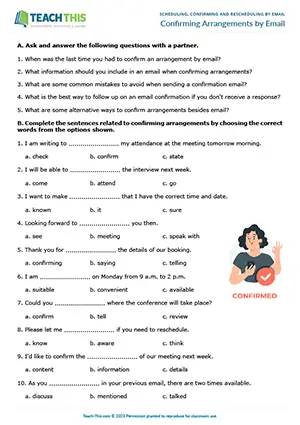
Business English Confirming Arrangements by Email Worksheet - Vocabulary, Reading and Writing: Gap-fill, Matching, Email Writing - Speaking: Discussion - Pair Work
In this insightful confirming arrangements worksheet, students practice phrases for confirming arrangements by email. In pairs, students begin by discussing...
Declining an Invitation by Email

Business English Declining Invitations by Email Worksheet - Reading and Writing Exercises: Unscrambling, Gap-fill, Ordering, Rewriting Sentences, Email Writing
In this free declining invitations worksheet, students learn and practice writing professional and polite emails declining work-related invitations. First,...
Rescheduling Emails

Business English Rescheduling by Email Worksheet - Reading, Vocabulary and Writing: Identifying, Labelling, Gap-fill, Email Writing, Peer Review
In this rescheduling by email worksheet, students practice how to reschedule meetings politely by using softening language, clear time options and brief reasons...
When are you available?
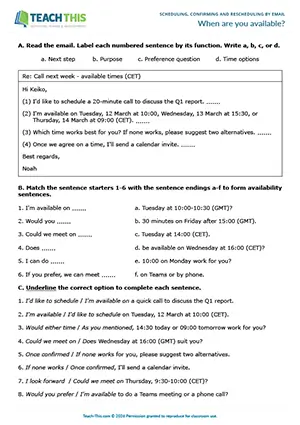
Business English Scheduling by Email Worksheet - Reading, Vocabulary and Writing: Matching, Binary Choice, Rewriting Sentences, Email Writing
In this scheduling by email worksheet, students practice writing short scheduling emails that offer clear time options with time zones, ask for a preference...
Rescheduling Deliveries
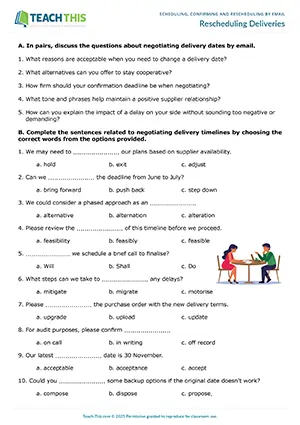
Business English Rescheduling by Email Worksheet - Reading and Writing Exercises: Multiple Choice, Gap-fill, Matching, Email Writing, Peer Feedback
In this rescheduling by email worksheet, students learn and practice the language for requesting revised delivery dates, proposing alternatives, and confirming...
Writing a Confirmation Email
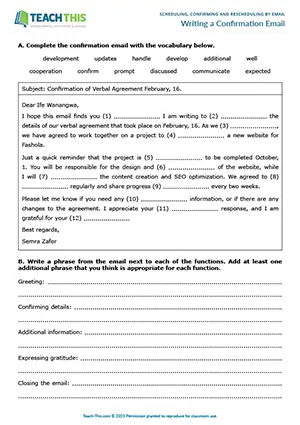
Business English Confirmation Emails Worksheet - Vocabulary, Reading and Writing Exercises: Gap-fill, Identifying, Email Writing Practice, Peer Review
Here is a productive business confirmation emails worksheet to help students practice writing emails confirming the terms of a verbal agreement. Students begin by...
Writing Scheduling and Confirmation Emails
Scheduling and confirmation emails help people propose times, respond to invitations, change arrangements and record what has been agreed. Clear wording distinguishes an available option from a confirmed plan and tells the reader what response or action is needed.
This page contains six worksheets across B1 and B2, with one free download. They cover scheduling meetings, confirming attendance and agreements, declining invitations, rescheduling meetings and negotiating delivery dates.
The table shows language for different stages of making and confirming arrangements.
| Email function | Purpose | Example language |
|---|---|---|
| Offer time options | Give the reader specific alternatives. | 'I am available on 12 October at 10 a.m. or 13 October at 2 p.m., both Bangkok time.' |
| Ask for a preference | Find out which option suits the recipient. | 'Which of these times would work best for you?' |
| Confirm attendance | Accept a specific arrangement. | 'I am writing to confirm that I will attend the interview on 12 October at 10 a.m., Bangkok time.' |
| Decline an invitation | Make clear that the recipient cannot attend. | 'Thank you for inviting me. Unfortunately, I am unable to attend the meeting.' |
| Propose a change | Request an alternative without implying agreement. | 'Would it be possible to move the delivery to 15 October?' |
| Confirm the next step | State what will happen after a response. | 'Once you confirm your preferred time, I will send the meeting invitation.' |
How to Schedule, Confirm and Reschedule by Email
Offer details the reader can act on: State the purpose of the meeting or arrangement and give specific dates and times. Include the time zone when participants are in different locations, and ask which option suits the reader rather than leaving the required response unclear.
Separate proposals from confirmed plans: Use a question or request when suggesting a new date. When confirming, repeat the agreed details and identify any points that still need clarification. A proposed change should remain a proposal until the other person accepts it.
Make changes considerate and clear: Acknowledge the existing arrangement, give a brief relevant reason where appropriate and offer an alternative. Keep the wording suited to the relationship and context, then explain who needs to respond and what will happen next.
3-Step Framework for Teaching Scheduling and Confirmation Emails
The first stage practices responding to invitations at B1. The later B2 stages extend the work to negotiating delivery dates and recording agreement terms. Use the sequence across lessons according to learners' levels and email-writing needs.
1. Respond Clearly to an Invitation: Students reconstruct email expressions and use them to complete an invitation. They discuss possible reasons for declining, order sentences into a refusal email and write their own response from a prompt. This establishes how to acknowledge an invitation and state availability before moving to an exchange about alternative arrangements.
2. Negotiate a Revised Date: Students choose wording for delivery timelines, complete a model email and match key phrases to their functions. They then write a reply negotiating a new delivery date and confirming next steps, followed by partner feedback using a checklist. This develops the connection between proposing an alternative and making the required response clear.
3. Record What Has Been Agreed: Students complete a confirmation email, identify phrases by function and add suitable alternatives before ordering example sentences. They then use a business role and supplied details to write an email confirming a verbal agreement, followed by peer review. This shifts the writing purpose from negotiating terms to recording an agreed outcome accurately.
Common Mistakes with Scheduling and Confirmation Emails
Using at before a calendar date: Use on for a date and at for a clock time. Incorrect: 'The interview is at 12 October on 10 a.m.' Correct: 'The interview is on 12 October at 10 a.m.'
Presenting an unaccepted change as confirmed: When asking to change an arrangement, make clear that the new date still needs agreement. Misleading wording: 'The delivery is now confirmed for 15 October' when the recipient has not accepted that date. Clearer request: 'Would 15 October work for the delivery? Please confirm whether this date is suitable.'
Common Questions About Teaching Scheduling and Confirmation Emails
What worksheet helps teach scheduling by email?
The worksheet When are you available? helps students offer clear meeting times and request a preference. Students analyse a model, build availability phrases and rewrite unclear dates, times and time zones. They then write an email offering two or three options and use a partner checklist to review its clarity.
How can I teach polite rescheduling emails?
The worksheet Rescheduling Emails compares a direct, incomplete message with a polite, complete example. Students identify missing elements, label the model and complete another email before writing from a scenario. Partner review checks the required elements, language and time options, with one positive comment and one suggestion to guide improvement.
What worksheet helps teach email confirmations?
The worksheet Confirming Arrangements by Email connects confirmation phrases with their purposes. Students choose suitable wording, complete a model email and match phrases to functions. They then reply to an interview invitation, confirming attendance and asking for clarification on specified points, so the writing task combines accepting an arrangement with checking its details.
Become a Teach This Member
Get unlimited access to the full library, plus new resources added every week.
Unlimited Resource Access
Download from 3000+ worksheets, activities, and games.
Save 5+ Hours Weekly
Cut lesson prep time with ready-to-use resources, plus teacher notes and answer keys.
Trusted Professional Quality
Classroom-tested, editable resources created by experienced ESL professionals.
Fresh Content Weekly
Get 5 new resources added to the library each week.
Here's what our members are saying...


