
Starting a Presentation Worksheets, Activities & Games
Ace the Opening!

Business English Starting Presentations Worksheet - Reading, Vocabulary and Writing Exercises: Ordering, Matching, Gap-fill - Speaking Activity: Presenting
This free starting presentations worksheet and role-play help students learn and practice steps used to start a business presentation together with related...
Multiple Starts

Business English Presentation Openings Game - Reading, Listening and Vocabulary Game: Gap-fill, Listening for Detail
This fun presentation openings game helps students practice phrases and vocabulary used at the start of a business presentation. Read the presentation opening from the answer sheet sentence-by...
Openings for Update Presentations

Business English Presentation Opening Activities - Reading, Writing and Speaking: Ordering, Matching, Writing and Giving a Presentation Opening - Group Work
In this engaging presentation openings activity, students learn and practice four types of openings that can be used for update presentations. First...
Interesting Openings
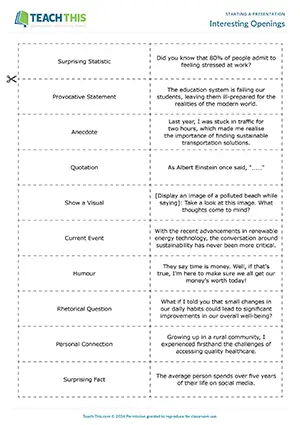
Business English Presentation Openings Resource - Vocabulary Game - Matching - Reading and Writing Exercises - Speaking Activity - Role-Play
Here is a useful presentation openers game, worksheet and activity to help students learn and practice using openers for starting presentations. First...
Let's Get Started!
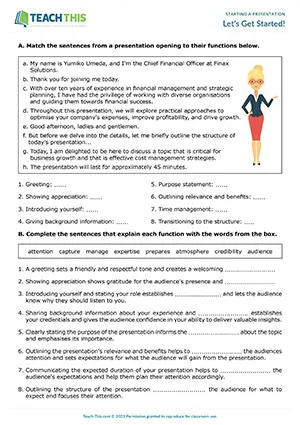
Business English Presentation Openings Worksheet - Vocabulary and Writing Exercises: Matching, Gap-fill, Writing Sentences - Speaking Activity: Presenting
Here is a comprehensive business presentation openings worksheet to help students learn and practice a structure for opening a presentation...
Starting a Business Presentation
Starting a business presentation involves welcoming the audience, establishing the topic and helping listeners understand what to expect. An opening connects the speaker's purpose with the audience's interests and provides a clear route into the main points.
This page contains five resources across B1 and B2, including worksheets, games, speaking activities and a role-play, with one free worksheet and role-play resource. They cover opening steps, presentation phrases, different types of opener, update presentations and spoken delivery.
The table shows language for different opening functions. Select the functions that suit the audience and the length and purpose of the talk.
| Opening function | Purpose | Example language |
|---|---|---|
| Welcome the audience | Acknowledge the people listening. | 'Good morning, everyone. Thank you for joining us.' |
| Introduce yourself | Explain your role when the audience needs this background. | 'I'm Maya, and I coordinate customer support training.' |
| Introduce the topic | Make the focus of the talk clear. | 'Today, I'd like to talk about our training programme.' |
| Establish relevance | Connect the topic with the audience's work or interests. | 'This session will explain how the new materials can support your team.' |
| Invite initial interest | Encourage listeners to consider a relevant question. | 'What helps you remember a new procedure after a training session?' |
| Outline the main points | Show the audience how the talk will develop. | 'First, I'll introduce the materials. Then, we'll look at how to use them.' |
How to Open a Business Presentation
Give the audience the background they need: Introduce yourself and your role when listeners do not already know you. State the topic and purpose clearly, keeping familiar background brief in an update for an existing team.
Choose an opener that leads into the topic: A relevant question or example can give listeners a reason to pay attention. Connect it promptly to the presentation's purpose, and avoid using an unrelated opener simply to attract interest.
Provide a route into the main content: Use sequence language to outline the points you will cover, with detail proportionate to the talk's length. Practice moving from the opening into the first point so the introduction prepares the audience for what follows.
3-Step Framework for Teaching Presentation Openings
This B2 sequence develops the choice of opener, preparation of an opening and spoken delivery. The first two stages use different parts of one resource, followed by a separate worksheet for delivery practice.
1. Connect Opening Types with Language: Students play a memory game, matching opener types with language examples and keeping correct pairs. They then choose four types and write an example sentence for each. This moves from recognising an approach to producing language that could introduce a topic.
2. Build a Complete Opening: Students examine a model opening and identify its opener type and language. They then prepare an opening using sequence words and an opener of their choice. In small groups, listeners identify the type and language used, giving the speaker an opportunity to check whether the intended approach is recognisable.
3. Rehearse Structure and Delivery: Students match opening sentences to their functions, complete explanations of those functions and choose wording for an outline of a presentation. They then prepare an opening for a business presentation and practice it with a partner, focusing on the worksheet's verbal delivery points. This adds attention to how the organised opening is spoken.
Common Mistakes with Presentation Openings
Using an infinitive after look forward to: In this expression, to is a preposition and is followed by a noun or an -ing form. Incorrect: 'I look forward to discuss these ideas with you.' Correct: 'I look forward to discussing these ideas with you.'
Giving an outline that does not match the talk: An opening should set accurate expectations about the points that follow. Misleading outline: 'I'll cover three options' when the presentation compares only two. Accurate outline: 'I'll compare two options.'
Common Questions About Teaching Presentation Openings
What worksheet helps teach presentation openings?
The free worksheet and role-play Ace the Opening! connects opening phrases with a sequence of presentation steps. Students identify and order steps in a model, match phrases and complete another opening. They then use ordered steps on role cards to prepare and deliver their own opening, turning the model into supported speaking practice.
What game helps practice presentation opening phrases?
The game Multiple Starts uses parts of speech as clues to missing words in presentation openings. Teams listen, mark the word types and then have three minutes to complete the gaps. Points reward correct answers, while reviewing alternative words helps students consider how different choices can fit the same opening.
How can students practice different presentation openings?
The activity Openings for Update Presentations asks groups to reconstruct four openings from sentence strips and match them with opening types. Students then use a type card and supplied information to write their own update presentation opening. Presenting it to the group and explaining its type connects recognising an approach with using it.
Become a Teach This Member
Get unlimited access to the full library, plus new resources added every week.
Unlimited Resource Access
Download from 3000+ worksheets, activities, and games.
Save 5+ Hours Weekly
Cut lesson prep time with ready-to-use resources, plus teacher notes and answer keys.
Trusted Professional Quality
Classroom-tested, editable resources created by experienced ESL professionals.
Fresh Content Weekly
Get 5 new resources added to the library each week.
Here's what our members are saying...


