I think that...

Pre-intermediate (A2) 25 minutes
ESL Giving Opinions Activity preview for Pre-intermediate (A2) showing gap-fill, sentence formation, and pair work

ESL Giving Opinions Activity - Speaking: Gap-Fill, Forming Sentences, Asking and Answering Questions, Communicative Practice - Pair Work

Here is a free giving opinions and reasons activity to help students practice phrases for giving opinions, adjectives of opinion, 'why' and 'because'. In pairs...

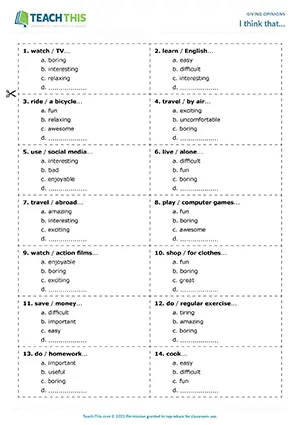
ESL Giving Opinions Activity - Speaking: Gap-Fill, Forming Sentences from Prompts, Asking and Answering Questions, Communicative Practice - Pair Work Here is a free giving opinions and reasons activity to help students practice phrases for giving opinions, adjectives of opinion, 'why' and 'because'. In pairs, students take turns picking up a card and laying it face-up on the table. The student then gives their opinion about the topic by making a sentence from the prompt, e.g. 'I think that learning English is easy.' Their partner then asks them why. The student then explains the reason for their opinion, starting with the word 'because'. Their partner then gives their opinion on the topic, and so on. Afterwards, students report back to the class on their partner's opinions and reasons. This activity can also be used to practice other phrases for giving opinions, e.g. 'In my opinion...'

In my Opinion

Pre-intermediate (A2) 25 minutes
ESL Giving Opinions Worksheet preview for Pre-intermediate (A2) with vocabulary, writing, and pair work

ESL Giving Opinions Worksheet - Vocabulary Exercises: Writing Sentences, Sentence Completion - Speaking Activity: Freer Practice - Pair Work

This comprehensive giving opinions worksheet helps students learn and practice how to give opinions using three positive and negative phrases. Students...

ESL Giving Opinions Worksheet - Vocabulary Exercises: Writing Sentences from Prompts, Sentence Completion - Speaking Activity: Freer Practice - Pair Work This comprehensive giving opinions worksheet helps students learn and practice how to give opinions using three positive and negative phrases. Students begin by underlining the adjective in each statement that is closest to their opinion. Students then write their opinions using three phrases, e.g. 'In my opinion, reading is fun.' Next, students read how to give an opinion by making the phrases negative to show disagreement. After that, students write four things they disagree with from the first exercise using the negative phrases, e.g. 'I don't think that reading is boring.' Students then read ten statements and write each one in an agree or disagree column based on their opinion. Finally, students take turns sharing their opinions with a partner, who responds by agreeing or disagreeing using the phrases from the worksheet.

Really?

Pre-intermediate (A2) 25 minutes
ESL Giving Opinions Game preview for Pre-intermediate (A2) with group work, true or false opinions, and Q&A

ESL Giving Opinions Game - Speaking: Asking and Answering Questions, True or False - Group Work

In this fun giving opinions game, students give true or false opinions about famous people or things. In groups, players take turns picking up a card and placing it face-up on the desk. Next, the student on the...

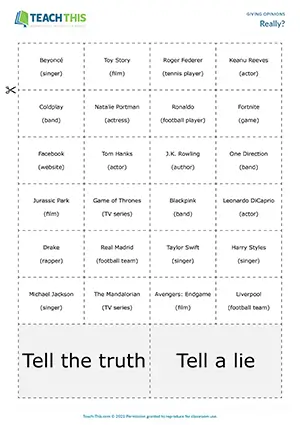
ESL Giving Opinions Game - Speaking: Asking and Answering Questions, True or False - Group Work In this fun giving opinions game, students give true or false opinions about famous people or things. In groups, players take turns picking up a card and placing it face-up on the desk. Next, the student on the player's right asks them for their opinion of the person or thing on the card, e.g. 'What do you think of Beyoncé?' The player then takes a 'Tell the truth' or 'Tell a lie' card and gives a true or false opinion as indicated on the card. Next, the other students each ask the player one follow-up question to help them decide if they are lying or telling the truth, e.g. 'What's your favourite Beyoncé song?' Each student then decides if the player is lying or telling the truth, and the player reveals the answer. If a student guesses correctly, they score one point. The student with the most points at the end of the game wins.

European Vacation

Intermediate (B1) 30 minutes
ESL Giving Opinions and Prioritizing Activity preview for Intermediate (B1) with pair work, guided discussion, and presenting

ESL Giving Opinions and Prioritizing Activity - Speaking: Discussion, Communicative Practice, Presenting - Pair Work

In this communicative giving opinions activity, students share opinions, prioritise, and agree on a list of items to pack for a European holiday. First, in pairs, students give their opinions on the things they...

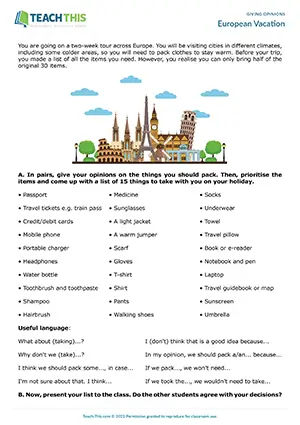
ESL Giving Opinions and Prioritizing Activity - Speaking: Guided Discussion, Communicative Practice, Presenting - Pair Work In this communicative giving opinions activity, students share opinions, prioritise, and agree on a list of items to pack for a European holiday. First, in pairs, students give their opinions on the things they should pack for their tour of Europe. Students then prioritise the items and come up with a list of 15 things to take with them on their holiday. Afterwards, pairs present their list of items to the class, who listen and then say whether they agree or disagree with the items chosen, pointing out any problems they see with the list, and the pair justifies their opinions if need be. Finally, students come up with a list together as a class.

Four Corners

Intermediate (B1) 30 minutes
ESL Giving and Defending Opinions Activity preview for Intermediate (B1) with group discussions, reporting, and refuting

ESL Giving and Defending Opinions Activity - Speaking: Discussions, Explaining, Reporting, Refuting, Communicative Practice - Group Work

In this free giving and defending opinions speaking activity, students practice expressing and defending their opinions. Place a sign in each corner...

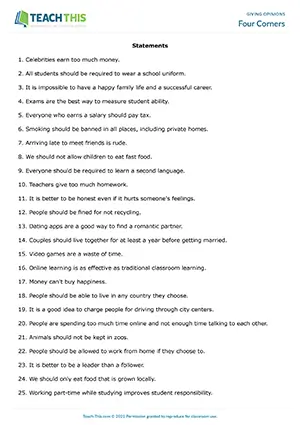
ESL Giving and Defending Opinions Activity - Speaking: Guided Discussions, Explaining, Reporting, Refuting, Communicative Practice - Group Work In this free giving and defending opinions speaking activity, students practice expressing and defending their opinions. Place a sign in each corner of the classroom (strongly agree, agree, disagree, and strongly disagree). Read a statement to the class, e.g. 'Celebrities earn too much money.' Students then go to the corner that best matches their opinion, e.g. strongly agree. Next, the students in the same corner discuss why they chose that opinion and then report their reasons to the class. After each corner has given reasons for their opinion, students from the different corners politely refute another corner's opinion. Afterwards, students who felt persuaded by any of the arguments switch corners. The process is then repeated with a new statement, and so on.

How to improve your English

Intermediate (B1) 30 minutes
ESL Giving Opinions Activity preview for Intermediate (B1) with ranking, pair work, and guided discussion

ESL Giving Opinions Activity - Speaking: Ranking Items, Discussion, Controlled and Freer Practice - Pair Work

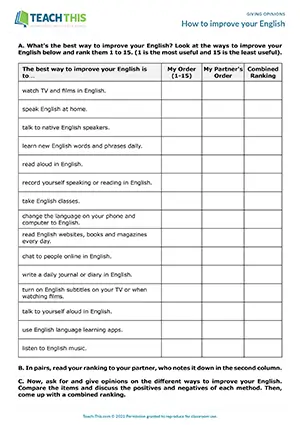
In this useful giving opinions speaking activity, students ask for and express opinions on ways to improve their English. First, students rank 15 ways to improve their English (1 is the most useful and 15 is the...

ESL Giving Opinions Activity - Speaking: Ranking Items, Guided Discussion, Controlled and Freer Practice - Pair Work In this useful giving opinions speaking activity, students ask for and express opinions on ways to improve their English. First, students rank 15 ways to improve their English (1 is the most useful and 15 is the least useful). In pairs, students then read their ranking to their partner who notes it down. Next, students ask for and give their opinions on the different methods, comparing them and discussing the merits and drawbacks of each method. Using their ideas, pairs then come up with a combined ranking. Afterwards, students work with a new partner and compare their combined rankings, discussing any similarities or differences. Finally, students rejoin with their original partner and report back to the class on their top three methods for improving their English.

Our Opinions

Intermediate (B1) 30 minutes
ESL Expressing Opinions Activity preview for Intermediate (B1) with asking, answering, discussion, summarizing in groups

ESL Expressing Opinions Activity - Speaking: Asking and Answering Questions, Discussion, Summarising - Pair and Group Work

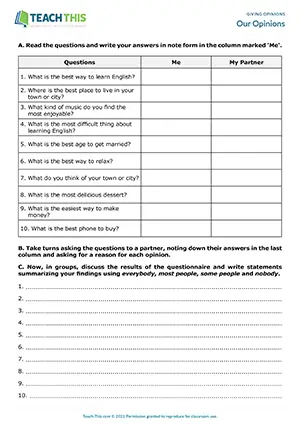
In this insightful expressing opinions speaking activity, students practice giving, explaining and summarizing opinions. First, students read questions and write...

ESL Expressing Opinions Activity - Speaking: Asking and Answering Questions from Prompts, Discussion, Summarising - Pair and Group Work In this insightful expressing opinions speaking activity, students practice giving, explaining and summarising opinions. First, students read questions and write their answers in note form. Students then take turns asking the questions to a partner, noting down their answers and asking for a reason for each opinion. Next, in groups, students discuss the results of the questionnaire and write statements summarising their findings, e.g. 'Most people think the best way to learn English is to practice it every day.' Groups then present their answers to the class. Finally, students discuss the findings as a class and groups debate any differences of opinion.

Rant or Rave

Intermediate (B1) 30 minutes
ESL Giving Opinions Game preview for Intermediate (B1) with impromptu speech and group opinion activities

ESL Giving Opinions Game - Speaking: Impromptu Speech, Communicative Practice - Group Work

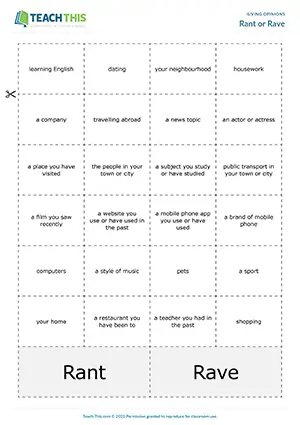
In this entertaining giving opinions game, students rant or rave about various topics using positive or negative opinion adjectives. In groups, players take turns picking up a topic card and placing it...

ESL Giving Opinions Game - Speaking: Impromptu Speech, Communicative Practice - Group Work In this entertaining giving opinions game, students rant or rave about various topics using positive or negative opinion adjectives. In groups, players take turns picking up a topic card and placing it face up on the desk. The player then picks up a 'Rant' or 'Rave' card. If the player turns over a 'Rant' card, they express negative opinions about the topic on the card for one minute without stopping. If the player picks up a 'Rave' card, they express positive opinions. The other students listen and award one point to the player for each appropriate opinion adjective they use during their rant or rave. If a player can't think of anything to say or stops talking before the time limit has been reached, no points are awarded. The player with the most points at the end of the game wins.

What's your Opinion?

Intermediate (B1) 25 minutes
ESL Giving Opinions Activity preview for Intermediate (B1) with gap-fill, asking questions, and writing sentences

ESL Giving Opinions Activity - Speaking: Gap-fill, Asking and Answering Questions, Writing Sentences - Pair Work

In this enjoyable giving opinions speaking activity, students ask for and share opinions on school subjects. First, students complete questions with different school subjects from a box or using their own...

ESL Giving Opinions Activity - Speaking: Gap-fill, Asking and Answering Questions from Prompts, Writing Sentences - Pair Work In this enjoyable giving opinions speaking activity, students ask for and share opinions on school subjects. First, students complete questions with different school subjects from a box or using their own ideas. In pairs, Students then ask for their partner's opinions using the questions and write sentences about their answers, e.g. 'Terry doesn't think that science is difficult. He scored 95% on his last test.' Afterwards, students check their partner's sentences for errors. Finally, students present their partner's opinions on school subjects to the class.

Controversial Statements

Upper-intermediate (B2) 30 minutes
ESL Giving and Justifying Opinions Activity preview for Upper-intermediate (B2) with group work, arguing and discussing controversial statements

ESL Giving and Justifying Opinions Activity - Speaking: Discussions, Communicative Practice - Group Work

In this engaging giving and justifying opinions speaking activity, students express and justify opinions by arguing for or against a set of controversial statements. Working alone, students read statements...

ESL Giving and Justifying Opinions Activity - Speaking: Guided Discussions, Communicative Practice - Group Work In this engaging giving and justifying opinions speaking activity, students express and justify opinions by arguing for or against a set of controversial statements. Working alone, students read statements and write down two reasons why someone might agree or disagree with each one. Next, in groups, comprising of two 'for' students and two 'against' students, students discuss the controversial statements, giving and justifying their opinions, and arguing for or against each statement. When the groups have finished, they tell the class who gave the most convincing arguments and why. As an extension, students discuss their real opinions on the controversial statements in their groups.

Explain Yourself

Upper-intermediate (B2) 30 minutes
ESL Giving Opinions Activity preview for Upper-intermediate (B2) with sentence completion, guessing, and group discussions

ESL Giving Opinions Activity - Speaking: Sentence Completion, Guessing, Asking Questions, Discussions, Communicative Practice - Group Work

In this communicative giving opinions activity, students practice giving opinions and asking embedded questions to gain more information. In groups...

ESL Giving Opinions Activity - Speaking: Sentence Completion, Guessing, Asking Questions, Guided Discussions, Communicative Practice - Group Work In this communicative giving opinions activity, students practice giving opinions and asking embedded questions to gain more information. In groups, students take turns choosing a numbered card and a controversial issue from the board. Each student then completes the opinion phrase on that numbered card with their opinion on the topic. Students then mix the opinion cards together. Next, the first student picks up one of the cards and reads the opinion to the group, who guesses which student the card belongs to. The writer then reveals themselves to the group, who then ask the student embedded questions to get them to explain more about their opinion and feelings on the issue. If the students have opposing views on their cards, they have a brief debate on the topic. The next student then chooses a number and controversial issue, and so on. Afterwards, groups give feedback on which topics caused the most debate and who gave the most convincing arguments.

It's Debatable

Upper-intermediate (B2) 40 minutes
ESL Giving Opinions Activity preview for Upper-intermediate (B2) with group debating and communicative practice

ESL Giving Opinions Activity - Speaking: Debating, Communicative Practice - Group Work

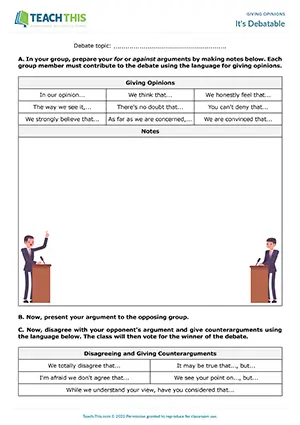
In this free debating activity, students participate in a debate to help them practice phrases for giving opinions, disagreeing and giving counterarguments. In competing groups, students write a...

ESL Giving Opinions Activity - Speaking: Debating, Communicative Practice - Group Work In this free debating activity, students participate in a debate to help them practice phrases for giving opinions, disagreeing and giving counterarguments. In competing groups, students write a debate topic on the worksheet and prepare their for or against arguments. When everyone is ready, two groups debate their topic in front of the class with each group member contributing to the debate. After each group has presented their arguments, the two groups respond to each other by disagreeing and giving counterarguments. Afterwards, the class votes for the winner. Two new groups then come to the front of the class and begin the next debate, and so on.

My Opinion

Upper-intermediate (B2) 45 minutes
ESL Giving Opinions and Persuading Activity preview for Upper-intermediate (B2) with group discussions and persuasion

ESL Giving Opinions and Persuading Activity - Speaking: Discussions, Persuading, Communicative Practice - Group Work

In this rewarding giving opinions speaking activity, students express opinions on controversial statements and try to persuade others with differing opinions to change their minds. In groups, students...

ESL Giving Opinions and Persuading Activity - Speaking: Guided Discussions, Persuading, Communicative Practice - Group Work In this rewarding giving opinions speaking activity, students express opinions on controversial statements and try to persuade others with differing opinions to change their minds. In groups, students take turns picking up a statement card and reading it to the group. Next, each student chooses an opinion card to show how much they agree or disagree with the statement and places it in front of them, e.g. strongly agree, undecided, disagree, etc. The reader then gives their opinion and the other students respond with their own opinion in turn. After that, students try to persuade the group members with differing opinions to change their minds. If anyone changes their mind during the discussion, they show this by changing the opinion card in front of them. Afterwards, groups give feedback on which statements caused the greatest argument and say who was the most persuasive.

Using Giving Opinions Language

Giving opinions in English means using specific phrases and expressions to share your point of view, such as 'I think that...', 'In my opinion...', 'As far as I'm concerned...', and 'I strongly believe that...'. Students who only use 'I think' for every situation miss the range of language English uses to signal how strongly they feel, whether they are hedging politely or stating something with conviction, and that flatness makes their spoken and written communication sound far less natural than it should.

This page covers giving opinions across A2, B1, and B2 levels, with thirteen activities including pair speaking tasks, group discussion activities, a classroom movement activity, and a full debating activity, with three resources available as free downloads.

The table below maps the most common English expressions for giving, asking for, and responding to opinions by function, so teachers and students can see at a glance how the language moves from a tentative personal view to a confident disagreement.

FunctionPhrase or ExpressionExample
Stating a personal opinion I think that... / I believe that... 'I think that social media does more harm than good.'
Giving a stronger opinion I strongly believe that... / I'm convinced that... 'I'm convinced that electric cars are the future.'
Hedging an opinion I tend to think that... / I would say that... 'I would say that working from home has its advantages.'
Giving a formal opinion In my opinion... / In my view... / As far as I'm concerned... 'In my opinion, public transport should be free.'
Asking for someone's opinion What do you think about...? / What's your view on...? 'What do you think about the new policy?'
Agreeing with an opinion I agree with you. / I think so too. / Absolutely. 'I agree with you. It's a real problem.'
Partially agreeing I see your point, but... / That's true, but... 'I see your point, but I think there are other factors.'
Disagreeing politely I'm not sure I agree. / I don't think that... / I see it differently. 'I'm not sure I agree. The evidence suggests otherwise.'
Disagreeing strongly I completely disagree. / I don't agree at all. 'I completely disagree. That approach has never worked.'

When to Use Giving Opinions Language

Starting a discussion or conversation: When you want to open a topic up for debate or invite others to engage with your point of view, leading with 'In my opinion...' or 'I think that...' signals clearly that what follows is a personal position and not a statement of fact, as in 'In my opinion, remote work is better for productivity.'

Disagreeing without causing offence: When someone states an opinion you disagree with, English speakers soften the disagreement by partly acknowledging the other person's view before redirecting, as in 'I see your point, but I think the data tells a different story.'

Making your level of certainty clear: When you want to signal that your opinion is tentative rather than fixed, hedging expressions let you share a view without overstating your confidence, as in 'I tend to think that a shorter working week would improve wellbeing, but I could be wrong.'

3-Step Framework for Teaching Giving Opinions Language

1. Introduce the Range of Opinion Phrases: Start by getting students to see that English has more than one way to give an opinion, and that the choice of phrase signals attitude as well as content. A worksheet that moves students through positive and negative forms works well here. Students write their own opinions using target phrases and then immediately practice flipping them into disagreement, for example turning a positive statement into 'I don't think that reading is boring.' That contrast between agreeing and disagreeing forms locks in both sides of the language at once.

2. Push for Fluency with Opinion Adjectives: Once students have the phrases, the next challenge is producing opinions quickly and confidently without defaulting to a single safe expression. A card game where students must speak about a topic for a full minute using as many opinion adjectives as possible puts that fluency under pressure in a memorable way. The scoring mechanic rewards range: students earn one point for each appropriate opinion adjective they use during their rant or rave, so the game pushes students to reach beyond their comfort zone naturally.

3. Build towards Justifying and Defending Opinions: The highest-level challenge is not just stating an opinion but sustaining and defending it when others push back. A structured group discussion where two students argue 'for' and two argue 'against' a controversial statement gives every student a position to defend, which forces them to use justification language rather than simply restating what they think.

Common Mistakes with Giving Opinions Language

Using 'I am agree' instead of 'I agree': Students often treat 'agree' as an adjective rather than a verb, adding 'am' as if it works like 'I am happy', which produces a form that no native speaker would use. Wrong: 'I am agree with your opinion about climate change.' Correct: 'I agree with your opinion about climate change.'

Using 'according to me' instead of 'in my opinion': Students often translate directly from their first language and produce 'according to me' to introduce a personal opinion, which sounds unnatural in English because 'according to' signals an external source rather than a personal view. Wrong: 'According to me, the government should invest more in education.' Correct: 'In my opinion, the government should invest more in education.'

Common Questions About Teaching Giving Opinions Language

What is a fun game for practicing giving opinions?

In the game Really?, students give a true or false opinion about a famous person or thing, such as 'I think Beyoncé is overrated.' Classmates ask follow-up questions to figure out whether the student is lying or telling the truth, then vote on their answer. Players score a point for each correct guess, making every opinion a small performance.

What is a useful activity for practicing giving and defending opinions?

Four Corners is a free activity that forces students to commit to a position before they speak. Students move to the corner that matches their view on a statement: strongly agree, agree, disagree, or strongly disagree. They explain their corner's reasoning to the class and politely refute a different corner's argument, with anyone persuaded by the discussion switching corners.

What is a good activity for debate practice?

The free activity It's Debatable gives students a structured debate format where groups prepare for or against arguments on a topic they choose themselves. Two groups debate in front of the class, then respond to each other by disagreeing and giving counterarguments. The class votes for the winning side, giving students a real reason to argue their case.

Become a Teach This Member

Get unlimited access to the full library, plus new resources added every week.

Unlimited Resource Access

Download from 3000+ worksheets, activities, and games.

Save 5+ Hours Weekly

Cut lesson prep time with ready-to-use resources, plus teacher notes and answer keys.

Trusted Professional Quality

Classroom-tested, editable resources created by experienced ESL professionals.

Fresh Content Weekly

Get 5 new resources added to the library each week.

Join Now Just $29.99 quarterly