
Etiquette & Manners ESL Activities & Games
Predictably Polite
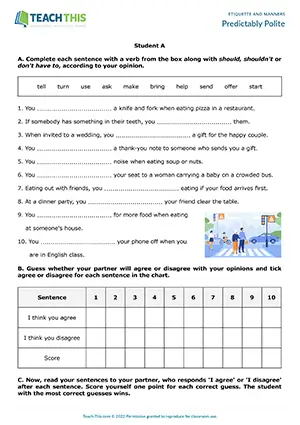
ESL Manners and Etiquette Activity - Speaking: Sentence Completion, Guessing - Pair Work
In this free manners and etiquette speaking activity, students give opinions on appropriate behaviour in certain situations and then play a guessing game where they decide whether a partner would agree or...
Etiquette Around the World
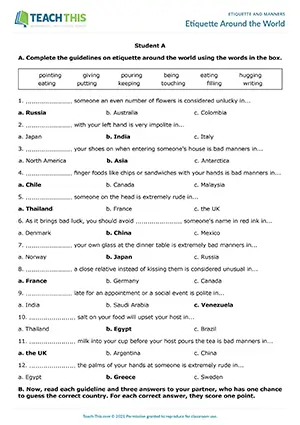
ESL Etiquette Activity - Vocabulary and Speaking: Gap-fill, Multiple-Choice Quiz, Guessing - Pair Work
In this fun etiquette speaking activity, students complete guidelines on etiquette around the world and then take part in a quiz using the advice. First, in two groups, students complete guidelines on...
Etiquette Trivia Board Game
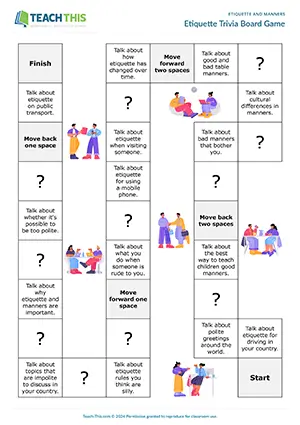
ESL Etiquette and Manners Board Game - Vocabulary and Speaking: Impromptu Speech, Multiple-choice, Guessing, Freer Practice - Group Work
In this enjoyable etiquette board game, students practice talking about etiquette and manners using topic-related vocabulary. Players take turns rolling...
Manners in the Moment
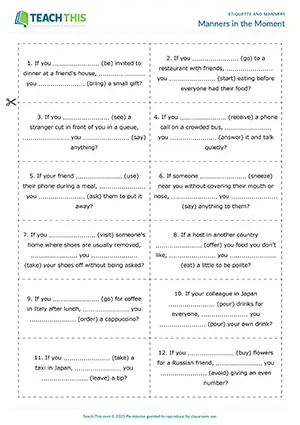
ESL Etiquette and Manners Activity - Grammar and Speaking: Completing Asking and Answering Questions, Discussion, Freer and Communicative Practice - Group Work
In this etiquette and manners discussion activity, students use the second conditional to discuss everyday and cross-cultural situations regarding etiquette...
Using Etiquette and Manners Language
Etiquette and manners language gives students the phrases and structures they need to behave politely and appropriately across a range of social situations, from making requests and accepting invitations to navigating cultural differences in behavior. Students who lack this language often default to blunt or overly direct responses that come across as rude even when no offense was intended, simply because they do not have the phrases needed to soften a request, acknowledge a social norm, or respond appropriately to someone else's generosity.
This page covers etiquette and manners from A2 to B2 level, with four activities including a speaking game, a cross-cultural quiz, a board game, and a second conditional discussion task, with one activity available as a free download.
When to Use Etiquette and Manners Language
Making a Request Politely: When asking for something in a formal or unfamiliar social setting, framing a request with the right level of indirectness shows awareness of etiquette and avoids sounding demanding, as in 'I was wondering if it would be possible to have a few minutes of your time.'
Acknowledging a Social Mistake: When someone has accidentally broken a social rule, knowing how to apologize briefly and move on is a social skill that repairs the moment without drawing more attention to it, as in 'I'm so sorry, I didn't realize that was the custom here.'
Navigating Table Manners Across Cultures: In cross-cultural dining situations, a brief comment that shows awareness of local customs signals respect and prevents unintended offense, as in 'I wasn't sure of the custom here, so I hope I haven't done anything wrong.'
3-Step Framework for Teaching Etiquette and Manners
1. Start with Opinions and Modal Language: Open with an activity that asks students to form and express opinions about social behavior using modal verbs. Students complete sentences about what people should, shouldn't, or don't have to do in various situations, choosing a verb from a box for each one. The guessing element adds real communicative purpose: working alone first, students predict whether a partner will agree or disagree with each of their opinions, then score one point for each correct guess when they compare.
2. Introduce Cross-Cultural Rules as a Quiz: Build on the social awareness angle by introducing cross-cultural etiquette rules that students complete using words from a box, working in separate groups first. The two groups then pair up and turn their completed guidelines into a quiz, with one student reading each guideline and three possible answers aloud while a partner has one chance to guess the correct country from the choices. Students score one point per correct guess, which keeps the pace sharp.
3. Push Fluency with a Board Game: Raise the level of fluency demand with a board game that puts students on the spot in two different ways. Landing on a 'Talk about' square requires a student to speak for 30 seconds without stopping in response to an etiquette-related prompt, with a penalty of going back two squares for stopping early. Landing on a 'Question mark' square triggers a multiple-choice trivia question read aloud by another student, with ten seconds to choose an answer before the same two-square penalty applies.
Common Mistakes with Etiquette and Manners Language
Using 'Can I' Instead of 'Could I' in Formal Situations: Students often use 'Can I' in formal contexts where 'Could I' or 'May I' would be more appropriate, which sounds too casual and can come across as impolite in professional or formal settings. Wrong: 'Can I leave the meeting early?' Correct: 'Could I possibly leave the meeting early?'
Overusing 'Sorry' as a Filler: Students often say 'sorry' reflexively in situations where it is not needed, which can undermine their confidence and make them sound uncertain rather than polite. Wrong: 'Sorry, I have a question about this.' Correct: 'Excuse me, I have a question about this.'
Common Questions About Teaching Etiquette and Manners Language
What is a good speaking activity for teaching etiquette and manners?
The activity Manners in the Moment gives students a second conditional question on a card, such as 'If you visited someone's home where shoes are usually removed, would you take your shoes off?' Students complete the question, ask the group, and each person answers and justifies their view before everyone agrees on the best response. It generates real discussion from a single prompt.
What is a fun ESL activity for teaching etiquette rules from different countries?
Etiquette Around the World is an activity that covers etiquette rules from countries around the world. Students fill in guidelines using words from a box, then pair up and take turns reading each guideline with three possible answers while a partner has one chance to guess the correct country. Every right answer scores a point, so students compete to recall what they just learned.
Become a Teach This Member
Get unlimited access to the full library, plus new resources added every week.
Unlimited Resource Access
Download from 3000+ worksheets, activities, and games.
Save 5+ Hours Weekly
Cut lesson prep time with ready-to-use resources, plus teacher notes and answer keys.
Trusted Professional Quality
Classroom-tested, editable resources created by experienced ESL professionals.
Fresh Content Weekly
Get 5 new resources added to the library each week.
Here's what our members are saying...


