
Future Continuous vs. Future Perfect ESL Activities, Games & Worksheets
An Interview with Richard Branson
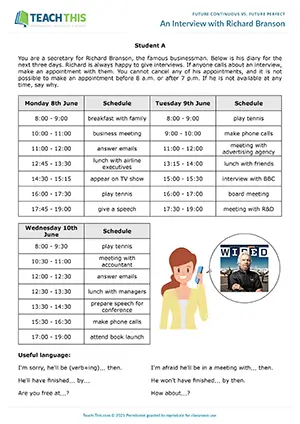
ESL Future Continuous vs. Future Perfect Role-Play - Speaking Activity: Asking and Answering Questions, Communicative Practice - Pair Work
In this future continuous and future perfect activity, students role-play a phone call to compare schedules and negotiate a one-hour interview time with Richard...
In Ten Years' Time
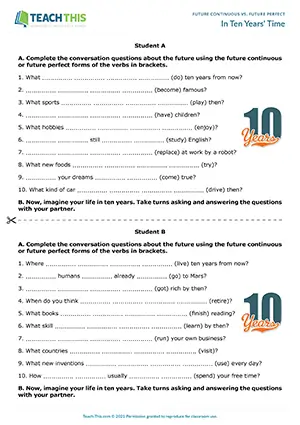
ESL Future Continuous and Future Perfect Questions Activity - Grammar and Speaking: Gap-fill, Asking and Answering Questions, Freer Practice - Pair Work
This future continuous vs. future perfect speaking activity helps students practice forming, asking and answering conversation questions about their lives in...
Perfectly Continuous Conversations

ESL Future Continuous vs. Future Perfect Activity - Grammar and Speaking: Writing, Asking and Answering Questions - Pair Work
This future continuous vs. future perfect speaking activity helps students practice forming, asking and answering conversation questions in the future continuous and future perfect. First, in two groups...
Shot in the Dark
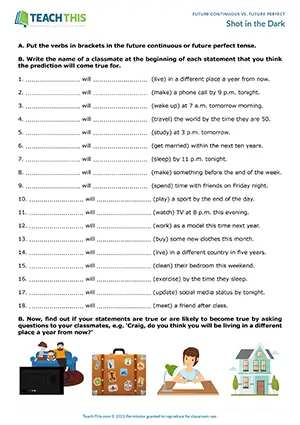
ESL Future Continuous and Future Perfect Game - Grammar and Speaking: Sentence Completion, Discussion, Freer Practice - Group Work
In this free future continuous vs. future perfect game, students practice making predictions and discussing future plans using the future continuous and...
This Time Next Year...
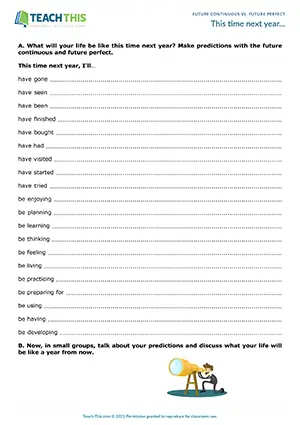
ESL Future Continuous and Future Perfect Activity - Grammar and Speaking: Sentence Completion, Discussion, Freer Practice - Group Work
In this insightful future continuous vs. future perfect activity, students make predictions about what life will be like a year from now. First, students make...
When I'm really old
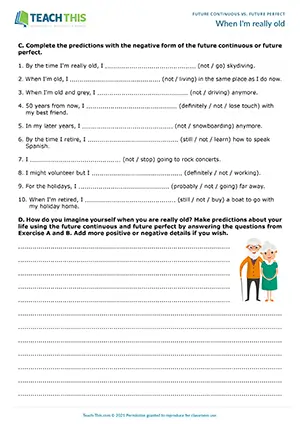
ESL Future Continuous vs. Future Perfect Worksheet - Grammar and Writing Exercises: Writing Questions, Identifying, Gap-fill, Writing a Paragraph
In this comprehensive future continuous and future perfect worksheet, students use the two tenses to make predictions about when they are really old. First...
Understanding the Future Continuous vs. Future Perfect
The future continuous describes an action still in progress at a future point, and it uses 'will be' plus the -ing form, as in 'This time next year, I will be living in Paris.' The future perfect describes an action completed before a future point, and it uses 'will have' plus the past participle, as in 'By this time next year, I will have moved to Paris.' When students mix up the two, they signal the wrong relationship between the action and the time point: writing 'I will be moved to Paris' instead of 'I will have moved to Paris' tells the reader the action is ongoing rather than finished, which can make a sentence logically contradictory.
This page covers the future continuous vs. the future perfect at B2 level, with six activities including speaking activities, a group prediction game, a role-play, and a worksheet, with one activity available as a free download.
This table compares the future continuous and future perfect side by side, showing how their structures, meanings, time markers, and example sentences differ.
| Aspect | Future Continuous | Future Perfect |
|---|---|---|
| Structure | will be + verb-ing | will have + past participle |
| Key meaning | action in progress at a future point | action completed before a future point |
| Typical time markers | this time tomorrow, at 6 p.m. next Friday, in an hour | by tomorrow, by this time next year, by the end of the week |
| Positive example | 'At 8 p.m. tonight, I will be cooking dinner.' | 'By 8 p.m. tonight, I will have cooked dinner.' |
| Negative example | 'She won't be working at noon.' | 'She won't have finished the report by noon.' |
| Question form | 'Will you be travelling this time next week?' | 'Will you have graduated by then?' |
When to Use the Future Continuous vs. Future Perfect
Promising Completion by a Deadline: Speakers use the future perfect to make a firm commitment that something will be finished before a set time, signaling reliable completion rather than vague intention, as in 'Don't worry, I will have sent you the contract before you land.'
Describing the Background Scene on Arrival: The future continuous sets the scene for what will already be happening when someone turns up, giving the listener a vivid picture of the situation they are about to walk into, as in 'When you get to the party, everyone will be dancing.'
Expressing Anticipated Achievement: Writers and speakers reach for the future perfect to mark a significant personal milestone they expect to reach by a future point, framing the achievement as a done deal rather than a hope, as in 'By the time I turn 40, I will have run a marathon.'
3-Step Framework for Teaching the Future Continuous vs. Future Perfect
1. Anchor the Contrast in Real Predictions: Start with a gap-fill task that requires students to choose between the future continuous and future perfect based on the time expression in each sentence, then move immediately into a personal prediction challenge. Students write a classmate's name into each sentence they think will come true for that person, for example writing 'Craig will be living in a different place a year from now,' then go around the class asking each person directly whether the prediction is accurate. The student with the most correct predictions wins.
2. Generate Genuine Questions About the Future: Move the class into a structured speaking task where both tenses drive the questions, not just the answers. Working in two groups, students complete a set of conversation questions by filling in the correct tense for each, then pair up with someone from the other group to ask and answer those questions while imagining their lives in ten years. Finishing with a class share-out gives every student a reason to listen carefully to their partner.
3. Put Both Tenses to Work in a Real Negotiation: Close with a role-play that gives students a clear communicative purpose for using both tenses. One student plays Richard Branson's secretary and the other plays a journalist for Wired magazine, and together they use the future continuous and future perfect to negotiate a one-hour interview slot when both Richard and the journalist are free. The role-play works because neither student can complete the task without producing accurate sentences in both tenses.
Common Mistakes with the Future Continuous vs. Future Perfect
Base Form Instead of Past Participle After 'will have': Students often leave the base form after 'will have' instead of using the past participle, treating 'have' like a modal and forgetting that the future perfect needs a past participle to complete the structure. Wrong: 'By Friday, I will have finish the project.' Correct: 'By Friday, I will have finished the project.'
Using the Future Continuous with 'by': Students often pair 'by' with the future continuous instead of the future perfect, not recognizing that 'by' signals a completion deadline that calls for the future perfect. Wrong: 'By next Monday, she will be completing her assignment.' Correct: 'By next Monday, she will have completed her assignment.'
Common Questions About Teaching the Future Continuous vs. Future Perfect
What is an interesting speaking activity for teaching future continuous and future perfect together?
The activity This Time Next Year gives both tenses a clear job. Students write future continuous predictions using 'this time next year' and future perfect predictions using 'by this time next year,' then share and compare those predictions in groups. A class feedback session at the end lets everyone hear how differently their classmates picture the future.
What is a good worksheet for practicing future continuous and future perfect?
For students who need both tenses in one focused task, the worksheet When I'm really old is worth trying. Students write Wh questions in the future continuous and future perfect, including two questions they would like to ask their future selves, then write predictions answering all those questions and read them to the class.
What is a fun future continuous and future perfect game?
The game Shot in the Dark turns both tenses into a prediction challenge. Students complete sentences in the future continuous or future perfect using time expressions as clues, then write a classmate's name into each sentence they think will come true for that person. The student who verifies the most correct predictions wins.
Become a Teach This Member
Get unlimited access to the full library, plus new resources added every week.
Unlimited Resource Access
Download from 3000+ worksheets, activities, and games.
Save 5+ Hours Weekly
Cut lesson prep time with ready-to-use resources, plus teacher notes and answer keys.
Trusted Professional Quality
Classroom-tested, editable resources created by experienced ESL professionals.
Fresh Content Weekly
Get 5 new resources added to the library each week.
Here's what our members are saying...


