He, She, It, We or They?

Beginner (A1) 20 minutes
ESL subject pronoun identification, sentence rewriting and gap-fill exercises

ESL Subject Pronouns Worksheet - Grammar Exercises: Identifying, Rewriting Sentences, Gap-fill

In this free subject pronouns worksheet, students learn to talk about people and things using he, she, it, we and they through a series of short sentence-building tasks. Students begin by writing a pronoun...

ESL Subject Pronouns Worksheet - Grammar Exercises: Identifying, Rewriting Sentences, Gap-fill In this free subject pronouns worksheet, students learn to talk about people and things using he, she, it, we and they through a series of short sentence-building tasks. Students begin by writing a subject pronoun for each noun or groups of nouns. Next, students rewrite sentences, replacing the subject with a subject pronoun and keeping the rest of the sentence the same, e.g. 'The bags are blue' becomes 'They are blue'. After that, students complete sentences with subject pronouns, using the first sentence in each item to help them choose the correct pronoun, e.g. 'This is my brother. He is six.' Finally, the class checks the answers and reviews any pronouns the students found difficult.

Is it you or me?

Beginner (A1) 30 minutes
ESL pronoun matching cards, multiple-choice sentences and conversation gap-fills

ESL Subject and Object Pronouns Game and Worksheet - Grammar and Vocabulary: Matching, Multiple Choice, Gap-fill

In this enjoyable subject and object pronouns game and worksheet, students match pronoun pairs, use them in short conversations and write about people and things in their own lives. In pairs, students...

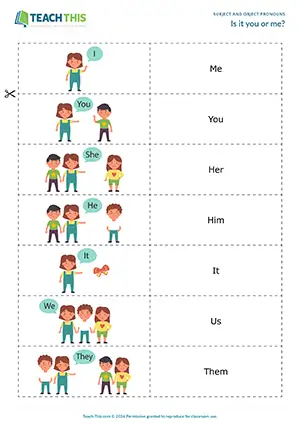
ESL Subject and Object Pronouns Game and Worksheet - Grammar and Vocabulary: Matching, Pelmanism, Multiple Choice, Gap-fill, Sentence Completion In this enjoyable subject and object pronouns game and worksheet, students match pronoun pairs, use them in short conversations and write about people and things in their own lives. In pairs, students play a memory game, taking turns turning over one subject pronoun picture card and one object pronoun word card. If the cards match, the student keeps the pair and plays again. If not, the cards are turned back over and the turn passes to their partner. The student with the most pairs wins. Students then read sentences and circle the correct subject or object pronoun. Next, students complete short conversations using pairs of subject and object pronouns, e.g. 'They are on the table. Can you see them?' Finally, students complete sentences with their own ideas and the correct pronouns.

I Mime, You Watch

Elementary (A1-A2) 25 minutes
ESL pronoun and action cards for miming and guessing present continuous sentences

ESL Subject Pronouns Game - Vocabulary, Grammar and Speaking: Miming, Guessing, Forming Sentences - Group Work

In this amusing subject pronouns game, students use gestures and actions to help their classmates guess pronouns and make present continuous sentences. In groups, students take turns picking up...

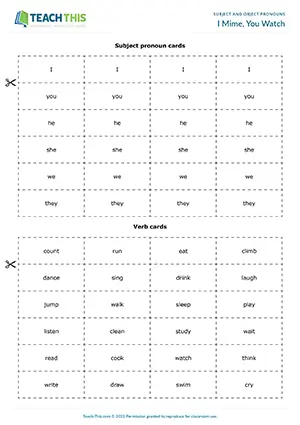
ESL Subject Pronouns Game - Vocabulary, Grammar and Speaking: Miming, Guessing, Forming Sentences, Controlled Practice - Group Work In this amusing subject pronouns game, students use gestures and actions to help their classmates guess pronouns and make present continuous sentences. In groups, students take turns picking up a subject pronoun card and a verb card and miming them to the other players. Students use agreed gestures to show the pronouns, including a group containing themselves for 'we' and other people for 'they'. The other players race to make the correct present continuous sentence from the mime player's perspective, e.g. 'I am jumping'. The first student to say the correct sentence keeps both cards. The game continues until all the cards have been used. The student with the most pairs of cards at the end of the game wins.

Pronouns Bingo

Elementary (A1-A2) 20 minutes
ESL bingo cards and two caller sheets for identifying missing pronouns

ESL Subject and Object Pronouns Game - Grammar: Listening, Matching - Group Work

In this rewarding subject and object pronouns game, students listen for missing pronouns and race to complete their bingo cards. In groups, one student acts as the caller and the others each take a bingo card. The caller reads sentences in random...

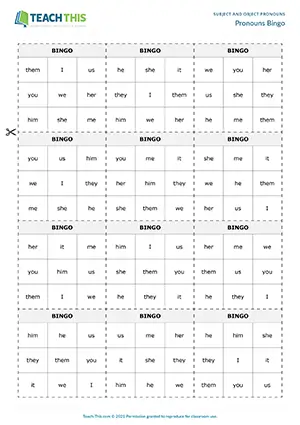
ESL Subject and Object Pronouns Game - Grammar: Listening, Matching - Group Work In this rewarding subject and object pronouns game, students listen for missing pronouns and race to complete their bingo cards. In groups, one student acts as the caller and the others each take a bingo card. The caller reads sentences in a random order, saying 'blank' for each missing pronoun, e.g. 'This is my bike. Blank is blue.' Players identify the pronoun and cross it off their card. The first player to cross off all the pronouns calls 'bingo' and reads out their answers. The caller checks these against the sentences used. A correct card wins the round and scores a point. Students play four rounds, changing callers and using fresh bingo cards each time. They alternate between two caller's sheets and change the calling order. The student with the most points wins.

Replace it

Elementary (A1-A2) 20 minutes
ESL pronoun and sentence cards for matching and replacing underlined words

ESL Subject and Object Pronouns Game - Grammar: Pelmanism, Matching, Reading Sentences - Pair Work

In this fun subject and object pronouns game, students test their memory and collect matching cards by replacing words in sentences with pronouns. In pairs, students take turns turning over...

ESL Subject and Object Pronouns Game - Grammar: Pelmanism, Matching, Reading Sentences - Pair Work In this fun subject and object pronouns game, students test their memory and collect matching cards by replacing words in sentences with pronouns. In pairs, students take turns turning over one pronoun card and one sentence card. If the pronoun matches the underlined words, the student reads the sentence aloud, replacing those words with the pronoun. A correct sentence allows the student to keep the pair and have another turn. If the cards do not match or the sentence is incorrect, the student turns the cards back over and their partner plays. The student with the most pairs of cards wins the game.

Subject and Object Pronoun Practice

Elementary (A1-A2) 25 minutes
ESL subject and object pronoun gap-fills and error correction

ESL Subject and Object Pronouns Worksheet - Grammar Exercises: Gap-fill, Error Correction

In this productive subject and object pronouns worksheet, students build confidence using pronouns by completing sentences and correcting pronoun mistakes. First, students complete sentences by...

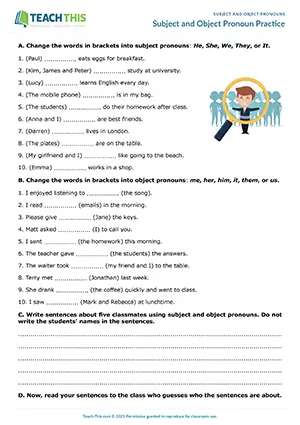
ESL Subject and Object Pronouns Worksheet - Grammar Exercises: Gap-fill, Error Correction In this productive subject and object pronouns worksheet, students build confidence using pronouns by completing sentences and correcting pronoun mistakes. First, students complete sentences by replacing words in brackets with subject pronouns. Students then complete sentences with object pronouns. Finally, students identify pronoun mistakes in sentences and write the correct forms.

Subject Object Snap

Elementary (A1-A2) 20 minutes
ESL question and answer cards for matching subject and object pronouns

ESL Subject and Object Pronouns Game - Vocabulary: Matching - Pair Work

In this entertaining subject and object pronouns game, students compete to match 'Do you like...?' questions with answers containing subject and object pronouns. In pairs, students turn over a question card and an answer card at the same...

ESL Subject and Object Pronouns Game - Vocabulary: Matching - Pair Work In this entertaining subject and object pronouns game, students compete to match 'Do you like...?' questions with answers containing subject and object pronouns. In pairs, students turn over a question card and an answer card at the same time. Any answer with the correct pronoun for the question counts as a match. The first student to say 'Snap' reads the matching question and answer aloud correctly to score a point. If a student calls 'Snap' for an incorrect match, their partner scores a point. The first student to score ten points wins the game.

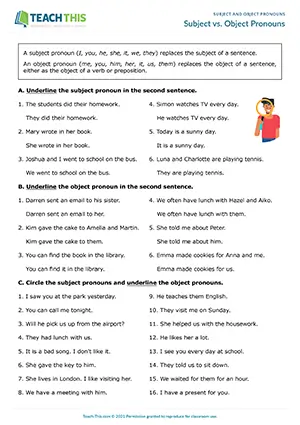
Subject vs. Object Pronouns

Elementary (A1-A2) 35 minutes
ESL pronoun identification, multiple choice, rewriting, gap-fill and picture prompts

ESL Subject and Object Pronouns Worksheet - Grammar: Identifying, Multiple Choice, Rewriting, Gap-fill, Picture Prompts

In this comprehensive subject and object pronouns worksheet, students build from recognising pronouns to using them in sentences and a short text. Students begin by underlining subject pronouns...

ESL Subject and Object Pronouns Worksheet - Grammar Exercises: Identifying, Multiple Choice, Rewriting Sentences, Gap-fill, Picture Prompts In this comprehensive subject and object pronouns worksheet, students build from recognising pronouns to using them in sentences and a short text. Students begin by underlining subject pronouns and then object pronouns in sentences. Students then circle the correct pronoun in each sentence. Next, students rewrite sentences, replacing underlined words with subject and object pronouns. After that, students complete a short text with suitable pronouns. Finally, students use pictures and prompts to write sentences containing subject and object pronouns.

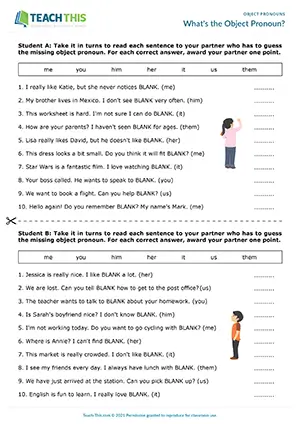
What's the Object Pronoun?

Elementary (A1-A2) 20 minutes
ESL paired listening sheets with object pronoun gaps

ESL Object Pronouns Game - Grammar: Listening, Gap-fill - Pair Work

In this free object pronouns game, students listen to sentences and complete them with object pronouns to score points. In pairs, students take turns reading sentences to their partner, saying the word 'blank' for each missing pronoun. Their...

ESL Object Pronouns Game - Grammar: Listening, Gap-fill - Pair Work In this free object pronouns game, students listen to sentences and complete them with object pronouns to score points. In pairs, students take turns reading sentences to their partner, saying the word 'blank' for each missing pronoun. Their partner listens and repeats the complete sentence with the correct object pronoun from the box. Students score their partner one point for each correct answer. The student with the most points at the end of the game wins.

Blank Out

Pre-intermediate (A2) 25 minutes
ESL subject and object pronouns group game preview for A2 showing sentence gap-fill and fast-paced competition

ESL Subject and Object Pronouns Game - Vocabulary and Grammar: Matching, Sentence Completion - Group Work

In this fast-paced subject and object pronouns game, students race to complete sentences with subject or object pronouns. In groups, the reader turns over a card and reads the sentence aloud...

ESL Subject and Object Pronouns Game - Vocabulary and Grammar: Matching, Sentence Completion - Group Work In this fast-paced subject and object pronouns game, students race to complete sentences with subject or object pronouns. In groups, the reader turns over a card and reads the sentence aloud to the players using the word 'blank' for the missing pronoun. The players listen and then race to grab the correct pronoun card to complete the sentence. The first player to grab the correct pronoun card from their set and give it to the reader, saying the pronoun at the same time wins and keeps the two cards. The student with the most cards at the end of the game wins.

Love it or hate it?

Pre-intermediate (A2) 25 minutes
ESL pair conversations giving opinions and reasons about people, places and things

ESL Subject and Object Pronouns Activity - Speaking: Questions, Opinions and Reasons - Pair Work

In this interesting subject and object pronouns activity, students discover their classmates' opinions of people, places and things and ask for reasons using short, supported conversations. First, students...

ESL Subject and Object Pronouns Activity - Vocabulary and Speaking: Asking and Answering Questions, Giving Opinions and Reasons - Pair Work In this interesting subject and object pronouns activity, students discover their classmates' opinions of people, places and things and ask for reasons using short, supported conversations. First, students write the names of people, places and things they love, like, don't mind, don't like or hate under headings. In pairs, students then take turns asking 'What do you think of...?' about the names on their worksheets. Their partner gives an opinion using subject and object pronouns. The student then asks 'Why?' and their partner gives a short reason. Finally, students give feedback on their likes and dislikes.

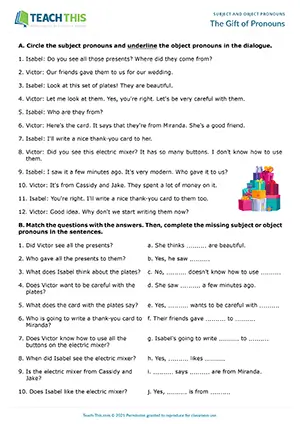
The Gift of Pronouns

Pre-intermediate (A2) 30 minutes
ESL subject and object pronouns worksheet preview for A2 showing dialogue, matching, gap-fill, and reading comprehension

ESL Subject and Object Pronouns Worksheet - Vocabulary and Reading Exercises: Identifying, Matching, Gap-fill, Answering Questions, Forming Sentences

In this useful subject and object pronouns worksheet, students identify and practice using subject and object pronouns. Students start by circling subject...

ESL Subject and Object Pronouns Worksheet - Vocabulary and Reading Exercises: Identifying, Matching, Gap-fill, Answering Questions, Forming Sentences In this useful subject and object pronouns worksheet, students identify and practice using subject and object pronouns. Students start by circling subject pronouns and underlining object pronouns in a dialogue. Next, students match questions with answers and then complete missing subject or object pronouns in the sentences. In the last exercise, students read a text and answer questions in sentence form using one subject pronoun and one object pronoun in each answer.

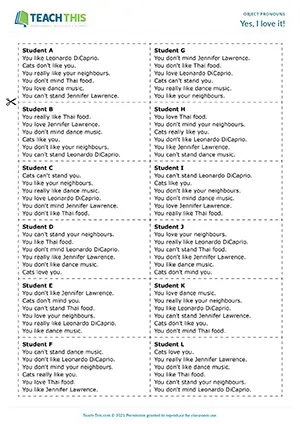
Yes, I love it!

Pre-intermediate (A2) 20 minutes
ESL object pronouns activity preview for A2 showing group and pair work for finding common likes and dislikes

ESL Object Pronouns Activity - Vocabulary and Speaking: Asking and Answering Questions - Group and Pair Work

In this engaging object pronouns speaking activity, students ask questions about likes and dislikes and reply using object pronouns in order to find someone who has the same likes and dislikes. First...

ESL Object Pronouns Activity - Vocabulary and Speaking: Asking and Answering Questions - Group and Pair Work In this engaging object pronouns speaking activity, students ask questions about likes and dislikes and reply using object pronouns in order to find someone who has the same likes and dislikes. First, students look at their likes and dislikes card and then go around asking questions to their classmates to find the person who has the same likes and dislikes as them, e.g. 'Do you like Thai food?' When a student asks a question, their classmate looks at the likes and dislikes on their card and answers using an appropriate object pronoun, e.g. 'No, I don't like it.' If a classmate responds with the same like or dislike as the student asking the question (e.g. 'Yes, I love it.'), the two students take turns asking questions to see if all their likes and dislikes match. If so, the two students sit down together. If not, the students move on to speak to someone else. Afterwards, pairs give feedback to the class on the likes and dislikes they have in common.

Appropriate Answers

Intermediate (B1) 30 minutes
ESL subject and object pronouns activity preview for B1 showing pair work, gap-fill, and matching

ESL Subject and Object Pronouns Activity - Vocabulary and Speaking: Asking and Answering Questions, Matching, Gap-fill - Pair Work

In this intriguing subject and object pronouns speaking activity, students answer questions by finding the correct response on a worksheet and completing...

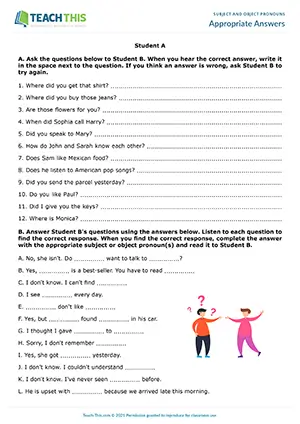
ESL Subject and Object Pronouns Activity - Vocabulary and Speaking: Asking and Answering Questions, Matching, Gap-fill - Pair Work In this intriguing subject and object pronouns speaking activity, students answer questions by finding the correct response on a worksheet and completing it with an appropriate subject or object pronoun. Student A begins by asking their first question to Student B who listens and tries to find the correct response on their worksheet. When Student B finds the correct response, they complete the answer with the appropriate subject or object pronoun and read it back to their partner. If Student A agrees the answer is correct, they write the response in the space next to the question. If Student A thinks an answer is wrong, they ask Student B to try again. When all the questions have been answered, students swap roles. Finally, check the correct answers with the class by having students read out their responses.

Understanding Subject and Object Pronouns

Subject pronouns replace the noun that performs the action in a sentence, so 'John called me' becomes 'He called me.' Object pronouns replace the noun that receives the action, so 'I called John' becomes 'I called him.' When students swap one for the other, the sentence either breaks grammatically or reverses its meaning entirely: 'Him called I' is ungrammatical, and 'Me saw them' signals to any reader that the student has not yet grasped how English sentences are built.

This page covers subject and object pronouns across A1, A1-A2, A2, and B1 levels, with 14 resources spanning worksheets, card games, speaking activities, and bingo, including two activities available as free downloads.

The table below shows each subject pronoun alongside its corresponding object pronoun, with an example sentence illustrating both forms.

PersonSubject PronounObject PronounExample
First person singular I me 'I saw the manager, and the manager spoke to me.'
Second person you you 'You left a message, and I replied to you.'
Third person singular masculine he him 'He called the office, and the office called him back.'
Third person singular feminine she her 'She wrote the report, and the director praised her.'
Third person singular neutral it it 'It arrived this morning, and we signed for it.'
First person plural we us 'We made a complaint, and they responded to us.'
Third person plural they them 'They asked a question, and the teacher answered them.'

When to Use Subject and Object Pronouns

Avoiding Repetition of Names: Speakers and writers switch to pronouns after the first mention of a person to stop the same name repeating through a sentence or paragraph, keeping the text flowing naturally, as in 'Sarah arrived late because she missed the bus and nobody had told her about the change.'

Showing Who Does What in a Description: Subject pronouns make clear who performs each action when a description involves more than one person, preventing confusion about roles, as in 'He finished first, then she checked his work and they submitted it together.'

Referring Back to Something Already Mentioned: Object pronouns let speakers refer back to something already named without repeating the full noun, keeping responses concise and natural in conversation, as in 'Have you seen the report? Yes, I read it this morning.'

3-Step Framework for Teaching Subject and Object Pronouns

1. Start With Recognition Before Production: Give students a text or set of sentences and ask them to identify which pronouns are subjects and which are objects before they write anything themselves. Then have them rewrite sentences by swapping underlined nouns for the correct pronoun form. Closing with a short story gap-fill lets students see how the two sets work together in continuous text.

2. Lock In the Pairs With a Memory Game: Once students can identify the two sets, run a pelmanism game where they match subject pronoun picture cards to object pronoun word cards. The matching rule is simple: a subject pronoun picture must pair with its corresponding object pronoun word card, which means students actively process the relationship between the two forms every time they flip a card, not just recognize them in isolation.

3. Push for Spontaneous Output: Set students a writing task where they describe five classmates using only pronouns, with no names allowed in the sentences. Then have them read their sentences aloud while the class tries to guess who each sentence is about. The guessing element creates a genuine communicative reason to use pronouns accurately, because a wrong pronoun sends the class to the wrong person.

Common Mistakes with Subject and Object Pronouns

Using an Object Pronoun as a Sentence Subject: Students often use an object pronoun at the start of a sentence where a subject pronoun is required, particularly with first person forms in informal speech that then transfer incorrectly into writing. Wrong: 'Me and my friend went to the market.' Correct: 'My friend and I went to the market.'

Using a Subject Pronoun After a Preposition: Students often place a subject pronoun after prepositions such as 'for,' 'with,' 'to,' and 'between,' when English requires an object pronoun in that position. Wrong: 'This present is for she.' Correct: 'This present is for her.'

Common Questions About Teaching Subject and Object Pronouns

What is an effective worksheet for teaching subject and object pronouns?

The worksheet The Gift of Pronouns moves students from recognition to production across four exercises. Students first identify subject and object pronouns in a dialogue, then match questions to answers and complete gap-fills. In the final exercise, they read a text and answer comprehension questions using one subject pronoun and one object pronoun in each answer.

What is an engaging speaking activity for practicing subject and object pronouns?

In the activity Love it or hate it!, students sort people, places, and things into opinion categories, then ask their partner 'What do you think of...?' Replies use both subject and object pronouns together, for example 'I like him. He's really good.' Using real opinions about real people gives students a genuine reason to get the pronouns right.

What is a fun game for practicing subject and object pronouns?

Both pronoun types come into play at once in the game Subject Object Snap, which matches 'Do you like...?' question cards to answer cards that use subject and object pronouns. If the cards match, the first student to call 'Snap' scores a point. The fast format trains students to recognize correct pronoun use quickly rather than working through it slowly.

Become a Teach This Member

Get unlimited access to the full library, plus new resources added every week.

Unlimited Resource Access

Download from 3000+ worksheets, activities, and games.

Save 5+ Hours Weekly

Cut lesson prep time with ready-to-use resources, plus teacher notes and answer keys.

Trusted Professional Quality

Classroom-tested, editable resources created by experienced ESL professionals.

Fresh Content Weekly

Get 5 new resources added to the library each week.

Join Now Just $29.99 quarterly