
Getting to Know You ESL Activities, Games & Icebreakers
Do you have a secret?

ESL Getting to Know You Game - Speaking: Forming, Asking and Answering Questions, Freer Practice
In this intriguing getting to know you game, students discover secrets about their classmates by asking yes/no questions. First, students write secrets about themselves on cards. Each secret can be...
First Class Interview and Introduction
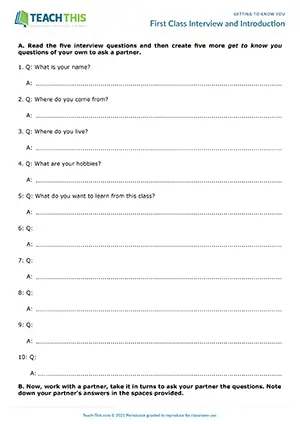
ESL First Day of Class Activity - Writing and Speaking: Writing, Asking and Answering Questions, Sentence Completion, Writing Sentences, Presenting - Pair Work
In this useful first day of class speaking activity, students write 'get to know you' questions to ask a new classmate and then interview them and use...
Getting to Know You Survey
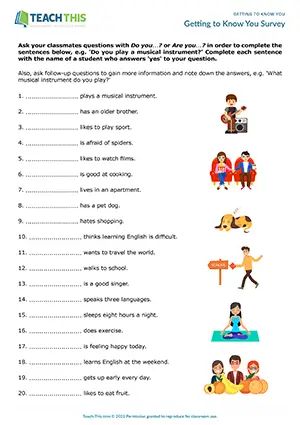
ESL Getting to Know You Activity - Grammar and Speaking: Forming, Asking and Answering Questions, Controlled and Freer Practice
In this free getting to know you speaking activity, students conduct a survey to get to know their classmates and find out information about them...
Introduce your Friend to the Class
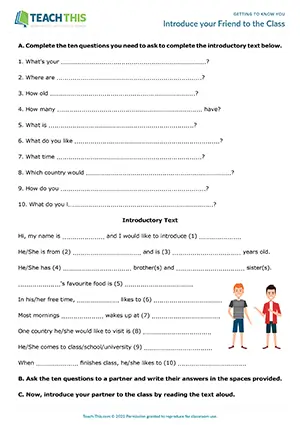
ESL First Day of Class Activity - Speaking: Completing, Asking and Answering Questions, Reading a Text, Presenting - Pair Work
Here is a productive first day of class speaking activity to help students get to know each other. In the activity, students complete an introductory text by...
Are we compatible?
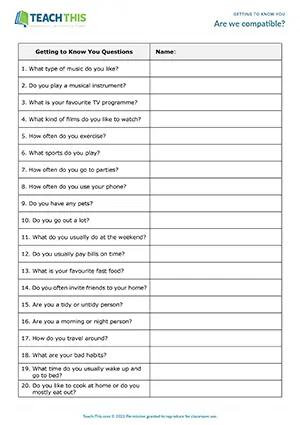
ESL Getting to Know You Activity - Speaking: Asking and Answering Questions, Comparing - Pair and Group Work
In this insightful getting to know you questions activity, students interview each other and share personal information to find people who would make compatible flatmates. In pairs, students take turns...
Can you tell me more?

ESL Icebreaker Activity - Speaking: Asking and Answering Questions, Communicative Practice - Pair Work
In this engaging getting to know you speaking activity, students practice asking for details to questions and making conversation. First, in two groups, students write short answers to questions in numbered...
Hello to Hangout
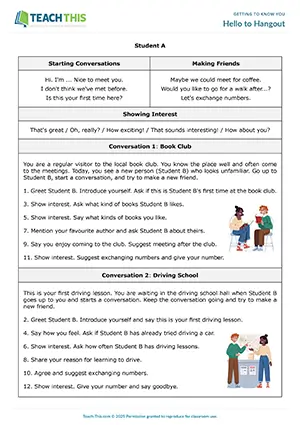
ESL Getting to Know You Activity - Vocabulary and Speaking: Gap-fill, Role-play, Asking and Answering Questions, Communicative Practice - Pair Work
In this productive getting to know you role-play, students practice starting conversations, showing interest, and making simple plans in everyday settings. Students...
The Question is...

ESL Getting to Know You Questions Game - Speaking: Forming Questions - Group Work
In this free getting to know you questions game, students race to make questions from answers given by other students. First, students read their question cards and complete sentences with answers that are true for them. Students then...
What do we have in common?

ESL Getting to Know You Activity - Speaking: Writing,Asking and Answering Questions, Communicative Practice
In this getting to know you speaking activity, students try to find things they have in common with their classmates by asking and answering 'getting to know you' questions. First, students read personal...
Assumptions

ESL Get to Know You Game - Speaking: Guessing, Writing, Asking and Answering Questions - Pair Work
In this light-hearted icebreaker game, students guess information about a partner and then form questions to ask them to find out the truth. Assign each student with a partner from the other...
Can You Spot My Lies?
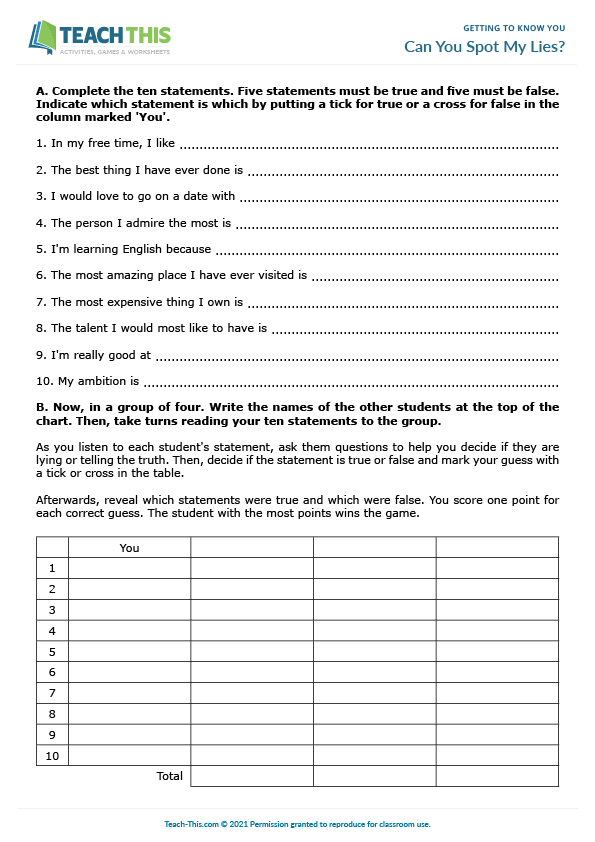
ESL Icebreaker Game - Speaking: True or False, Sentence Completion, Asking and Answering Questions - Group Work
In this free icebreaker game, students give true and false personal information and their classmates ask questions to help them decide if the information is true or false. First, students complete ten...
Pair Introductions
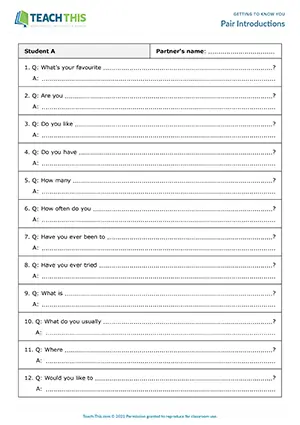
ESL First Day of Class Activity - Speaking: Completing, Asking and Answering Questions, Writing Sentences, Presenting - Pair Work
In this first day of class icebreaker activity, students create 'getting to know you' questions to ask a partner, interview them and use the information to...
Shapes of You
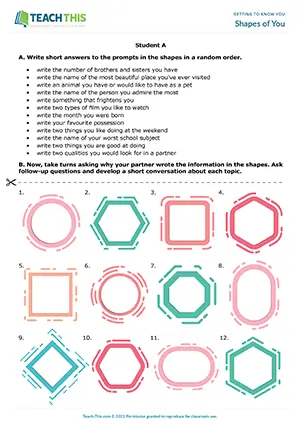
ESL Getting to Know You Activity - Speaking: Asking Questions, Explaining, Discussion - Pair Work
In this interesting getting to know you speaking activity, students ask questions and develop short conversations in order to get to know a partner. Students begin by writing short answers to prompts...
Shared Interests

ESL Getting to Know You Board Game - Speaking: Asking and Answering Questions, Forming Sentences, Freer Practice - Pair and Group Work
In this engaging getting to know you board game, students practice asking questions and making true statements with 'both of us' or 'neither of us' about things...
Tell Us About...
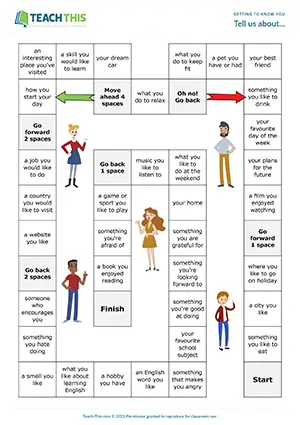
ESL Getting to Know You Board Game - Speaking: Impromptu Speech, Asking Questions, Free Practice - Group Work
This fun getting to know you board game can be used as an icebreaker activity on the first day of class to help students talk about themselves and become acquainted with one another. Students take...
That's Interesting!
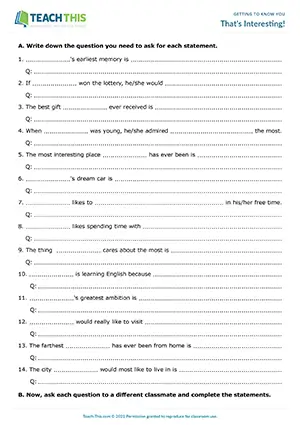
ESL First Day of Class Activity - Speaking: Forming, Asking and Answering Questions, Sentence Completion, Discussion
Here is an enjoyable getting to know you speaking activity for the first day of class to help students find out interesting information about one another. First, students read incomplete statements and...
Prepositions in Common

ESL Getting to Know You Activity - Grammar and Speaking: Gap-fill, Asking and Answering Questions, Controlled and Freer Practice - Group and Pair Work
Here is a creative getting to know you activity to help students get to know a classmate and practice dependent prepositions at the same time. First, in two groups...
Tell the group about...
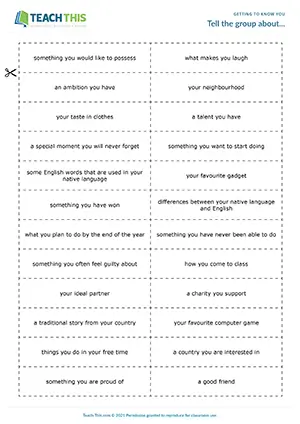
ESL Getting to Know You Game - Speaking: Impromptu Speech, Fluency Practice - Group Work
In this rewarding getting to know you game, students talk about various topics for one minute to help them get to know each other and improve fluency. In groups, students take turns picking up a card...
The A to Z of You
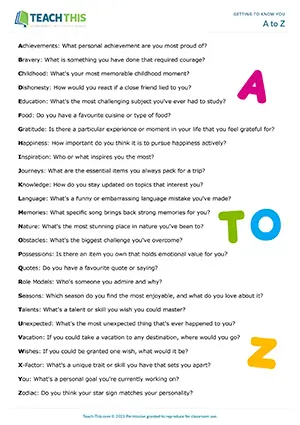
ESL Getting to Know You Activity - Speaking: Asking and Answering Questions, Guided Discussion - Group Work
This memorable getting to know you activity can be used as an icebreaker on the first day of class. In groups, students take turns picking up an alphabet card and reading the corresponding topic and...
Using Getting to Know You Language
Getting to know you language is the set of questions and phrases that lets speakers start conversations with new people, show interest in what they say, and keep a conversation going beyond a first exchange. Students who only know 'What is your name?' and 'Where are you from?' hit a wall almost immediately, while a wider set of questions and conversation phrases lets them build real rapport in English from the very first lesson.
This page covers getting to know you questions and phrases across four levels from A1 to B2, with 19 activities ranging from icebreaker games and surveys to role-plays and fluency challenges, with two free downloads.
The table below shows common getting-to-know-you situations alongside the speaker role and a typical example phrase.
| Situation | Speaker | Example Phrase |
|---|---|---|
| Starting a conversation | New acquaintance | 'So, how do you know the hosts here?' |
| Showing interest | Listener | 'That's great that you lived in Tokyo. What was it like?' |
| Asking for more detail | Listener | 'Tell me more about that. How long did it take?' |
| Finding things in common | Either speaker | 'No way! I love hiking too.' |
| Keeping the conversation going | Either speaker | 'Anyway, do you have any plans for the weekend?' |
How to Use Getting to Know You Phrases
Starting a Conversation: Open with a simple question tied to your shared context rather than a generic opener, as in 'So, how do you know the hosts here?' — it gives the other person something specific to respond to and gets the conversation moving immediately.
Showing Genuine Interest: Follow up any short answer with a question that asks for more detail, as in 'That's great that you lived in Tokyo. What was it like?' — this signals you are actually listening and keeps the other person talking naturally.
Keeping the Conversation Going: When a topic runs dry, introduce a new subject with a light transition question rather than letting silence build, as in 'Anyway, do you have any plans for the weekend?' — this moves things forward without making the conversation feel forced.
3-Step Framework for Teaching Getting to Know You Language
1. Get Everyone Talking Straight Away: Open with a mingle survey that gets everyone on their feet and talking straight away. Students move around the class asking questions with 'Do you...?' or 'Are you...?' to complete statements on their worksheet. When a classmate says yes, the student notes their name and asks a follow-up question to get more detail. It is the simplest possible structure for maximum student interaction in minimum time.
2. Push Students to Go Deeper: Move to a paired activity that pushes students beyond basic questions and answers. Students write short personal answers in shapes in a random order, then swap sheets with a partner who has to ask why each piece of information was written, for example 'Why did you write Spain in shape number 2?' That 'why' question is the key: it forces genuine explanation and opens up a real conversation rather than a simple exchange of facts.
3. Build Fluency Under Pressure: Finish with a fluency challenge where students pick a card and talk about the topic on it continuously for one minute. The pressure is real: if a student hesitates too often, repeats information, or stops talking before the time is up, they do not score anything. That scoring rule keeps every student focused and turns a speaking activity into something students genuinely want to do well at.
Common Mistakes with Getting to Know You Questions
Confusing 'Interesting' and 'Interested': Students often say 'Are you interesting in...?' instead of 'Are you interested in...?', confusing the two participial adjective forms because both sound similar and the distinction is not obvious to learners. Wrong: 'Are you interesting in travelling?' Correct: 'Are you interested in travelling?'
Translating 'What is your job?' Directly: Students often produce a grammatically literal question about profession by translating from their first language, when the natural English way to ask this in conversation is a fixed functional phrase. Wrong: 'What is your job?' Correct: 'What do you do?' or 'What do you do for a living?'
Common Questions About Getting to Know You Language
What is a fun game for the first day of class?
The free game True or False? has students complete ten personal statements, five true and five false, then read them aloud to the group. The others ask questions to work out who is lying and score a point for each correct guess, which means everyone has a real reason to listen from the very first round.
What is a useful activity for teaching students how to start a conversation?
Students who need practice with conversation-starting phrases get the most from the activity Hello to Hangout. They complete a getting-to-know-you dialogue using phrases for starting conversations, showing interest, and making simple plans, then act out two role-plays, one set in a book club and the other at a driving school.
What is an engaging board game for the first day of class?
In the board game Shared Interests, two teams race to find something they have in common and be the first to say it correctly in a sentence using 'both of us' or 'neither of us.' If a team makes a grammar mistake, the other team can steal the point, which keeps every student alert and competing right to the finish.
Become a Teach This Member
Get unlimited access to the full library, plus new resources added every week.
Unlimited Resource Access
Download from 3000+ worksheets, activities, and games.
Save 5+ Hours Weekly
Cut lesson prep time with ready-to-use resources, plus teacher notes and answer keys.
Trusted Professional Quality
Classroom-tested, editable resources created by experienced ESL professionals.
Fresh Content Weekly
Get 5 new resources added to the library each week.
Here's what our members are saying...


