Cause-and-Effect Chains

Intermediate (B1) 50 minutes
EAP Cause-and-Effect Essays AQctivity preview for Intermediate B1: matching, guided discussion, table completion, writing a paragraph, pair work

EAP Cause-and-Effect Paragraphs Activity - Speaking and Writing: Matching, Guided Discussion, Table Completion, Writing a Paragraph - Pair Work

In this cause-and-effect paragraphs activity, students organise ideas about everyday issues and use them to write a clear, coherent cause-and-effect paragraph...

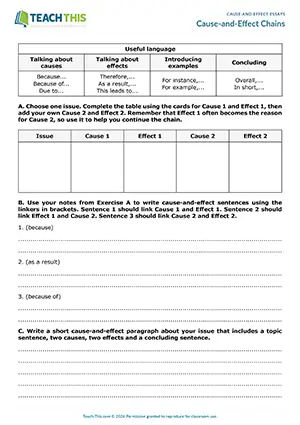
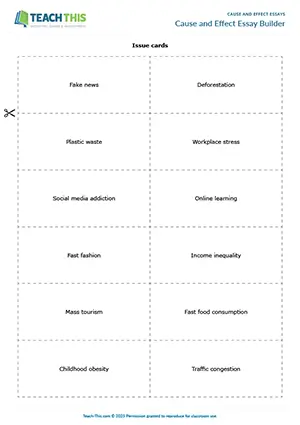
EAP Cause-and-Effect Paragraphs Activity - Speaking and Writing: Matching, Guided Discussion, Table Completion, Writing a Paragraph - Pair Work In this cause-and-effect paragraphs activity, students organise ideas about everyday issues and use them to write a clear, coherent cause-and-effect paragraph. First, in pairs, students match each issue with the most logical cause and effect to make eight cause-and-effect sets. Working alone, students then choose one issue they want to write about and complete a table using the cards for Cause 1 and Effect 1, then add their own Cause 2 and Effect 2. After that, students use their notes to write three cause-and-effect sentences using the linkers provided. Finally, students use their notes and sentences to write a short cause-and-effect paragraph about their chosen issue.

Cause-and-Effect Connections

Intermediate (B1) 45 minutes
EAP Cause-and-Effect Worksheet preview for Intermediate B1: matching, categorising, binary choice, gap-fill, table completion, writing sentence pairs

EAP Cause-and-Effect Signal Words Worksheet - Vocabulary and Writing Exercises: Categorising, Binary Choice, Table Completion, Writing Sentence Pairs

In this cause-and-effect signal words worksheet, students explore how everyday changes lead to results and practice linking ideas with clear cause-and...

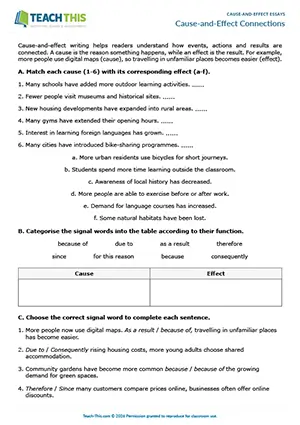
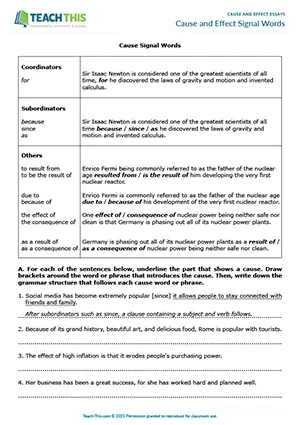
Cause-and-Effect Signal Words Worksheet - Vocabulary and Writing Exercises: Matching, Categorising, Binary Choice, Gap-fill, Table Completion, Writing Sentence Pairs In this cause-and-effect signal words worksheet, students explore how everyday changes lead to results and practice linking ideas with clear cause-and-effect signal words. First, students match six causes with their corresponding effects. Students then categorise signal words that show cause or effect. Next, students choose the correct signal word to complete each sentence. After that, students complete sentences using suitable signal words from Exercise B. In pairs, students then discuss possible effects for four causes and complete a table with their partner. Following that, working alone, students choose two cause-and-effect pairs from Exercise E and write one or two sentences for each pair using at least one signal word. Finally, students review their work using a checklist and make any necessary corrections.

From Reasons to Results

Intermediate (B1) 45 minutes
EAP Cause-and-Effect Essays Worksheet preview for Intermediate B1: matching, identifying, binary choice, gap-fill, table completion, paragraph writing, discussion, freer practice, pair work

EAP Cause-and-Effect Paragraph Worksheet - Reading, Vocabulary and Writing Exercises: Identifying, Paragraph Writing - Speaking Activity: Discussion - Pair Work

In this comprehensive cause-and-effect paragraph worksheet, students identify causes and effects, practice using signal words, and write a short...

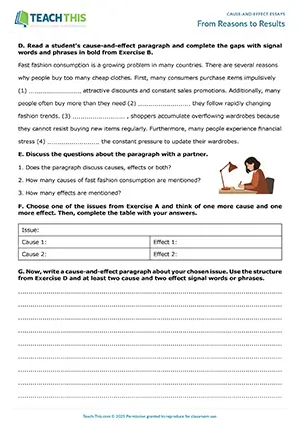
EAP Cause-and-Effect Paragraph Worksheet - Reading, Vocabulary and Writing Exercises: Matching, Identifying, Binary Choice, Gap-fill, Table Completion, Paragraph Writing - Speaking Activity: Discussion, Freer Practice - Pair Work In this comprehensive cause-and-effect paragraph worksheet, students identify causes and effects, practice using signal words, and write a short cause-and-effect paragraph. First, students read information about cause-and-effect essays. Students then match one cause and one effect from a box to each issue. Next, students look at words and phrases in bold and mark each sentence as showing cause or effect. After that, students underline the correct signal word or phrase in each sentence. Students then read a student's cause-and-effect paragraph and complete the gaps with signal words or phrases. Following that, students discuss three questions about the paragraph with a partner. Next, students complete a table by choosing an issue from Exercise A and thinking of another cause and another effect. Finally, students write a cause-and-effect paragraph about the issue they chose, using the structure of the previous paragraph and at least two cause and two effect signal words or phrases.

Block Pattern Cause-and-Effect Essays
Upper-intermediate (B2) 90 minutes
EAP Cause-and-Effect Essays Worksheet preview for Upper-intermediate B2: block structure, categorising, gap-fill, outlining, essay writing, peer review

EAP Block Structure Cause-and-Effect Essay Worksheet - Writing Exercises: Categorising, Gap-fill, Identifying, Listing, Creating an Essay Outline, Writing an Essay

In this useful block structure cause-and-effect essay worksheet, students are introduced to cause-and-effect essay block structure and attempt a cause-and-effect...

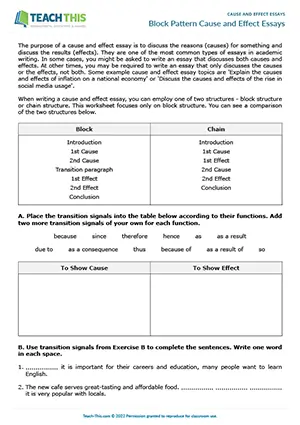
EAP Block Structure Cause-and-Effect Essay Worksheet - Writing Exercises: Categorising, Gap-fill, Identifying, Listing, Creating an Essay Outline, Writing an Essay, Peer Review In this useful block structure cause-and-effect essay worksheet, students are introduced to cause-and-effect essay block structure and attempt a cause-and-effect essay writing practice. First, students read a description of cause-and-effect essays and compare two structures for organising a cause-and-effect essay - block structure and chain structure. Students then arrange transition signals in cause-and-effect essays according to their functions and complete two sentences with the transition signals. After that, students read an example essay and underline all the transition signals. Next, with a partner, students discuss and list the possible causes and effects of three issues. Students then move on to choose one issue and create a cause-and-effect essay outline. Following that, students use the outline to write their own cause-and-effect essay. Finally, students swap their essay with another student and do a peer review.

Burnout

Upper-intermediate (B2) 90 minutes
EAP Cause-and-Effect Essays Worksheet preview for Upper-intermediate B2: burnout, reading, gap-fill, outlining, essay writing, group work

EAP Block Structure Cause-and-Effect Essay Worksheet - Reading and Writing Exercises: Gap-fill, Writing an Outline and Essay - Speaking Activity: Discussion - Group Work

In this productive block structure cause-and-effect essay worksheet, students read a text on the topic of burnout and then plan and write a block-structure...

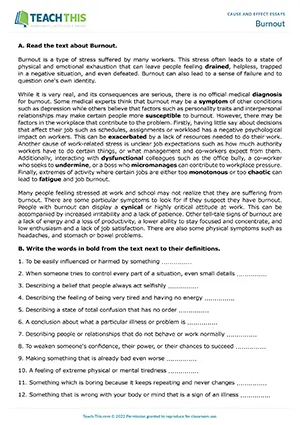
EAP Block Structure Cause-and-Effect Essay Worksheet - Reading and Writing Exercises: Matching, Gap-fill, Writing an Outline and Essay - Speaking Activity: Discussion - Group Work In this productive block structure cause-and-effect essay worksheet, students read a text on the topic of burnout and then plan and write a block-structure cause-and-effect essay about a health issue. Students start by reading a text on the topic of burnout. Students then match words in bold from the text to their definitions. Next, students complete advice about writing a cause-and-effect essay with the words provided. In small groups, students then choose another health issue and discuss its causes and effects and list them in a table. Working alone, students then use the list to prepare a cause-and-effect essay outline. After that, students use their outline to write a cause-and-effect essay about their chosen health issue. Lastly, students swap papers with a partner and use a checklist to review and provide feedback on their partner's essay.

Cause-and-Effect Essay Builder

Upper-intermediate (B2) 50 minutes
EAP Cause-and-Effect Essays Activity preview for Upper-intermediate B2: brainstorming, creating an essay outline, presenting, communicative practice, group work

EAP Cause-and-Effect Essay Outline Activity - Writing and Speaking: Brainstorming, Creating an Essay Outline, Presenting, Communicative Practice - Group Work

In this cause-and-effect essay outline activity, students brainstorm the causes and effects of an issue, create an essay outline based on block or point-by-point...

EAP Cause-and-Effect Essay Outline Activity - Writing and Speaking: Brainstorming, Creating an Essay Outline, Presenting, Communicative Practice - Group Work In this cause-and-effect essay outline activity, students brainstorm the causes and effects of an issue, create an essay outline based on block or point-by-point structure, and present it to the class. First, in groups, students brainstorm as many causes and effects as they can for an issue. Afterwards, groups review their lists, eliminate any weak or irrelevant ideas, decide on their three strongest causes and three strongest effects, and choose whether a point-by-point or a block structure best fits their issue and why. Groups then complete an essay outline by adding a thesis statement and a topic sentence for each paragraph, adhering to their chosen structure. Next, each group prepares and then presents the completed outline to the class, providing clear reasons why their chosen structure, block or point-by-point, is most effective for their specific issue. Finally, the class reviews the topics presented and notes which structure each group chose.

Cause-and-Effect Newsroom

Upper-intermediate (B2) 60 minutes
EAP cause-and-effect Essays Activity preview for Upper-intermediate B2: discussion, presenting, communicative practice, essay writing

EAP Cause-and-Effect Essay Writing Activity - Speaking and Writing: Discussion, Answering Questions, Communicative Practice, Essay Writing - Group Work

Here is an engaging cause-and-effect essay writing activity to help students practice identifying and explaining causes and effects of hypothetical events...

EAP Cause-and-Effect Essay Writing Activity - Speaking and Writing: Discussion, Presenting, Asking and Answering Questions, Communicative Practice, Essay Writing - Group Work Here is an engaging cause-and-effect essay writing activity to help students practice identifying and explaining causes and effects of hypothetical events and writing a short essay. First, in groups of three, students take on the role of an anchor, researcher and analyst, whose task it is to prepare a news report about a major hypothetical event. Students then read an event card and use prompts to brainstorm possible causes and effects of the event. Groups then complete a framework, prepare their news report and present it to the class, with each student presenting their assigned part. The other groups listen and act as fact-checkers, each asking a question to the presenting group after their report. Finally, students use their completed news report framework for a timed writing task in which they write a short four-paragraph cause-and-effect essay based on their group's event.

Cause-and-Effect Signal Words

Upper-intermediate (B2) 90 minutes
EAP Cause-and-Effect Essays Worksheet preview for Upper-intermediate B2: signal words, grammar, writing, outlining, essay writing

EAP Cause-and-Effect Signal Words Worksheet - Grammar and Writing Exercises: Identifying, Combining Sentences, Writing an Outline and Essay

In this free cause-and-effect signal words worksheet, students review and practice signal words that can be used in a cause-and-effect essay. Students...

EAP Cause-and-Effect Signal Words Worksheet - Grammar and Writing Exercises: Identifying, Combining Sentences, Writing an Outline and Essay In this free cause-and-effect signal words worksheet, students review and practice signal words that can be used in a cause-and-effect essay. Students start by previewing a table illustrating the usage of various cause signal words. Students then analyse sentences containing cause signal words, identifying the part of the sentence that introduces the cause, the cause signal word and the grammar structure that follows the cause signal. Next, students preview a table illustrating the usage of various effect signal words and repeat the same procedure as the first exercise. After that, students read sentence pairs and decide which expresses a cause and which expresses an effect. Students then combine the sentences using a suitable signal word. Next, students choose a topic and create a cause-and-effect essay outline. Finally, students use the outline to write a cause-and-effect essay to practice the cause-and-effect signal words from the worksheet.

Point-by-Point Cause-and-Effect Essays

Upper-intermediate (B2) 90 minutes
EAP Cause-and-Effect Essays Worksheet preview for Upper-intermediate B2: point-by-point structure, identifying, gap-fill, outlining, peer review, essay writing

EAP Point-by-Point Cause-and-Effect Essay Worksheet - Reading and Writing Exercises: Identifying, Gap-fill, Categorising, Creating an Outline, Peer Review, Essay Writing

In this point-by-point cause-and-effect essay worksheet, students learn and practice point-by-point cause-and-effect essay structure. First, students discuss a...

EAP Point-by-Point Cause-and-Effect Essay Worksheet - Reading and Writing Exercises: Identifying, Gap-fill, Categorising, Matching, Creating an Outline, Peer Review, Essay Writing In this point-by-point cause-and-effect essay worksheet, students learn and practice point-by-point cause-and-effect essay structure. First, students discuss a cause-and-effect related question in pairs. Students then read an introduction explaining the difference between block and point-by-point cause-and-effect essay structure. Next, students read an example point-by-point cause-and-effect essay and then list the causes and effects mentioned. After that, students list two causes and two effects for three topics. Students then complete sentences with cause-and-effect signal words from a box and categorise them, according to their function. Following that, students match sentence halves to create topic sentences. Next, students choose a topic and complete a point-by-point cause-and-effect essay outline which is peer reviewed by a partner. After that, students give each other feedback and make any necessary changes to the outline. Finally, students use the outline to write a point-by-point cause-and-effect essay.

Understanding Cause-and-Effect Essays

A cause-and-effect essay explains why something happens, what results from it, or both. Writers need to organise these relationships clearly and support their explanations rather than assume that events occurring together establish a cause.

This page contains nine resources from intermediate (B1) to upper-intermediate (B2), including one free download. The materials develop paragraph writing, signal words, essay outlines, block and point-by-point organisation, drafting and peer review.

Use the reference below to connect each writing decision with its purpose. The examples illustrate language and organisation rather than provide evidence for a particular essay topic.

Writing focusPurposeExample or guidance
Introduce a cause Explain why something happened 'The event was cancelled because the venue was unavailable.'
Introduce a cause with a noun phrase Use the structure required by the expression 'The event was cancelled because of a booking error.'
Introduce an effect Explain a result 'The venue was unavailable. As a result, the event was cancelled.'
Use block organisation Group the discussion of causes and effects into separate sections Explain the main causes before moving to the resulting effects, with clear links between the sections.
Use point-by-point organisation Discuss related causes and effects together Develop one cause and its associated effect before moving to the next relevant relationship.
Qualify a causal claim Match the strength of the explanation to the evidence 'May contribute to' can express a possible influence when the evidence does not establish a definite cause.

How to Develop Cause-and-Effect Essays

Check the direction of each relationship: Ask students to identify what happens first and explain how it could lead to the result. Distinguish an actual explanation from a list of events, and ask what information would support the proposed connection.

Choose organisation to suit the ideas: Compare a plan that groups causes and effects separately with one that discusses related points together. Ask students to justify their choice based on their topic and assignment rather than treat one structure as compulsory.

Teach signal words with their grammar: Model the difference between 'because' followed by a clause and 'because of' followed by a noun phrase. Check sentence boundaries and meaning as well as the expression itself; adding a linker does not repair an unsupported relationship.

3-Step Framework for Teaching Cause-and-Effect Essays

Build from supported paragraph work to extended essay writing across lessons. The paragraph stages suit intermediate students, while the full essay stage is intended for upper-intermediate students who are ready to organise and develop a longer text.

1. Select and connect ideas: Students match issues with logical causes and effects, then choose an issue and organise notes in a table. They add another cause and effect of their own before forming linked sentences. Discuss the reasoning behind each connection before students develop it into a paragraph.

2. Develop a coherent paragraph: Students examine a model paragraph, complete missing signal words and discuss how its ideas connect. They then plan and write their own paragraph using the model as support. Check that the paragraph explains the relationships rather than merely naming causes and effects.

3. Extend the plan into an essay: Students compare essay structures, examine a model and identify its transition signals. After discussing possible causes and effects of an issue, they prepare an outline and write an essay. Peer review provides a final opportunity to check organisation, clarity and the support for each main point.

Common Mistakes with Cause-and-Effect Essays

Treating sequence as proof of causation: One event happening after another does not, by itself, show that the first caused the second. In a hypothetical example, Unsupported conclusion: 'Attendance increased after the timetable changed, so the change caused the increase.' More cautious interpretation: 'Attendance increased after the timetable changed, but further evidence is needed to determine whether the change contributed to the increase.'

Using a clause after 'because of': Use 'because' before a subject and verb, or 'because of' before a noun phrase. Incorrect: 'The event was cancelled because of the venue was unavailable.' Correct: 'The event was cancelled because the venue was unavailable.' Another possible structure is 'The event was cancelled because of a problem with the venue.'

Common Questions About Teaching Cause-and-Effect Essays

How can I help students plan a cause-and-effect essay?

The activity Cause-and-Effect Essay Builder helps students select and organise ideas before writing. Groups brainstorm causes and effects, remove weak or irrelevant points and choose a suitable structure. They prepare an outline with a thesis statement and topic sentences, then present it and explain their organisational choices.

What free worksheet helps teach cause-and-effect signal words?

The worksheet Cause-and-Effect Signal Words connects linking expressions with the grammar that follows them. Students identify causes, effects and signal words in examples, then combine sentence pairs using suitable expressions. They finish by planning and writing an essay, applying the language beyond individual sentences in a complete piece of writing.

What activity helps students practice writing cause-and-effect essays?

The activity Cause-and-Effect Newsroom gives groups a hypothetical event to investigate through a news report. Students take different roles, discuss possible causes and effects and present their report. Classmates ask questions before students use the completed framework to write a short essay, moving from spoken explanations to organised writing.

Become a Teach This Member

Get unlimited access to the full library, plus new resources added every week.

Unlimited Resource Access

Download from 3000+ worksheets, activities, and games.

Save 5+ Hours Weekly

Cut lesson prep time with ready-to-use resources, plus teacher notes and answer keys.

Trusted Professional Quality

Classroom-tested, editable resources created by experienced ESL professionals.

Fresh Content Weekly

Get 5 new resources added to the library each week.

Join Now Just $29.99 quarterly