
Business Idioms Games, Activities & Worksheets
Bite the Bullet
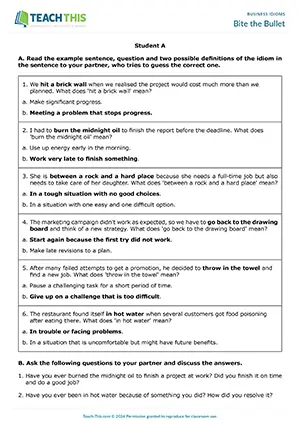
Business English Idioms Game and Activity - Vocabulary: Guessing - Speaking and Reading Activity: Answering Questions, Gap-fill, Freer Practice - Pair Work
In this engaging business idioms game and activity, students learn and practice idioms related to challenges and problems. First, in pairs, students take turns...
Hit the Nail on the Head

Business English Idioms Game - Vocabulary: Identifying, Guessing
In this free business idioms game, students guess idioms commonly used in business from sentences that describe their meaning. To begin, write the business idioms from the cards on the board. In pairs, students then take turns picking up a card...
Business Idioms in Action
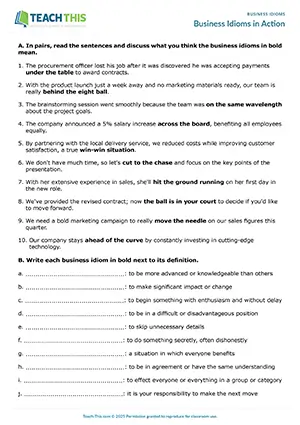
Business English Idioms Worksheet - Reading, Writing and Vocabulary Exercises: Writing a Dialogue - Speaking Activities: Role-Play, Freer Practice - Pair Work
In this comprehensive business idioms worksheet, students learn and practice ten idioms commonly used in business. First, in pairs, students read sentences...
Competition Idioms

Business English Idioms Games - Vocabulary: Matching, Gap-fill, Guessing - Group and Pair Work
Here are two fun business idioms games to help students practice idioms related to competition. To begin, students play a game of dominoes to practice the competition idioms. In groups the first...
Financial Idioms

Business Idioms Worksheet - Vocabulary Exercises: Identifying, Matching - Speaking Activity: Asking and Answering Questions - Vocabulary Game: Gap-fill - Group Work
In this useful business idioms worksheet and game, students learn and practice some common financial idioms. Students begin by identifying and underlining...
Talk the Talk
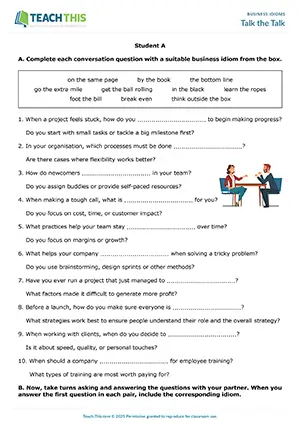
Business English Idioms Activity - Vocabulary and Speaking: Gap-fill, Asking and Answering Questions, Controlled and Freer Practice - Group and Pair Work
In this insightful business idioms activity, students complete, ask and answer conversation questions containing useful idioms. First, in two groups...
Using Business Idioms
Business idioms are expressions used in workplace communication whose meaning cannot always be understood from the individual words. Learning them helps students interpret colleagues' messages and choose expressions that fit the situation, while recognising when a plain-language alternative would be clearer.
This page contains six resources across B2 and C1, including worksheets, games and speaking activities, with one free game.
The table shows idioms with their meanings and hypothetical workplace examples.
| Idiom | Meaning | Example |
|---|---|---|
| bite the bullet | Accept and do something difficult or unpleasant that needs doing. | 'We need to bite the bullet and replace the outdated system.' |
| cut corners | Skip proper steps to save time, effort or money, often reducing quality. | 'We cannot cut corners on the product checks.' |
| hit the nail on the head | Identify or describe something exactly right. | 'You hit the nail on the head when you identified the scheduling problem.' |
| be on the same page | Share an understanding of a situation or plan. | 'Let's confirm the priorities so we are on the same page.' |
| get the ball rolling | Start an activity or process. | 'I'll arrange an initial meeting to get the ball rolling.' |
When to Use Business Idioms
Interpret meaning from the situation: Ask students what the speaker intends rather than translate each word separately. For example, a colleague who says 'Let's get the ball rolling' is proposing a start, not discussing a physical ball.
Consider the audience: An idiom may work well among colleagues familiar with it. When understanding is uncertain, especially in instructions or important decisions, choose a direct alternative such as 'Let's begin' or explain the expression.
Keep the message more important than the expression: Use an idiom when it communicates the intended meaning naturally. Avoid adding several merely to sound fluent, and check whether its implications fit, such as the criticism often conveyed by 'cut corners'.
3-Step Framework for Teaching Business Idioms
The first two stages use different parts of a B2 activity about challenges and problems. A C1 financial-idioms resource extends contextual recall, with another C1 option for learners ready to work on competition idioms.
1. Infer Meaning from Context: Pairs read example sentences and possible definitions to each other, then guess the meaning of each idiom. Comparing the choices connects the expression with a situation before students need to produce it themselves.
2. Use and Recall the Expressions: Students discuss questions containing the idioms, complete a story with the expressions in their correct forms and then hide the answers to retell it. This moves from supported discussion to recalling the language within a connected account.
3. Apply Idioms to New Sentence Contexts: With financial idioms, students identify expressions, match meanings and discuss questions before racing to complete spoken sentence gaps. For a C1 extension, use competition-idiom dominoes followed by a task in which students repeat sentences with correctly formed idioms. These tasks check whether students can select and adapt an expression to fit its context.
Common Mistakes with Business Idioms
Changing a fixed part of an expression: Some words and prepositions belong to the established idiom. Incorrect: 'We are in the same page.' Correct: 'We are on the same page.'
Using an idiom with the wrong implication: Cutting corners suggests omitting proper steps, not simply working efficiently. Misleading praise: 'The team cut corners by organising the files carefully.' Clearer meaning: 'The team saved time by organising the files carefully.'
Common Questions About Teaching Business Idioms
What free game helps students practice business idioms?
The game Hit the Nail on the Head asks students to replace a plain-language phrase in a sentence with a business idiom. Partners read clues aloud, and students repeat each sentence using an idiom from the board. Correct answers win cards, linking the idiom's meaning with its use in a complete sentence.
What worksheet helps teach business idioms?
The worksheet Business Idioms in Action develops ten idioms through contextual sentences, definition matching and scenarios. Pairs then create a workplace dialogue that demonstrates an assigned idiom without saying it. Classmates watch the role-play and guess the expression, so students need to show its meaning through a situation rather than simply recite a definition.
What speaking activity helps students practice business idioms?
The activity Talk the Talk has students complete conversation questions with business idioms before pairing with someone from another group. They ask and answer the questions, using the corresponding idiom in their response to the first question in each pair. Reporting their findings afterwards adds a further purpose to the conversation.
Become a Teach This Member
Get unlimited access to the full library, plus new resources added every week.
Unlimited Resource Access
Download from 3000+ worksheets, activities, and games.
Save 5+ Hours Weekly
Cut lesson prep time with ready-to-use resources, plus teacher notes and answer keys.
Trusted Professional Quality
Classroom-tested, editable resources created by experienced ESL professionals.
Fresh Content Weekly
Get 5 new resources added to the library each week.
Here's what our members are saying...


