
Prefixes ESL Games, Worksheets & Activities
Prefix Professionals

ESL Prefixes Games - Vocabulary: Pelmanism, Matching
Here are two fun prefix games to help introduce pre-intermediate students to prefixes and root words. Students begin by playing a prefixes pelmanism game. In pairs, students take it in turns to turn over one prefix card and one root word card...
Ten Common Prefixes
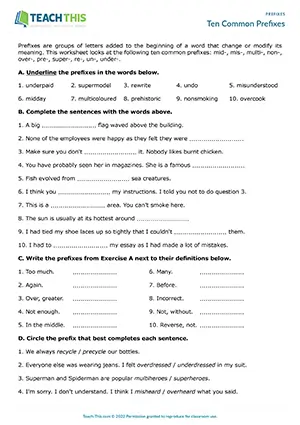
ESL Prefixes Worksheet - Vocabulary Exercises: Identifying, Gap-fill, Matching, Binary Choice - Speaking Activity: Asking and Answering Questions, Freer Practice
In this free prefixes worksheet, students learn and practice the ten common prefixes: under-, super-, re-, mis-, un-, mid- multi-, pre-, non-, over-. First, students...
Find Someone Who...
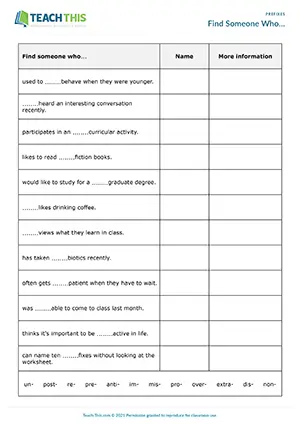
ESL Prefixes Activity - Speaking: Asking and Answering Questions, Controlled and Freer Practice
In this prefixes 'Find Someone Who' activity, students ask and answer yes/no questions containing words that use prefixes. Students start by completing the items on the worksheet with 12 prefixes...
Negative Prefixes

ESL Negative Prefixes Worksheet - Vocabulary Exercises: Word Search, Identifying, Matching, Writing Sentences
Here is a productive negative prefixes worksheet to help students practice the four negative prefixes: mis-, im-, dis-, in-. Students begin by finding 12 adjectives or verbs in a word search that have...
Prefix Dominoes
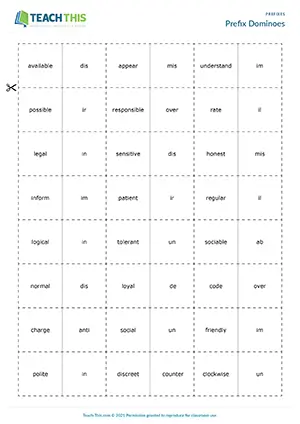
ESL Negative Prefixes Game - Grammar, Vocabulary and Speaking: Matching, Forming Sentences, Freer Practice
In this engaging negative prefixes game, students match prefixes that have an opposite or negative meaning to words. The first player puts down one of their dominoes, making sure that the prefix or word on...
Prefix Practice
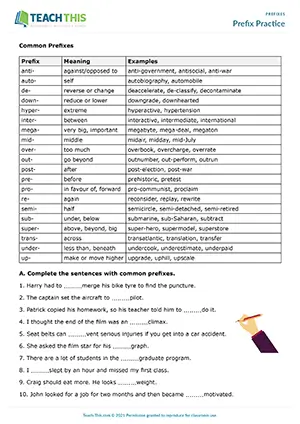
ESL Prefixes Worksheet - Vocabulary Exercises: Gap-fill, Adding Prefixes, Providing Antonyms
This comprehensive prefixes worksheet helps students to learn and practice common and negative prefixes. First, students read through the common prefixes and examples table. Students then complete a set...
What's the word?
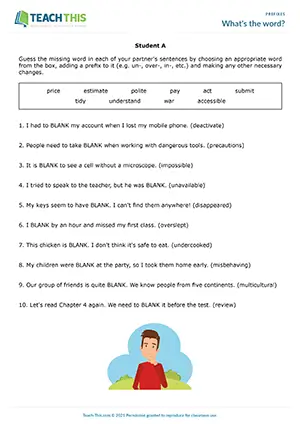
ESL Prefixes Game - Vocabulary: Adding Prefixes to Words, Gap-fill
In this entertaining prefixes game, students listen to sentences with missing words and complete them by choosing suitable words and adding prefixes to them. Students take it in turns to read the first sentence on their worksheet to their partner...
Prefix Puzzle
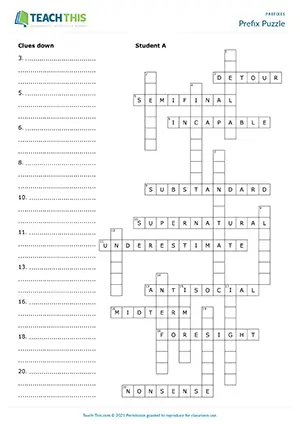
ESL Prefixes Activity - Grammar and Vocabulary: Writing Crossword Clues, Defining, Guessing
Here is a creative prefixes crossword activity to help students practice 20 of the most common prefixes. In two groups, students define and write down clues for the words written on their crossword...
Understanding Prefixes
Prefixes are letters or groups of letters added to the front of a word to change its meaning, such as adding 'un-' to 'happy' to get 'unhappy', or 're-' to 'write' to get 'rewrite'. Students who guess at prefixes rather than learn the common ones regularly produce non-words or choose the wrong negative form, which makes their writing harder to understand and signals a weak vocabulary range to any reader.
This page covers prefixes across B1, B2, and C1 levels, with eight activities ranging from pair card games and a class mingle to a crossword task, including one free download.
Unlike grammar structures, prefixes do not follow a tense-based pattern, but knowing the most common ones and what they mean gives students a reliable tool for expanding vocabulary in any direction. The table below shows twelve common prefixes, their meanings, and example words and sentences to show how each one works.
| Prefix | Meaning | Example Word | Example Sentence |
|---|---|---|---|
| un- | not / opposite | unhappy | 'She was unhappy with the result.' |
| re- | again | rewrite | 'He had to rewrite the report.' |
| mis- | wrongly | misunderstand | 'Students often misunderstand this rule.' |
| pre- | before | preview | 'Watch the preview before the film starts.' |
| over- | too much | overwork | 'Try not to overwork yourself before the exam.' |
| under- | too little / below | underestimate | 'Don't underestimate how long the task will take.' |
| dis- | not / opposite | disagree | 'I disagree with that decision.' |
| im- / in- | not | impossible / incorrect | 'That answer is incorrect.' |
| super- | above / beyond | supernatural | 'The story had a supernatural element.' |
| multi- | many | multilingual | 'She is multilingual and speaks four languages.' |
| non- | not | non-fiction | 'He prefers non-fiction to novels.' |
| mid- | middle | midnight | 'The deadline is midnight tonight.' |
When to Use Prefixes
Reversing or repeating an action: Writers use the prefix re- when they want to signal that an action is being done again, avoiding an extra clause and keeping the sentence tight, as in 'The contract was renegotiated after both sides raised concerns.'
Expressing disagreement politely: Speakers reach for negative prefixes like dis- or un- when they want to push back on an idea without sounding blunt, as in 'I find that approach somewhat unconventional' rather than saying 'I think that approach is wrong.'
Indicating scale or degree: Prefixes like over-, under-, and super- let writers express quantity or degree in a single word rather than a whole phrase, as in 'The project was underfunded from the start' instead of 'The project did not have enough money from the start.'
3-Step Framework for Teaching Prefixes
1. Build Recognition Through Matching: Start with a hands-on card game that gets students physically handling prefixes and root words as separate pieces. Pairs take turns flipping one prefix card and one root word card and reading them aloud to test whether they combine into a real word. Then add a snap round to sharpen accuracy: if a student calls 'Snap' when the cards don't actually match, the other player scores the point, so students have to think before they shout.
2. Move Into Real Communication: Once students can recognize and form prefixed words, push them into genuine conversational use with a mingle activity. Students first fill in worksheet items with a set of prefixes and then prepare the yes/no questions they will need to ask. They circulate around the class, posing questions that contain prefixed words and noting down names and follow-up answers as they go.
3. Deepen Understanding Through Definition: At a more advanced level, raise the stakes by asking students to demonstrate what they know about each prefix, not just the word it creates. In a crossword activity, students write clues for their own set of prefixed words, specifying the part of speech and explaining what the prefix itself means, for example 'It's an adjective. The prefix means opposite.' Partners use those clues to guess the missing words, which pushes students to think precisely about how prefixes carry meaning.
Common Mistakes with Prefixes
Choosing the wrong negative prefix: Students often use 'un-' as a default negative prefix for all words, even when the correct form requires 'im-', 'in-', or 'dis-', because they have not yet learned which prefix attaches to which root. Wrong: 'That behavior was very unpolite.' Correct: 'That behavior was very impolite.'
Over-generalizing a prefix to words that don't accept it: Students often attach a familiar prefix to a new word by analogy with words they already know, without checking whether that combination exists in English. Wrong: 'She gave a very unsmart answer.' Correct: 'She gave a very unintelligent answer.'
Common Questions About Teaching Prefixes
What is a good worksheet for teaching prefixes?
The free worksheet Ten Common Prefixes covers ten prefixes systematically, moving students from identifying and gap-fill exercises through to completing and asking conversation questions with a partner. That progression from recognition to spoken production in a single worksheet is what makes it a strong teaching resource.
What is a fun game for teaching prefixes?
What makes the game Prefix Dominoes fun is that every turn has two moments of challenge. Players place a domino at either end of the chain to form a valid opposite or negative word, then immediately use that word in a sentence to earn a second point. Students have to both know the prefix and prove they can use it.
What is an interesting game for teaching prefixes?
The game What's the word? asks students to do more than recall a prefix. They listen to a sentence with a missing word, pick a base word from a box, add the right prefix, and adjust the form to fit the context. That three-step process is what makes it a more demanding and interesting activity than a standard gap-fill.
Become a Teach This Member
Get unlimited access to the full library, plus new resources added every week.
Unlimited Resource Access
Download from 3000+ worksheets, activities, and games.
Save 5+ Hours Weekly
Cut lesson prep time with ready-to-use resources, plus teacher notes and answer keys.
Trusted Professional Quality
Classroom-tested, editable resources created by experienced ESL professionals.
Fresh Content Weekly
Get 5 new resources added to the library each week.
Here's what our members are saying...


