
Space ESL Games, Worksheets & Activities
Solar System Superlatives
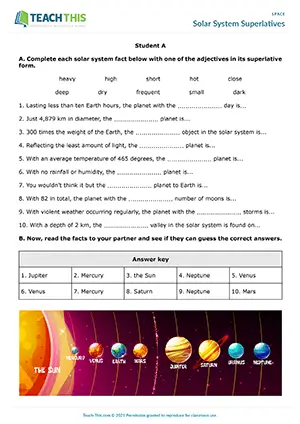
ESL Planets Activity - Speaking: Gap-fill, Reading Sentences, Guessing - Pair Work
In this free planets speaking activity, students complete facts about the solar system with superlatives and then used the sentences in a quiz. In two groups, students complete each solar system fact with one of the adjectives shown on the worksheet...
Space Odyssey
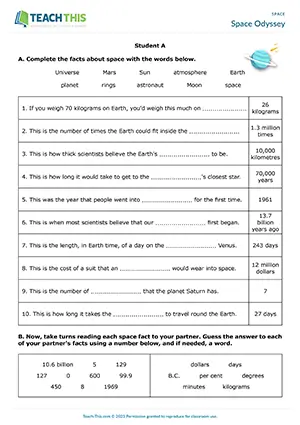
ESL Space Vocabulary Game - Vocabulary: Gap-fill, Guessing - Pair Work
Here is an enjoyable space vocabulary game to help students review and practice words related to space. In two groups, students begin by completing facts about space with the vocabulary provided. Next, students pair up with someone from the...
A Journey into Space
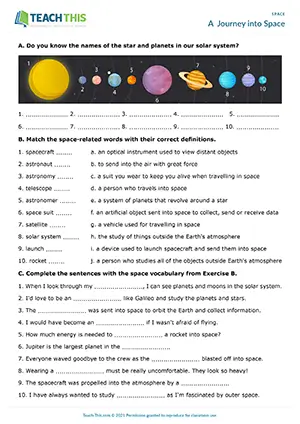
ESL Space Worksheet - Vocabulary Exercises: Labelling, Matching, Gap-fill, Multiple Choice - Speaking Activity: Drawing and Describing a Picture - Pair Work
In this useful space vocabulary worksheet, students learn and practice words associated with space and space travel. Students begin by naming the star and planets...
The Universe
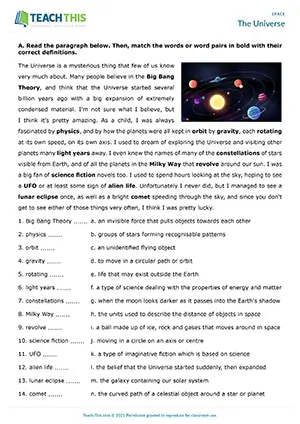
ESL The Universe Worksheet - Reading and Vocabulary Exercises: Matching, Gap-fill, Guessing - Speaking Activity: Asking and Answering Questions - Pair Work
This informative space worksheet helps students to learn and practice words associated with the Universe. First, students read a text that contains...
What to See in the Solar System
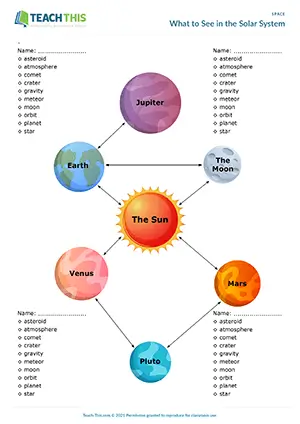
ESL Space Board Game - Vocabulary: Gap-fill - Group Work
In this fun space board game, students answer quiz questions about the Solar System in order to practice space vocabulary. The aim of the game is to be the first player to cross off all the space-related words on a checklist by answering questions...
Cosmic Conversations
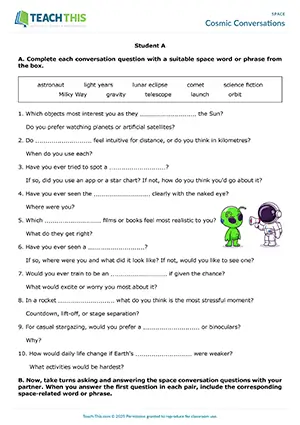
ESL Space Activity - Vocabulary and Speaking: Gap-fill, Asking and Answering Questions, Controlled and Freer Practice - Group and Pair Work
In this engaging space vocabulary activity, students complete, ask and answer conversation questions containing space-related vocabulary. First...
Using Space Vocabulary
Space vocabulary names celestial objects and describes space exploration and the wider universe. Using these words accurately helps students distinguish related ideas, explain what they mean and discuss space topics clearly.
This page contains six resources from intermediate (B1) to advanced (C1), including one free download. The materials combine space vocabulary with factual sentences, comparisons, picture descriptions and conversation tasks.
Use the distinctions below to connect each word with a clear meaning and example.
| Word or phrase | Meaning or use | Example |
|---|---|---|
| star | A celestial object such as the Sun that produces its own light | 'The Sun is a star.' |
| planet | A world such as Earth that orbits a star | 'Earth is a planet in our solar system.' |
| moon | A natural satellite orbiting a planet or another body | 'The Moon orbits Earth.' |
| solar system | The Sun and the objects that orbit it | 'Our solar system includes eight planets.' |
| galaxy | A vast collection of stars, gas and dust held together by gravity | 'Our solar system is in the Milky Way galaxy.' |
| spacecraft | A vehicle designed to travel in space | 'The spacecraft carries scientific instruments.' |
How to Use Space Vocabulary
Make differences visible: Use a labelled diagram to contrast a planet, a moon, a solar system and a galaxy. Ask students to explain how the terms relate to one another rather than simply memorising separate definitions.
Teach words in useful combinations: Build phrases such as 'orbit a planet', 'launch a spacecraft' and 'explore space'. Have students use these combinations in sentences before expecting them to explain a longer idea.
Separate language knowledge from factual recall: Give students reference information when a task depends on unfamiliar space facts. Check whether an incorrect answer reflects a vocabulary problem or missing background knowledge before deciding what to review.
3-Step Framework for Teaching Space Vocabulary
For students working towards upper-intermediate level, move from understanding words in a text to using them in factual sentences and discussion. This sequence combines intermediate review with upper-intermediate work; the final discussion returns to the opening worksheet.
1. Establish meanings in context: Students read a text about the universe, match vocabulary with definitions and complete sentences. Ask them to use the surrounding information to check their choices. This establishes meanings and sentence patterns for later spoken work.
2. Use vocabulary in factual exchanges: Students complete space facts with supplied words, then exchange them with a partner who guesses the answers from numerical options and, where needed, a suitable word. This gives students practice reading the vocabulary aloud and interpreting complete statements.
3. Extend into questions and discussion: Return to the opening worksheet's partner task. Students predict whether statements are true for a partner, check their predictions through questions and ask follow-up questions. Reporting what they learned shifts the focus from supplied facts to communicating new information.
Common Mistakes with Space Vocabulary
Confusing 'solar system' and 'galaxy': Our solar system is one part of the Milky Way galaxy. Incorrect: 'The Milky Way is our solar system.' Correct: 'The Milky Way is our galaxy.' Use a diagram to show the difference in scale.
Adding 'the' when referring to space generally: Use 'space' without an article when referring to the region beyond Earth's atmosphere in general. Incorrect: 'Astronauts travel into the space.' Correct: 'Astronauts travel into space.' 'The space' can be correct when referring to a specific area, such as 'the space between two objects'.
Common Questions About Teaching Space Vocabulary
What board game helps students practice space vocabulary?
In the board game What to See in the Solar System, students answer questions using space words from a checklist. They choose locations and question numbers, then cross off words after answering correctly. Winning requires completing the checklist, so students need to use a range of vocabulary rather than repeat one answer.
What worksheet can I use for teaching space vocabulary?
The worksheet A Journey into Space combines naming planets with vocabulary definitions and sentence completion. Students also answer space trivia questions before drawing a scene and describing it for a partner to reproduce. Comparing the pictures gives students a concrete way to check how clearly they used the vocabulary.
What free speaking activity helps students practice planet vocabulary?
The free activity Solar System Superlatives combines planet facts with superlative forms. Students complete sentences using supplied adjectives, then exchange facts with a partner who guesses the answers. Points reward correct guesses, giving students a reason to listen closely while using comparison language in a solar system context.
Become a Teach This Member
Get unlimited access to the full library, plus new resources added every week.
Unlimited Resource Access
Download from 3000+ worksheets, activities, and games.
Save 5+ Hours Weekly
Cut lesson prep time with ready-to-use resources, plus teacher notes and answer keys.
Trusted Professional Quality
Classroom-tested, editable resources created by experienced ESL professionals.
Fresh Content Weekly
Get 5 new resources added to the library each week.
Here's what our members are saying...


