
Dependent Prepositions ESL Activities, Games & Worksheets
Get the Preposition
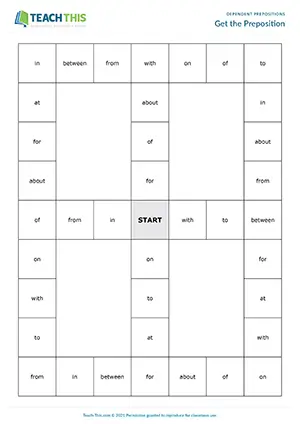
ESL Dependent Prepositions Board Game - Vocabulary: Matching, Gap-fill - Group Work
In this fun dependent prepositions board game, students collect various prepositions in order to complete dependent prepositions in sentences. The aim of the game is to be the first player to complete all the sentences on their card correctly with...
Verb-Preposition Dominoes

ESL Dependent Prepositions Game - Vocabulary: Matching - Group Work
In this useful dependent prepositions game, students practice common verb-preposition collocations by playing dominoes. The first player tries to combine a verb and preposition to form a sentence or question by placing a domino down either...
Who has the same answer?

ESL Dependent Preposition Activity - Vocabulary and Speaking: Completing, Asking and Answering Questions, Freer Practice
In this free dependent prepositions speaking activity, students ask and answer questions that contain dependent prepositions with verbs and adjectives...
Who wrote it?

ESL Dependent Prepositions Activity - Speaking: Sentence Completion, Asking and Answering Questions
In this engaging dependent prepositions speaking activity, students complete true sentences that contain dependent prepositions and then find out who wrote other sentences by asking...
Dependent Prepositions Practice

ESL Dependent Prepositions Worksheet - Vocabulary Exercises: Categorizing, Multiple Choice, Gap-fill, Matching
Here is a comprehensive dependent prepositions worksheet for upper-intermediate students. First, students put verbs, nouns, and adjectives under their dependent prepositions...
Let's Discuss
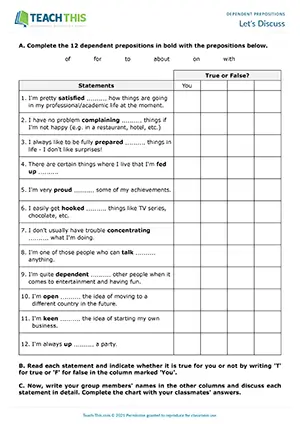
ESL Dependent Prepositions Activity - Vocabulary and Speaking: Gap-fill, Discussion, Freer Practice - Group Work
In this interesting dependent prepositions speaking activity, students learn 12 dependent prepositions and use them in a group discussion. To start, students complete dependent prepositions...
Understanding Dependent Prepositions
Dependent prepositions are fixed word-and-preposition pairings where the word itself dictates which preposition must follow. Students who guess by translating from their first language often produce errors like 'interested on' or 'good in,' which mark their writing as non-native and are hard to correct without deliberate practice.
This page covers dependent prepositions at B1 and B2 levels, with six activities ranging from a board game and dominoes to mingle speaking tasks and a guided group discussion, including one free download.
When to Use Dependent Prepositions
Expressing Attitude Precisely: When a speaker wants to describe their exact relationship to something, the dependent preposition after the adjective carries that meaning, so someone showing strong commitment would say 'dedicated to the project' rather than 'dedicated for the project,' which sounds unnatural even if the speaker's intention is clear.
Writing Formal Correspondence: In professional and academic writing, the noun or verb in a sentence almost always locks in a specific preposition, and getting it right signals command of the register, so a writer drafting a business proposal would write 'with reference to your inquiry' rather than 'in reference to' or 'on reference to,' where only one form fits the convention.
Linking Points in Discussion and Debate: Speakers use verb-preposition combinations to connect their contribution to what has just been said, so a student responding in a seminar who wants to push back diplomatically would say 'I disagree with your interpretation' rather than 'I disagree to your interpretation,' which distracts the listener from the argument itself.
3-Step Framework for Teaching Dependent Prepositions
1. Build Recognition Through a Board Game: Start with a competitive board game where students collect prepositions from squares on the board and race to complete the sentences on their card. The movement mechanic keeps every turn unpredictable: players roll the dice and move their counter in any direction, so each landing brings a new preposition to test against their sentences.
2. Push into Production with a Class Mingle: Follow up with a speaking mingle where students complete questions with dependent prepositions, write their own answers, then walk around asking classmates the same questions to find people who answered the same way. The activity rewards accuracy: when a student finds someone with the same answer, they write that person's name down and ask follow-up questions to find out more.
3. Deepen Fluency with a Group Discussion: Close with a discussion activity built around 12 statements that each contain a dependent preposition. Students complete the prepositions first, then mark each statement true or false for themselves in the column marked 'You' before comparing answers and discussing in detail with their group.
Common Mistakes with Dependent Prepositions
Wrong Preposition After Adjective: Students often use a preposition that sounds logical to them rather than the fixed form English requires, particularly with common adjectives they already know well. Wrong: 'She is good in math.' Correct: 'She is good at math.'
Wrong Preposition After Noun: Students often attach a preposition that feels natural from their first language or from a similar English phrase, when the noun requires a different fixed form. Wrong: 'I have no experience of this kind of work.' Correct: 'I have no experience with this kind of work.'
Common Questions About Teaching Dependent Prepositions
What is a fun game for practicing dependent prepositions?
What makes the board game Get the Preposition enjoyable is that students hunt for the preposition they need rather than waiting to see what they land on. They move their counter in any direction, so every roll is a decision. The first player to complete all their sentence cards by landing on matching prepositions wins.
What is a useful dependent prepositions worksheet?
The worksheet Dependent Prepositions Practice covers six exercise types in sequence, giving dependent prepositions the varied repetition they need to stick. Students begin by categorizing verbs, nouns, and adjectives under their dependent prepositions, then move through multiple choice, gap-fill, and matching tasks, including sentences where one word can take more than one preposition.
What is a good dependent prepositions speaking activity?
For a speaking activity that gets students producing dependent prepositions in real, personal sentences, the activity Who wrote it? is hard to beat. Students complete sentence cards with dependent prepositions and add true details about themselves, then circulate asking yes/no questions to find the person who wrote each card. The student who identifies the most writers wins.
Become a Teach This Member
Get unlimited access to the full library, plus new resources added every week.
Unlimited Resource Access
Download from 3000+ worksheets, activities, and games.
Save 5+ Hours Weekly
Cut lesson prep time with ready-to-use resources, plus teacher notes and answer keys.
Trusted Professional Quality
Classroom-tested, editable resources created by experienced ESL professionals.
Fresh Content Weekly
Get 5 new resources added to the library each week.
Here's what our members are saying...


