
Writing Exam Preparation EAP Activities, Worksheets & Games
Conclusion Clinic
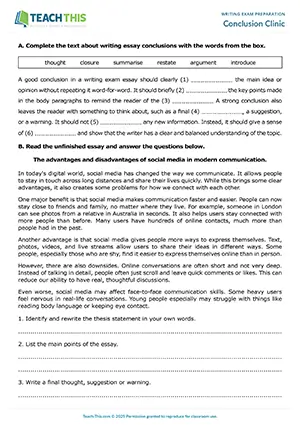
EAP Essay Conclusions Worksheet - Reading and Writing Exercises: Gap-fill, Answering Questions, Writing and Revising a Conclusion, Peer Review - Pair Work
In this productive essay conclusions worksheet, students practice writing and revising an essay conclusion based on peer feedback. Students begin by...
Editing in Action
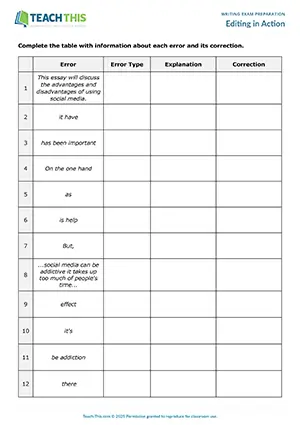
EAP Editing and Revising Activity - Reading, Grammar, Vocabulary and Writing: Identifying, Error Correction - Speaking: Discussion, Freer Practice - Pair Work
In this comprehensive writing exam preparation activity, students practice their editing and revision skills by identifying common writing errors...
Essay Station Rotation
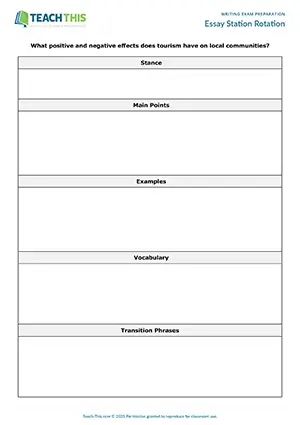
EAP Writing Exam Preparation Activity -Writing and Speaking: Brainstorming, Creating an Essay Outline, Presenting, Communicative Practice - Group Work
In this collaborative outlining activity, students generate, organise and expand on ideas for answering essay questions and then present their developed outlines...
Perfect Punctuation

EAP Writing Exam Preparation Worksheet - Reading and Writing Exercises: Matching, Identifying, Error Correction, Paragraph Writing, Peer Review - Pair Work
In this punctuation errors worksheet, students learn to identify and correct common punctuation errors to improve their ability to construct grammatically...
Writing Jeopardy
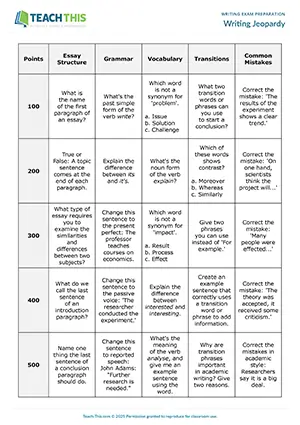
EAP Writing Exam Preparation Game - Grammar, Vocabulary, and Speaking: Answering Quiz Questions, Freer Practice - Group Work
In this free writing exam preparation game, students review key writing concepts by answering quiz questions in different categories. This Jeopardy-style...
Writing Task Match Up
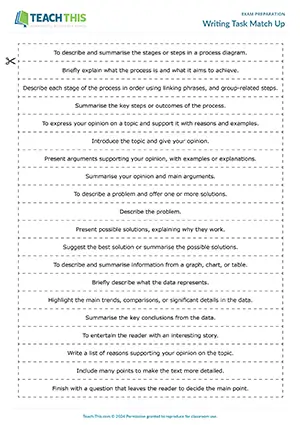
EAP Writing Exam Preparation Activity - Reading, Writing and Speaking: Matching, Writing Instructions, Discussion, Freer Practice - Pair Work
This useful writing exam preparation activity introduces students to four common writing exam task types, familiarising them with their purpose and general structure...
Time Management Challenge
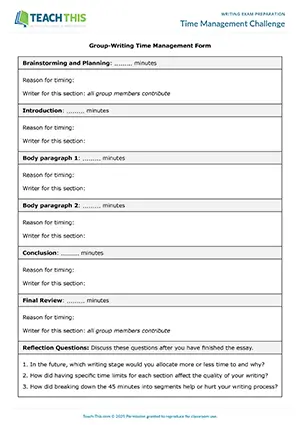
EAP Writing Exam Preparation Activity - Writing and Speaking: Discussion, Form Completion, Brainstorming, Writing Sentences, Essay Writing, - Group Work
In this engaging writing exam preparation activity, students organise an essay writing process into timed segments and then collaboratively plan and write...
Understanding Academic Writing Exam Preparation
Academic writing exam preparation develops students' ability to interpret a task, organise a response and write clearly within a time limit. Effective preparation connects planning, drafting and checking with the requirements of the particular exam rather than relying on a memorised answer or a fixed timing formula.
This page contains seven resources across B1 and B2, including activities, worksheets and one free game covering task types, essay planning, conclusions, editing and time management.
The table connects preparation priorities with practical checks students can make before and during a writing task.
| Preparation focus | Purpose | Student check |
|---|---|---|
| Task requirements | Identify what the response must explain, argue, solve or summarise. | 'What exactly does this question require me to do?' |
| Relevant planning | Select ideas and organise them into a focused response. | 'Does each planned paragraph help answer the question?' |
| Time allocation | Leave workable amounts of time for planning, writing and checking. | 'How much time remains, and what still needs completing?' |
| Developing ideas | Explain points and support them appropriately for the task. | 'Have I explained why this point matters rather than simply listed it?' |
| Concluding an essay | Bring the response to a close using the argument already developed. | 'Does my conclusion follow from the essay and answer its question?' |
| Checking the response | Review task coverage and correct language errors. | 'Have I answered all parts and checked grammar, punctuation, vocabulary and spelling?' |
How to Prepare for Academic Writing Exams
Work from the actual task: Help students distinguish an opinion essay from a process explanation or data summary. Use the relevant exam instructions to establish the required response, length and time allowance rather than assuming every writing task follows an essay format.
Build control before adding time pressure: Begin with focused practice in planning, developing paragraphs or checking language. Then combine these skills in timed writing, adjusting the amount of support as students become more confident.
Move from shared practice to independent performance: Group planning and collaborative writing let students compare strategies. Follow these with individual practice under the relevant conditions so students can assess what they can manage without classmates' help.
3-Step Framework for Teaching Writing Exam Preparation
This B1 sequence develops task awareness, outlining and conclusions through separate practice tasks. It prepares students for a later complete writing task rather than serving as a full exam simulation.
1. Recognise the Required Response: Pairs match instruction strips to task cards for process explanations, opinion essays, problem-solution essays and data summaries. They identify the purpose and organisation of each response, correct mismatches and discuss what they learned. This helps students choose an approach that fits the task.
2. Build and Improve an Outline: Groups rotate around essay-question stations, choosing a stance or focus and adding or developing ideas in the outlines. They strengthen weaker sections before returning to their original station to review and present the completed plan. Comparing outlines makes relevance and balance visible before drafting.
3. Write a Conclusion That Fits: Students read an unfinished essay, answer questions about its content and use their answers to write a conclusion. They exchange feedback with a partner and rewrite their conclusion. This checks whether the ending follows from the response already developed rather than introducing an unrelated argument.
Common Mistakes with Writing Exam Preparation
Using a rehearsed answer that does not fit the question: Familiar vocabulary and a polished structure cannot compensate for missing the task. Off-task response: Describing the causes of a problem when the question asks students to evaluate solutions. Better approach: Identify the instruction first, then plan points that assess the proposed solutions.
Leaving no time to check: Continuing to add detail until time runs out can leave missing task elements and avoidable errors unnoticed. Unbalanced plan: Allocating the entire available time to drafting. Better approach: Reserve a realistic checking period, test the plan during practice and adjust it to the task and time limit.
Common Questions About Teaching Writing Exam Preparation
What free game helps students prepare for writing exams?
Writing Jeopardy reviews writing concepts through quiz questions in five categories, with different difficulty levels. Teams compete to answer correctly and win points, and the winning team chooses the next question. This gives teachers a way to review writing knowledge before students apply it in a written response.
What activity helps students practice timed essay writing?
Time Management Challenge asks groups to divide a forty-five-minute writing task into stages and explain their timing choices. They assign writing responsibilities, choose an essay question and write collaboratively within the limit. Afterwards, students discuss how their timing strategy worked, giving them a basis for adjusting their approach to future writing tasks.
What activity helps students practice editing for writing exams?
Editing in Action has students identify errors in an essay, then compare their choices with a partner. They classify the errors, explain why they are incorrect and make corrections before reviewing answers with the class. The explanation stage encourages students to understand the changes rather than simply replace an incorrect form.
Become a Teach This Member
Get unlimited access to the full library, plus new resources added every week.
Unlimited Resource Access
Download from 3000+ worksheets, activities, and games.
Save 5+ Hours Weekly
Cut lesson prep time with ready-to-use resources, plus teacher notes and answer keys.
Trusted Professional Quality
Classroom-tested, editable resources created by experienced ESL professionals.
Fresh Content Weekly
Get 5 new resources added to the library each week.
Here's what our members are saying...


