
Academic Reading Comprehension EAP Worksheets
Colour Psychology
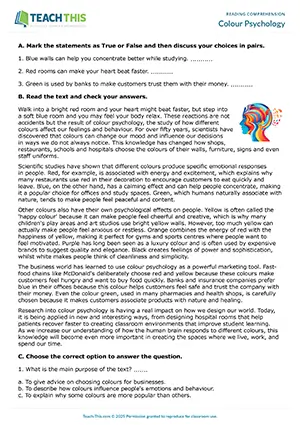
EAP Reading Comprehension Worksheet - Reading and Writing Exercises: True or False, Comprehension Questions - Speaking Activity: Discussion - Pair Work
In this colour psychology reading comprehension worksheet, students explore how colour psychology influences emotions and decisions, check...
The Changing World of Work
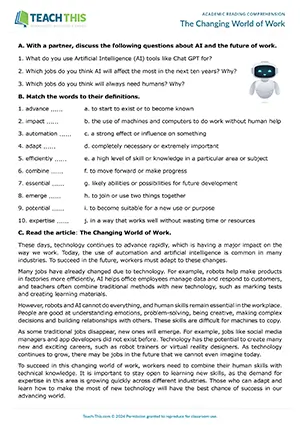
EAP Reading Comprehension Worksheet - Reading and Writing Exercises: Matching, True, False or Not Given - Speaking Activities: Discussion - Pair Work
In this academic reading comprehension worksheet, students read an article on the topic of AI and the future of work and practice reading comprehension skills...
The Science of Sleep
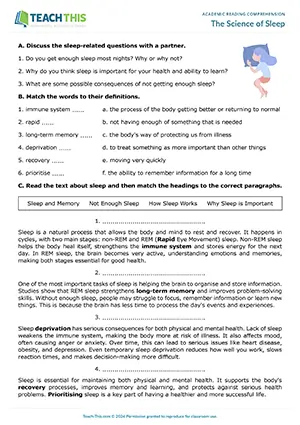
EAP Reading Comprehension Worksheet - Reading Exercises: Matching, Multiple Choice, Gap-fill - Speaking Activitiy: Discussion, Freer Practice - Pair Work
In this intriguing academic reading comprehension worksheet, students practice reading skills through a science-focused text about sleep. To begin...
Immigration
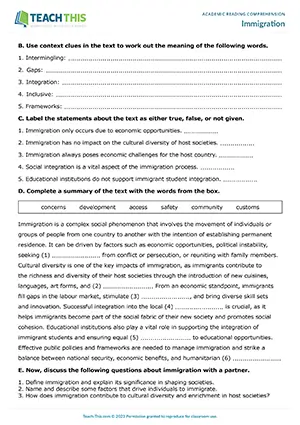
EAP Reading Comprehension Worksheet - Reading Exercises: Guessing Meaning from Context, True or False, Summary Completion
Here is a useful academic reading comprehension worksheet based on the topic of immigration to help students practice reading an academic text for specific information. To begin...
Unethical Business Practices
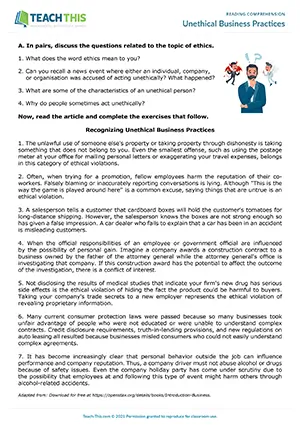
EAP Reading Comprehension Worksheet - Reading Exercises: Matching, True or False
In this academic reading comprehension worksheet, students read an article about unethical business behaviours and practice several reading skills that include recognising main ideas and scanning to locate and identify information. As a lead into...
Classifying Intelligence
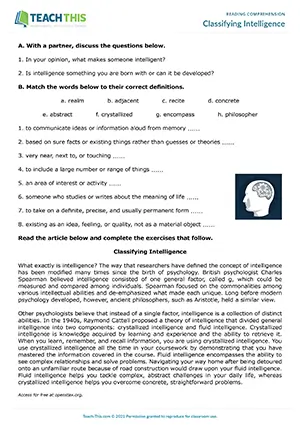
EAP Reading Comprehension Worksheet - Reading and Writing Exercises: Matching, Scanning, Paraphrasing, Multiple Choice, Reading for Detail, Error Correction
In this intelligence reading comprehension worksheet, students read an article about intelligence and practice reading for detail and building their vocabulary...
Commerce in the New World
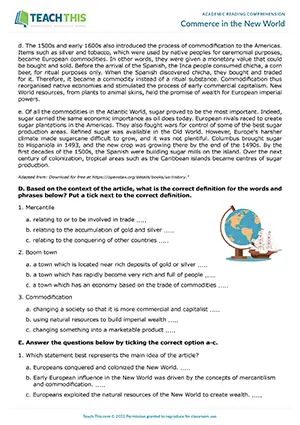
EAP Reading Comprehension Worksheet - Reading and Writing Exercises: Matching, Multiple Choice, True, False or Not Given
In this colonialism reading comprehension worksheet, students read a brief article on the topic of European colonialism and practice a number of reading strategies that include guessing the meaning of a...
Issues in Education
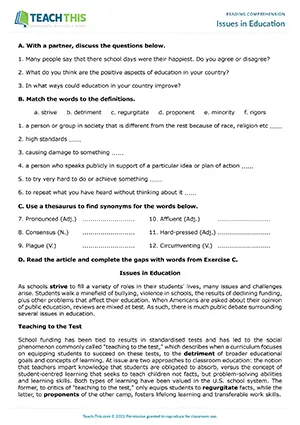
EAP Reading Comprehension Worksheet - Reading Exercises: Matching, Thesaurus Work, Reading for Detail, Gap-fill, Multiple Choice
This education reading comprehension worksheet focuses on the topic of education and helps students practice reading for detail, paraphrasing and vocabulary...
Nutrition and Diet
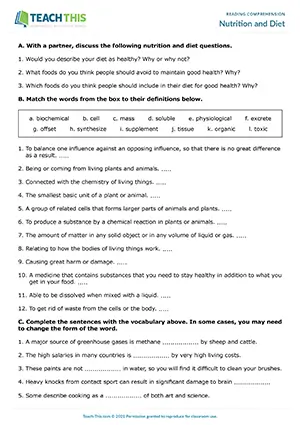
EAP Reading Comprehension Worksheet - Reading and Writing Exercises: Matching, Gap-fill, Short Answer Questions, True or False, Paraphrasing
In this nutrition and diet reading comprehension worksheet, students read an academic article on the topic of nutrition and diet and complete reading...
The Entrepreneurial Mindset
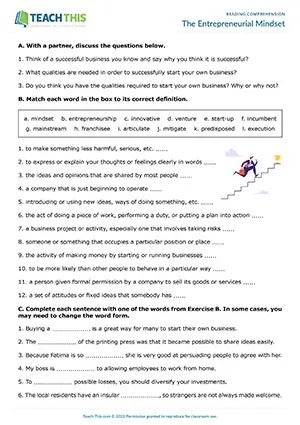
EAP Reading Comprehension Worksheet - Reading and Writing Exercises: Gap-fill, Multiple Choice, Short Answer Questions
In this entrepreneurship reading comprehension worksheet, students practice reading for main ideas and specific details in an article about entrepreneurship. To begin, students discuss three...
The Value of a University Degree
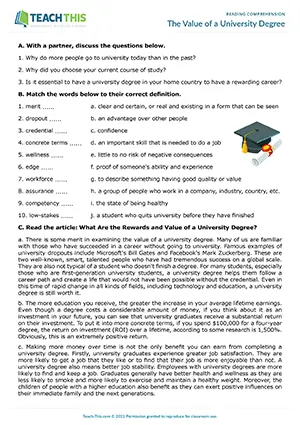
EAP Reading Comprehension Worksheet - Reading Exercises: Matching, True, False or Not Given, Multiple Choice
In this free academic reading comprehension practice worksheet, students read a brief article on the topic of going to university and practice a variety of reading skills that include recognising main ideas, and...
Understanding Academic Reading Comprehension
Academic reading comprehension involves understanding a text's main ideas, locating relevant details and interpreting relationships between claims and supporting information. Readers also need to distinguish what the text states from what it implies or leaves unanswered.
This page contains eleven worksheets across B1, B2 and C1, covering topics such as work, education, science and business. Tasks include matching headings, locating information, interpreting vocabulary in context, making inferences and checking paraphrases, with one free worksheet available.
The table links reading purposes with practical checks. Choose the approach that fits the question rather than reading every passage in the same way.
| Reading focus | Approach | Checking question |
|---|---|---|
| Main idea | Consider what the paragraph as a whole develops | 'Does this heading cover the paragraph, or just one example?' |
| Specific information | Locate likely keywords, then read the surrounding sentences carefully | 'Does this passage answer the exact question?' |
| Vocabulary in context | Use nearby explanations, contrasts and grammatical clues | 'Does this meaning fit the sentence and the wider point?' |
| Inference | Combine textual clues without claiming more than they support | 'Which words support this interpretation?' |
| True, false or not given | Check whether the text supports, contradicts or does not establish the statement | 'Is there a contradiction, or is the information simply missing?' |
| Paraphrase accuracy | Compare the meaning, scope and qualifications of both versions | 'Has the wording changed without changing the claim?' |
How to Develop Academic Reading Comprehension
Set a purpose before reading: Ask students what they need to find out and whether the task concerns the overall message, a detail or an interpretation. Use that purpose to decide when a quick overview is enough and when closer reading is needed.
Require a reason for the answer: Ask students to locate the relevant wording and explain how it supports their choice. This helps reveal whether a correct answer reflects understanding or a guess based on familiar vocabulary.
Separate comprehension from evaluation: Establish what the author says before discussing whether students agree with it. Personal knowledge can support discussion, but answers to text-based questions must follow the information in the passage.
3-Step Framework for Teaching Academic Reading Comprehension
Use this sequence as a progression across levels, selecting texts that suit the class. The stages move from locating support at B1 to organising information at B2 and checking meaning closely at C1.
1. Locate support for statements: Students prepare vocabulary, read about AI and the future of work and classify statements as true, false or not given. They then answer comprehension questions before discussing their own ideas. Ask them to identify the passage supporting each answer, establishing a clear boundary between textual information and personal opinion.
2. Connect paragraph meaning with specific situations: Students read descriptions of unethical business behaviours, match headings to paragraphs and identify which paragraph fits each new situation. They then check true-or-false statements. This combines recognising a paragraph's central concept with locating the details needed to apply it.
3. Check meaning across different wording: Students explore vocabulary and synonyms in an education text, complete gaps and answer detailed multiple-choice questions. They then compare paraphrases with the original sentences and choose the closest meanings. Ask them to explain why an alternative changes or loses part of the message, building on the evidence checks from earlier stages.
Common Mistakes with Academic Reading Comprehension
Treating missing information as false: A statement is false when the text contradicts it, not merely when it is unmentioned. In this hypothetical example, the text says a library opens at nine but gives no closing time. Unsupported judgement: Marking 'The library closes at six' as false. Correct judgement: Not given, because the closing time is not established.
Choosing a heading because it repeats a keyword: A heading must represent the paragraph's main point rather than an incidental detail. In a paragraph about several ways to reduce commuting costs, cycling may appear as one example. Too narrow: 'Cycling to work.' Better fit: 'Ways to reduce commuting costs.'
Common Questions About Teaching Academic Reading Comprehension
What worksheet helps teach main ideas in reading?
The worksheet The Science of Sleep asks students to match headings to paragraphs before answering questions about details. Vocabulary preparation supports access to the text, while multiple-choice questions and sentence completion check understanding. Moving between paragraph headings and specific information helps students distinguish a main idea from the details supporting it.
What worksheet helps teach reading inference?
The worksheet Colour Psychology combines comprehension questions with inference questions that require textual evidence and students' reasoning. Pairs then choose colours for a room, explain their choices and present their design. This gives students a practical application for ideas from the reading while distinguishing what the text states from what they infer.
What free worksheet helps teach academic reading?
The worksheet The Value of a University Degree uses a text about university education to practice several reading skills. Students prepare vocabulary, match headings to paragraphs and classify statements as true, false or not given. Multiple-choice questions provide a further comprehension check, combining attention to main ideas with locating specific information.
Become a Teach This Member
Get unlimited access to the full library, plus new resources added every week.
Unlimited Resource Access
Download from 3000+ worksheets, activities, and games.
Save 5+ Hours Weekly
Cut lesson prep time with ready-to-use resources, plus teacher notes and answer keys.
Trusted Professional Quality
Classroom-tested, editable resources created by experienced ESL professionals.
Fresh Content Weekly
Get 5 new resources added to the library each week.
Here's what our members are saying...


