
Adverb-Adjective Collocations ESL Activities
Adverb-Adjective Collocations in Action
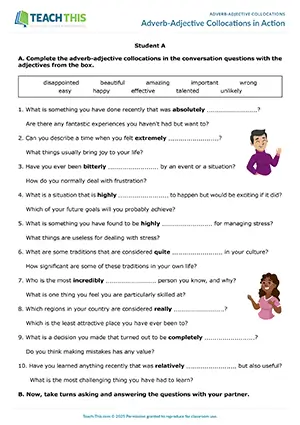
ESL Adverb-Adjective Collocations Activity - Vocabulary and Speaking: Gap-fill, Asking and Answering Questions, Controlled and Freer Practice - Group and Pair Work
In this insightful adverb-adjective collocations speaking activity, students complete, ask and answer conversation questions containing useful adverb-adjective...
Collocation Conundrum
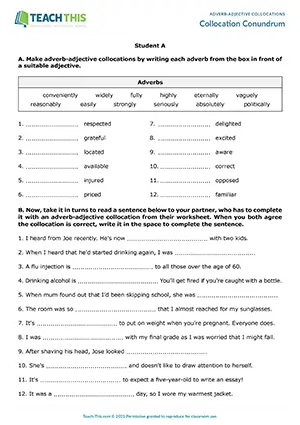
ESL Adverb-Adjective Collocations Activity - Vocabulary and Speaking: Matching, Gap-fill, Forming Sentences - Pair Work
In this free adverb-adjective collocations activity, students form adverb-adjective collocations and then use them to complete sentences. In two groups, students match adverbs from a box with...
Perfectly Matched
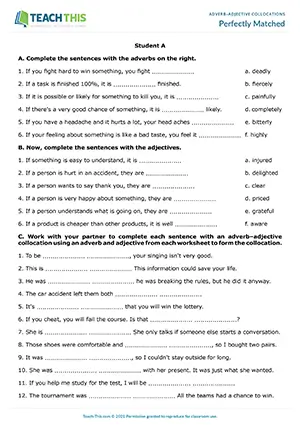
ESL Adverb-Adjective Collocations Activity - Vocabulary: Matching, Gap-fill - Pair Work
In this engaging adverb–adjective collocations activity, students work together to complete sentences with adverb–adjective collocations. In two groups, students start by completing sentences with adverbs and adjectives. Next, students pair up with...
Understanding Adverb-Adjective Collocations
Adverb-adjective collocations are fixed or strongly preferred word pairings in which an adverb modifies an adjective, such as 'deeply concerned' or 'highly unlikely.' When students reach for the wrong adverb, their language sounds unnatural to a native speaker even when the meaning is technically clear, and that unnatural quality can quietly undermine their credibility in academic or professional writing.
This page covers adverb-adjective collocations at B2 level, with three speaking and vocabulary activities spanning gap-fill, matching, and sentence completion formats, one of which is available as a free download.
The table below shows common adverbs used in adverb-adjective collocations, with their most frequent adjective partners and an example sentence for each.
| Adverb | Common Adjective Partners | Example Sentence |
|---|---|---|
| deeply | concerned, troubled, committed, flawed | 'She was deeply concerned about the results.' |
| highly | unlikely, recommended, qualified, competitive | 'The position is highly competitive.' |
| fully | aware, committed, prepared, qualified | 'He was fully aware of the risks.' |
| widely | available, accepted, known, regarded | 'The data is widely available online.' |
| absolutely | certain, horrified, convinced, essential | 'I was absolutely certain it was correct.' |
| bitterly | cold, disappointed, divided, opposed | 'The team was bitterly disappointed.' |
| perfectly | clear, normal, reasonable, capable | 'Her explanation was perfectly clear.' |
| utterly | exhausted, devastated, convinced, baffled | 'They were utterly exhausted after the climb.' |
When to Use Adverb-Adjective Collocations
Expressing precise degree: Writers and speakers choose a specific collocating adverb when they need to signal exactly how strong or extreme a quality is, because words like 'deeply' or 'utterly' carry a weight and precision that a general intensifier cannot match, as when a journalist writes 'The findings were deeply troubling' rather than 'very troubling.'
Signaling fluency in formal writing: In academic and professional writing, readers expect certain adverb-adjective pairings as markers of educated fluency, so a business report that says 'widely available data' reads more naturally and authoritatively than one that says 'very available data.'
Adding emotional color in conversation: In spoken English, speakers reach for adverb-adjective collocations to add emotional emphasis without overusing the word 'very,' making their responses sound more expressive and natural, as when someone says 'I was absolutely horrified' rather than 'I was very shocked.'
3-Step Framework for Teaching Adverb-Adjective Collocations
1. Recognition to Production: Open with a gap-fill conversation activity where students complete questions containing adverb-adjective collocations by selecting adjectives from a word box. Once they have the forms in front of them, pair students across groups to ask and answer the questions. The key productive challenge is that for the first question in each set, students must include the corresponding adverb-adjective collocation in their own spoken response, not just recognize it on the page.
2. Peer Verification: Move to a sentence completion activity where pairs take turns reading incomplete sentences aloud while the listener completes each one with an adverb-adjective collocation from their own worksheet. Build in the agreement check: both students must decide together that the collocation is correct before either student writes it down. This keeps the focus on judgment and accuracy rather than speed.
3. Split-Information Assembly: Finish with a task where each student holds a different set of words, some adverbs, some adjectives, so the pair must combine their separate worksheets to form each collocation, with one adverb and one adjective coming from each student's sheet. Neither student can complete the task alone, which creates a genuine reason to talk and negotiate.
Common Mistakes with Adverb-Adjective Collocations
Substituting a generic intensifier for the natural adverb: Students often replace the correct collocating adverb with 'very' or 'really' because those words feel safer and more familiar, even when a specific adverb is the natural and expected choice with that adjective. Wrong: 'I was very aware of the problem.' Correct: 'I was fully aware of the problem.'
Inventing non-existent collocations: Students often combine a grammatically correct adverb and adjective that simply do not collocate in natural English, producing phrases that sound plausible but strike a native speaker as off. Wrong: 'The news was deeply surprising.' Correct: 'The news was deeply shocking.'
Common Questions About Teaching Adverb-Adjective Collocations
What is an engaging speaking activity for practicing adverb-adjective collocations?
The activity Adverb-Adjective Collocations in Action has students complete gap-fill conversation questions with adverb-adjective collocations, then pair up to ask and answer them. For the first question in each set, students must include the corresponding collocation in their spoken response, which pushes them to produce the target language rather than just recognize it.
What is a creative activity for teaching adverb-adjective collocations?
Perfectly Matched is a split-information activity where each student holds a different set of adverbs and adjectives. The pair must combine their two worksheets to build each collocation, with one adverb and one adjective coming from each student's sheet. Neither student can complete the task alone, so there is always a genuine reason to discuss each answer.
Become a Teach This Member
Get unlimited access to the full library, plus new resources added every week.
Unlimited Resource Access
Download from 3000+ worksheets, activities, and games.
Save 5+ Hours Weekly
Cut lesson prep time with ready-to-use resources, plus teacher notes and answer keys.
Trusted Professional Quality
Classroom-tested, editable resources created by experienced ESL professionals.
Fresh Content Weekly
Get 5 new resources added to the library each week.
Here's what our members are saying...


