
Money ESL Worksheets, Games & Activities
Easy Money
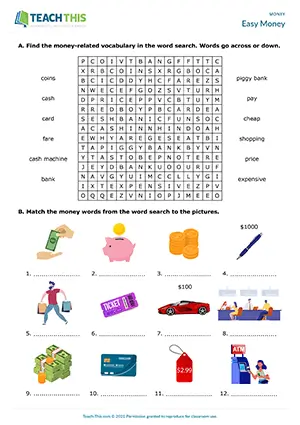
ESL Money Worksheet - Vocabulary Exercises: Word Search, Matching, Unscrambling, Gap-fill
This free money vocabulary worksheet helps students learn and practice basic money-related vocabulary. Students begin by finding money vocabulary in a word search. Next, students match the money...
Money Match

ESL Money Vocabulary Games - Vocabulary and Speaking: Matching, Pelmanism, Forming Sentences, Controlled and Freer Practice - Pair Work
Here are two rewarding money games to help students practice common vocabulary related to money. First, students play a gap-fill pelmanism game to practice...
Money Talk
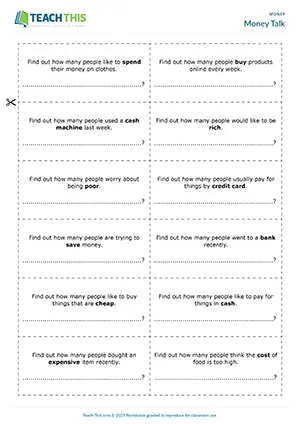
ESL Money Vocabulary Activity - Speaking: Forming, Asking and Answering Questions - Group Work - Vocabulary Game: Describing, Guessing - Pair Work
In this interesting two-part money activity, students practice money vocabulary by conducting a survey and playing a describing game. First, in groups...
Find Someone Who...

ESL Spending Habits Activity - Vocabulary and Speaking: Gap-fill, Asking and Answering Questions, Controlled and Freer Practice
In this insightful spending habits speaking activity, students ask and answer questions about their spending habits and preferences. First, students complete gaps...
Money Mania

ESL Money Game - Vocabulary: Guessing, Gap-fill - Pair Work
In this engaging money vocabulary game, students complete sentences with verbs, adjectives and nouns related to money. In pairs, students take it in turns to pick up a card and read the sentence on the card to their partner using the word...
Money Dominoes
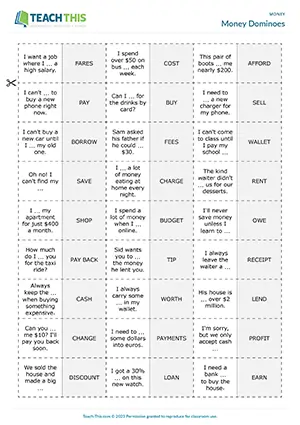
ESL Money Game - Vocabulary: Matching, Gap-fill - Group Work
In this enjoyable money vocabulary game, students play dominoes by completing sentences with words related to money. The first player puts down one of their dominoes on either side of the domino on the table, making sure that the money...
Money Talks

ESL Money Worksheet - Vocabulary Exercises: Unscrambling, Matching, Gap-fill - Speaking Activity: Asking and Answering Questions, Freer Practice - Pair Work
In this useful money vocabulary worksheet, students practice money verbs and other vocabulary associated with money. To start, students complete sentences...
Banking and Spending Habits
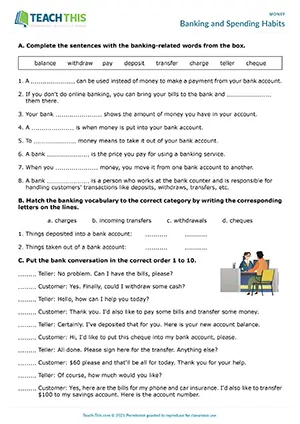
ESL Banking Worksheet - Vocabulary and Reading Exercises: Gap-fill, Matching, Ordering, Binary Choice - Speaking Activity: Freer Practice - Pair Work
In this comprehensive banking vocabulary worksheet, students learn and practice vocabulary related to banking and spending habits. First, students...
Bet on It!

ESL Money Vocabulary Game - Vocabulary: Gap-fill, Betting
In this fun money verbs game, students complete sentences with verbs associated with money and then place bets on their answers. To begin, students complete sentences with money verbs from a box in their correct form. Students...
From Cash to Crypto
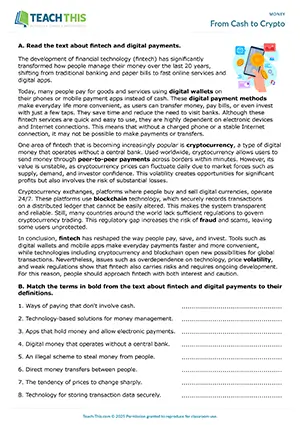
ESL Fintech Worksheet - Reading and Vocabulary Exercises: Matching, True or False, Gap-fill - Speaking: Discussion, Communicative Practice - Pair Work
Here is an insightful fintech worksheet to help teach students fintech vocabulary related to digital payments and cryptocurrency. First, students read a text about...
Money, Money, Money

ESL Money Worksheet - Vocabulary Exercises: Categorising, Listing, Matching, Gap-fill, Sentence Completion
This productive money vocabulary worksheet helps students to learn and practice verbs, nouns and adjectives related to money. To begin, students put money verbs into their correct category: ways of...
Money Phrasal Verbs
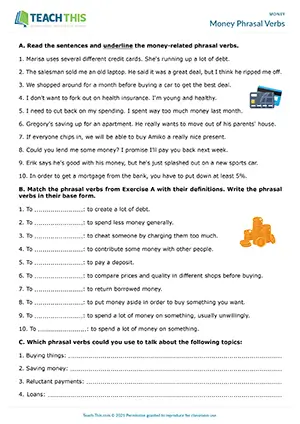
ESL Money Phrasal Verbs Worksheet - Vocabulary Exercises: Identifying, Matching, Listing, Gap-fill - Speaking Activity: Asking and Answering Questions - Pair Work
In this free money phrasal verbs worksheet, students learn and practice ten phrasal verbs related to money. Students start by reading sentences and underlining...
Money Verbs Race
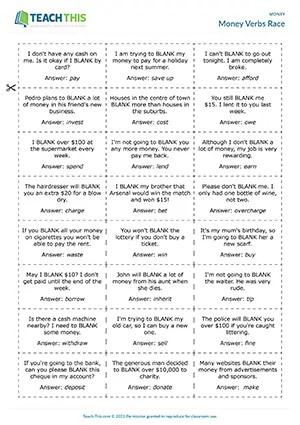
ESL Money Game - Vocabulary: Gap-fill, Matching - Group Work
In this entertaining money verbs game, students race to complete sentences with verbs related to money. The reader turns over a card and reads the sentence aloud to the players using the word 'blank' for the missing money verb. The players...
Money Vocabulary
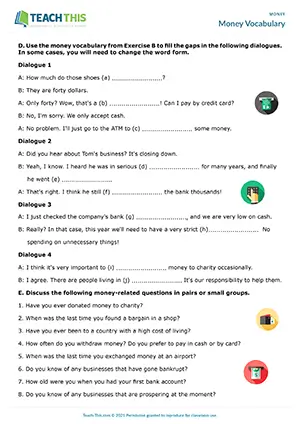
ESL Money Vocabulary Worksheet - Reading and Vocabulary Exercises: Identifying, Matching, Gap-fill - Speaking Activity: Asking and Answering Questions - Pair Work
This informative money vocabulary worksheet helps students learn and practice common money-related words. To start, students read two texts and underline all...
Using Money Vocabulary
Money vocabulary describes payments, spending, saving and banking. Choosing the right verbs and prepositions helps students explain transactions and discuss how they use money.
This page contains 14 resources from elementary (A1-A2) to upper-intermediate (B2), including two free downloads. Topics range from everyday money words to banking, money phrasal verbs and digital payments.
Teach words in short combinations so students can use them in complete messages.
| Purpose | Useful language | Example |
|---|---|---|
| Describe spending | spend money on something | 'I spend money on books.' |
| Explain payment | pay for something, pay by card | 'Can I pay for the tickets by card?' |
| Talk about saving | save money for something | 'We are saving money for a holiday.' |
| Describe borrowing | borrow money from someone | 'I borrowed ten pounds from my brother.' |
| Describe lending | lend someone money | 'My brother lent me ten pounds.' |
| Discuss banking | deposit money, withdraw cash | 'She withdrew cash from her account.' |
How to Use Money Vocabulary
Show who gives and receives: Use two characters and an arrow to explain a loan. Describe the same exchange from each person's viewpoint to make the difference between 'lend' and 'borrow' visible.
Keep words with their partners: Record phrases such as 'pay for a ticket' and 'spend money on food' together. Ask students to change the item while keeping the verb and preposition, then use the new phrase in a sentence.
Give discussions a practical purpose: Ask students to compare ways of paying or decide how a fictional person could use a budget. Allow invented examples so students can practice the language without sharing personal financial details.
3-Step Framework for Teaching Money Vocabulary
For intermediate students, build from understanding money verbs to choosing words in sentences and using them in conversation. The sequence below draws on the page's intermediate resources, with an earlier-level survey for supported speaking practice.
1. Establish meanings and combinations: Have students unscramble money verbs in sentences and match them with definitions. Follow this with preposition choices and sentence completion. This prepares students to recognise both the meaning and the grammatical pattern a sentence requires.
2. Choose vocabulary in context: Students play dominoes by matching money words with sentences containing gaps. Each matching domino extends the chain, and the first player to use all their dominoes wins. Ask students to read completed sentences aloud as an additional check before moving to personal responses.
3. Ask questions and develop answers: Students complete spending-habit prompts, form yes/no questions and ask classmates for answers. After a 'yes', they record a name and ask a follow-up question before reporting their findings. This moves practice beyond selecting a word to using it in an exchange with new information.
Common Mistakes with Money Vocabulary
Reversing 'borrow' and 'lend': 'Borrow' describes receiving something temporarily; 'lend' describes giving it temporarily. Incorrect: 'Can you borrow me ten pounds?' Correct: 'Can you lend me ten pounds?' From the receiver's viewpoint, say 'Can I borrow ten pounds from you?'
Using the wrong preposition after 'spend': Use 'spend money on' to name the thing bought. Incorrect: 'I spent twenty pounds for this book.' Correct: 'I spent twenty pounds on this book.' With 'pay', use 'for': 'I paid twenty pounds for this book.'
Common Questions About Teaching Money Vocabulary
What speaking activity helps students practice money vocabulary?
The activity Money Talk combines a survey with a vocabulary guessing game. Students ask classmates yes/no questions about money and report their findings. They then describe words from the survey to a partner, who has 20 seconds to guess each one, using the same vocabulary for a different speaking purpose.
What game can I use for practicing money verbs?
In the game Money Verbs Race, students listen to a sentence with a missing verb and race to select the correct card from their set. The first player to hand over the right card and say the verb keeps both cards, making accurate listening and verb choice central to winning.
What free worksheet can I use for teaching money vocabulary?
The free worksheet Easy Money introduces money vocabulary through a word search and picture matching. Students unscramble common money verbs, use them to complete sentences in the correct form, then fill gaps in a short story. The sequence moves from recognising individual words to choosing them in context.
Become a Teach This Member
Get unlimited access to the full library, plus new resources added every week.
Unlimited Resource Access
Download from 3000+ worksheets, activities, and games.
Save 5+ Hours Weekly
Cut lesson prep time with ready-to-use resources, plus teacher notes and answer keys.
Trusted Professional Quality
Classroom-tested, editable resources created by experienced ESL professionals.
Fresh Content Weekly
Get 5 new resources added to the library each week.
Here's what our members are saying...


