
Reading Exam Preparation EAP Activities, Games & Worksheets
Common Reading Exam Question Types
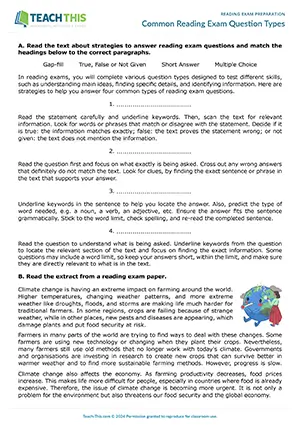
EAP Reading Exam Question Types Worksheet - Reading Exercises: True, False or Not Given, Multiple Choice, Gap-Fill, Short Answer Questions - Speaking Activity
In this useful reading exam preparation worksheet, students read about strategies to answer four common reading question types and then practice them...
Context Clues in Action
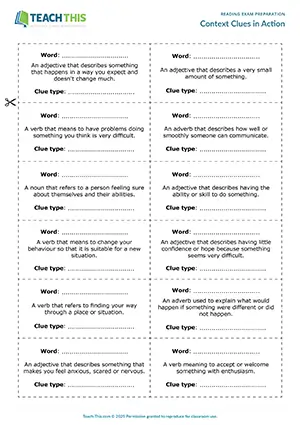
EAP Context Clues Activity - Reading: Matching, Using Context Clues, Identifying - Pair Work
In this rewarding context clues activity, students work out the meaning of unfamiliar words using five types of context clues. First, students read an introduction to context clues along with five clue types...
Gap-fill Relay

EAP Reading Exam Preparation Game - Reading: Skimming, Scanning, Gap-fill - Pair Work
This fun reading exam preparation game helps students practice skills for answering gap-fill questions. First, in pairs, students skim-read a gap-fill text for two minutes, predicting what kind of word would go...
Jigsaw Reading
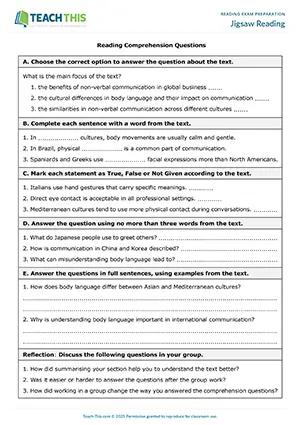
EAP Reading Exam Preparation Activity - Reading, Writing and Speaking: Discussion, Summary Writing, Presenting, Comprehension Questions - Group Work
In this free reading exam preparation activity, students practice analysing a text, summarising key information, presenting their findings and answering...
Mastering Multiple Choice
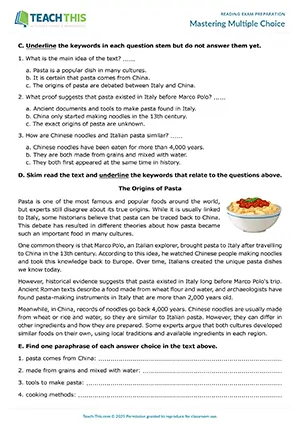
EAP Reading Exam Multiple-Choice Questions Worksheet- Reading Exercises: Multiple Choice, Identifying - Speaking Activity: Discussion - Pair Work
In this reading exam preparation worksheet, students learn and practice five strategies to answer multiple-choice questions. First, students read about...
Reading Rotation Challenge

EAP Skimming and Scanning Game - Reading, Writing and Speaking: Skimming, Scanning, Answering Comprehension Questions - Pair Work
In this fast-paced reading exam preparation game, students use skimming and scanning techniques to answer comprehension questions about various texts...
Reading Response Race

EAP Reading Exam Preparation Game - Reading and Speaking: Answering Comprehension Questions, Citing Evidence, Discussion - Group Work
In this engaging reading exam preparation game, students race to answer comprehension questions by locating and citing evidence, and making...
True, False or Not Given
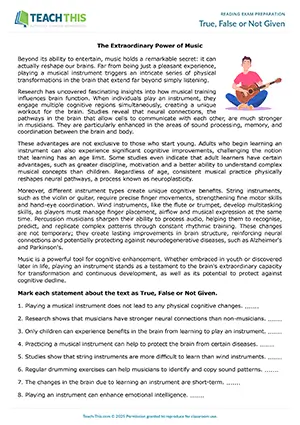
EAP Reading Exam Preparation Activity - Reading and Speaking: True, False or Not Given, Identifying, Citing Evidence, Discussion - Pair Work
This handy reading exam preparation activity helps students develop their skills in answering True, False or Not Given questions by justifying their responses...
Understanding Reading Exam Preparation
Reading exam preparation develops the ability to understand texts, select an appropriate reading strategy and answer questions according to their instructions. Students need to locate relevant information, recognise paraphrases and check that each answer is supported by the passage rather than by general knowledge.
This page contains eight resources across B1 and B2, including worksheets, activities and games covering question types, context clues, skimming, scanning and evidence-based answers. One group reading activity is available as a free download.
The table connects common reading tasks with practical checks. Use the instructions and timing of the target assessment when applying these techniques.
| Task or skill | Approach | Final check |
|---|---|---|
| Skimming | Read quickly for the overall topic and organisation | 'Have I identified the broad message rather than one detail?' |
| Scanning | Locate a likely answer using keywords and related wording | 'Have I read the surrounding sentence to confirm the meaning?' |
| Multiple choice | Compare each option with the relevant passage | 'Does the whole option match, including any qualifications?' |
| Gap-fill | Check the meaning and grammatical form needed in the gap | 'Does the answer fit the sentence and follow the word limit?' |
| Short answers | Find the precise information requested | 'Have I answered the question using the permitted number of words?' |
| True, false or not given | Distinguish support, contradiction and insufficient information | 'Can I justify the choice from what the text does or does not establish?' |
How to Prepare Students for Reading Exams
Teach accuracy before adding time pressure: Let students explain how they located an answer and rejected alternatives before shortening the time available. Timed practice is more useful when students already have a reliable process to apply.
Use unfamiliar vocabulary as a reading problem: Ask students to look for definitions, examples, contrasts and other clues before deciding that an unknown word prevents understanding. Check the proposed meaning against the sentence and the question being answered.
Review the reason for an error: Distinguish misunderstanding the text from overlooking a word limit, misreading the question or choosing a partly correct option. Use that diagnosis to choose the next practice task rather than simply repeating another test.
3-Step Framework for Teaching Reading Exam Skills
Use the first two stages with B1 learners, then extend the work to evidence-based responses at B2. The sequence builds an answer-finding process before adding competitive practice.
1. Establish the demands of different questions: Students read strategies for four question types and match headings to the guidance. They then use a reading extract to answer true, false or not given, multiple-choice, gap-fill and short-answer questions. Draw attention to the different word limits in the exercises and ask students to explain what each task requires.
2. Use context to resolve uncertainty: Students review five types of context clues, skim a text and work in pairs to match unfamiliar words with definitions. They underline the supporting clues and identify their types. This develops a way to test possible meanings before relying on them in an exam answer.
3. Support answers under pressure: Teams answer comprehension questions by locating and underlining relevant information, earning points for both correct answers and supporting evidence. They finish with a prepared inference supported by the text. After the game, ask students to review where speed helped and where closer reading was needed.
Common Mistakes with Reading Exam Preparation
Ignoring an answer-length instruction: An answer can contain the right information but fail to follow the task requirements. In this hypothetical exercise, the instruction is 'Use no more than two words' and the required location is 'the library'. Too long: 'in the library'. Within the limit: 'the library'.
Selecting an option from a keyword match alone: Repeated vocabulary does not establish that the full meaning matches. Suppose the text states that an office is open on weekdays only. Unsupported choice: 'The office is open every day.' Supported choice: 'The office is closed at weekends.'
Common Questions About Teaching Reading Exam Skills
What game helps students practice skimming and scanning?
The game Reading Rotation Challenge gives students twenty seconds to identify a text's topic, followed by two minutes to locate answers to comprehension questions. Teams repeat the process across six texts and earn points for correct responses. The separate stages give students practice choosing between reading for an overview and locating specific information.
What worksheet helps teach multiple-choice reading strategies?
The worksheet Mastering Multiple Choice introduces five strategies and gives students guided practice with keywords, paraphrased information and distractors. They explain why an option is incorrect and use elimination when unsure. A second set of questions asks students to apply the strategies together, moving from examining individual choices to independent practice.
What free activity helps students prepare for reading exams?
The activity Jigsaw Reading assigns each expert group a paragraph to discuss and summarise. Students return to their original groups and present their summaries before answering comprehension questions about the whole text. Explaining their section and combining information from classmates gives students collaborative practice in identifying key points and checking understanding.
Become a Teach This Member
Get unlimited access to the full library, plus new resources added every week.
Unlimited Resource Access
Download from 3000+ worksheets, activities, and games.
Save 5+ Hours Weekly
Cut lesson prep time with ready-to-use resources, plus teacher notes and answer keys.
Trusted Professional Quality
Classroom-tested, editable resources created by experienced ESL professionals.
Fresh Content Weekly
Get 5 new resources added to the library each week.
Here's what our members are saying...


