
Active vs. Passive Voice ESL Games & Worksheets
Active vs. Passive Snap
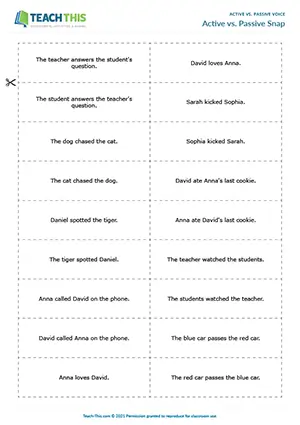
ESL Active vs. Passive Voice Games - Grammar: Writing and Reading Sentences, Matching - Pair Work
In these fun active vs. passive games, students match active and passive sentences that have the same meaning. First, students write down five active sentences in different tenses and their passive...
Changing Voices Challenge

ESL Active vs. Passive Voice Game - Grammar and Writing: Rewriting Sentences, Changing Verb Forms, True or False, Guessing - Pair Work
In this free active vs. passive voice game, students practice rewriting statements from active to passive voice or vice versa. First, students rewrite trivia...
Active vs. Passive Pursuit
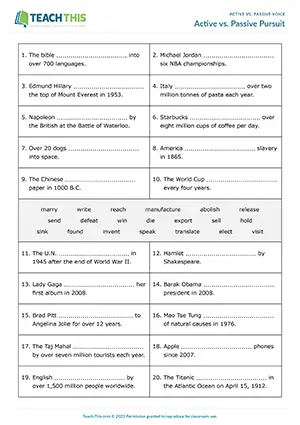
ESL Active vs. Passive Voice Board Game - Grammar and Vocabulary: Matching, Gap-fill, Forming Verbs - Group Work
In this engaging active vs. passive board game, students race to claim as many squares as they can by completing factual sentences with verbs in the correct active or passive form. Teams take turns...
Choosing the Right Voice
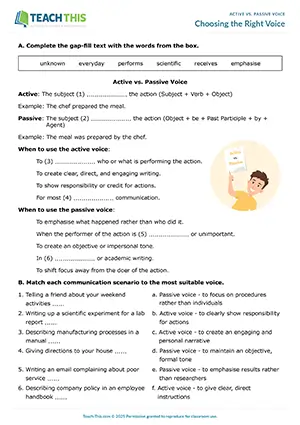
ESL Active vs. Passive Voice Worksheet - Grammar, Reading and Writing Exercises: Gap-fill, Writing and Rewriting Sentences
In this informative active vs. passive voice worksheet, students practice choosing between active and passive voice based on real-world communication contexts. First, students complete a gap-fill...
Police Interview Role-Play
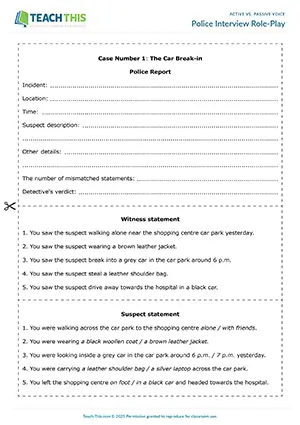
ESL Active vs. Passive Voice Activity - Grammar, Writing and Speaking: Role-play, Asking and Answering Questions, Freer Practice - Group Work
This active vs. passive voice speaking activity helps students practice using the active and passive voice appropriately in different contexts through crime...
Something in Common
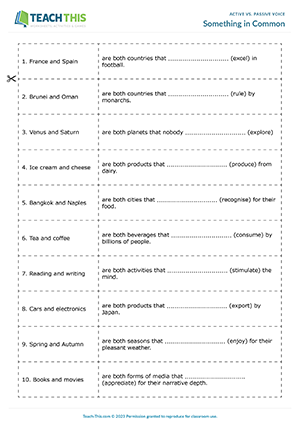
ESL Active vs. Passive Voice Game - Grammar: Matching, Changing Verb Forms, Gap-fill - Pair Work
In this enjoyable active vs. passive game, students race to complete sentences by putting the verb in brackets into the correct active or passive form. In pairs, students begin by lining up...
Understanding the Active vs. Passive Voice
The active voice puts the subject at the front as the doer of the action, as in 'The chef prepared the meal.' The passive voice shifts focus to the receiver of that action, putting the doer second or dropping them entirely, as in 'The meal was prepared by the chef.' When students misuse one voice for the other, their writing sends the wrong signal: overusing the passive in everyday speech sounds stiff and evasive, while reaching for the active in a formal report where the action matters more than who did it can sound too personal and direct.
This page covers active vs. passive voice at B1 and B2 levels, with six activities ranging from a pair card snap game to a group crime investigation role-play, including one free download.
The table below maps the active and passive voice structures across the key tenses taught at B1 and B2 level, with a sentence showing how each form shifts.
| Tense | Active Structure | Passive Structure | Example Shift |
|---|---|---|---|
| Present Simple | subject + base verb (s/es) | subject + is/are + past participle | 'She writes the report.' → 'The report is written.' |
| Past Simple | subject + past tense verb | subject + was/were + past participle | 'They built the bridge.' → 'The bridge was built.' |
| Present Continuous | subject + is/are + verb-ing | subject + is/are + being + past participle | 'He is writing the email.' → 'The email is being written.' |
| Past Continuous | subject + was/were + verb-ing | subject + was/were + being + past participle | 'They were testing the product.' → 'The product was being tested.' |
| Present Perfect | subject + has/have + past participle | subject + has/have + been + past participle | 'She has signed the contract.' → 'The contract has been signed.' |
| Past Perfect | subject + had + past participle | subject + had + been + past participle | 'Someone had stolen the painting.' → 'The painting had been stolen.' |
| Future Simple (will) | subject + will + base verb | subject + will + be + past participle | 'They will announce the results.' → 'The results will be announced.' |
| Future (going to) | subject + is/are + going to + base verb | subject + is/are + going to + be + past participle | 'We are going to launch the app.' → 'The app is going to be launched.' |
When to Use the Active vs. Passive Voice
Unknown or Unimportant Doer: Writers choose the passive when the person who performed an action is unknown, obvious from context, or simply not important to the message, as in 'The window was broken overnight.'
Softening Accountability: Speakers and writers use the passive to describe a mistake or negative outcome without pointing a finger at anyone directly, making the statement feel less confrontational, as in 'Errors were made during the filing process.'
Giving Instructions in Official Documents: The passive appears in rules, manuals, and official notices when an instruction needs to sound impersonal and authoritative rather than directed at one specific person, as in 'All forms must be submitted before the deadline.'
3-Step Framework for Teaching the Active vs. Passive Voice
1. Build the Recognition Foundation: Start students off by having them write active sentences in different tenses and their passive equivalents, then put that knowledge straight to work in a competitive pair card game where both players flip a card simultaneously and the first to spot a matching active-passive pair calls it out to score a point. To keep students sharp, each sentence has a similar-looking decoy version on another card, so accuracy matters just as much as speed.
2. Ramp Up the Challenge with a Team Board Game: Move into group competition with a board game where teams race to claim squares by filling factual sentence gaps with a verb from a central bank, choosing the correct active or passive form each time. A neat dice constraint drives extra focus: an odd number roll limits the team to odd-numbered sentences and an even roll to even-numbered ones, so students cannot simply cherry-pick the gaps they find easiest.
3. Take It into Real Communication: Bring the grammar to life with a group role-play built around crime investigation, where a detective, a suspect, and a witness work through a series of cases. The detective records witness answers in formal report language, using the passive voice for crimes and actions done to objects or people and the active voice for suspect descriptions and movements, filling in sections including Incident, Location, Time, Suspect Description, and Other Details before switching to active-voice questions when interviewing the suspect.
Common Mistakes with the Active vs. Passive Voice
Wrong Past Participle Form: Students often confuse the simple past form of an irregular verb with its past participle, using the wrong form inside a passive construction. Wrong: 'The novel was wrote by a famous author.' Correct: 'The novel was written by a famous author.'
Missing the "To Be" Auxiliary: Students often leave out the required form of "be" when building a passive sentence, placing only the past participle without a supporting verb. Wrong: 'The report prepared by the manager yesterday.' Correct: 'The report was prepared by the manager yesterday.'
Common Questions About Teaching the Active vs. Passive Voice
What is a good active and passive voice game?
The free game Changing Voices Challenge gives active and passive voice practice a trivia twist that students find motivating. Students rewrite trivia statements from active to passive voice or vice versa, then guess which are true or false. If a pair thinks a statement is false, they can earn a bonus point by guessing the right person.
How do I help students choose between active and passive voice?
The worksheet Choosing the Right Voice builds this skill through context-based decisions. Students match communication scenarios to the most suitable voice, then rewrite sentences accordingly. In the final stage, students decide whether active or passive fits each scenario, explain why, and write an example passive sentence for each one.
What games help students practice active and passive voice verb forms?
The game Something in Common sends students racing to complete active and passive verb forms. Students line up sentence beginning cards and match each with an ending card, then complete each ending by putting the verb in brackets in the correct active or passive form. The first pair to finish correctly wins.
Become a Teach This Member
Get unlimited access to the full library, plus new resources added every week.
Unlimited Resource Access
Download from 3000+ worksheets, activities, and games.
Save 5+ Hours Weekly
Cut lesson prep time with ready-to-use resources, plus teacher notes and answer keys.
Trusted Professional Quality
Classroom-tested, editable resources created by experienced ESL professionals.
Fresh Content Weekly
Get 5 new resources added to the library each week.
Here's what our members are saying...


