
Conditionals Review ESL Games, Activities & Worksheets
First vs. Second Conditional
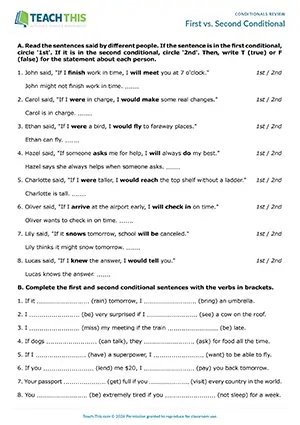
ESL First vs. Second Conditional Worksheet - Grammar Exercises: Binary Choice, True or False, Gap-fill, Rewriting Sentences, Sentence Completion
This free first vs. second conditional worksheet helps students understand and use both structures, focusing on the difference between real future...
Zero and First Conditional Challenge

ESL Zero and First Conditional Board Game - Grammar and Speaking: Forming Sentences - Group Work
In this useful zero vs. first conditional board game, students use verb prompts to make zero and first conditional sentences. Players take turns rolling the dice and moving their counter along the board...
Conditional Battleships
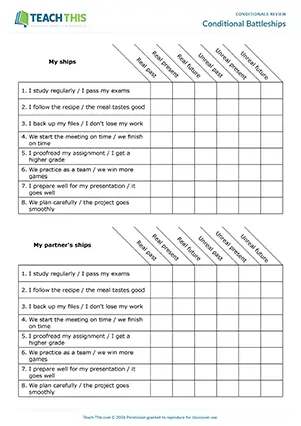
ESL Conditionals Game - Grammar and Speaking: Forming Sentences, Freer Practice - Pair Work
In this rewarding conditionals game, students play battleships by producing conditional sentences from prompts, practicing real and unreal past, present and future forms. First, students mark four ships on...
Conditional Cards

ESL Conditionals Review Game - Grammar, Writing and Speaking: Sentence Completion, Freer Practice - Group Work
In this fast-paced conditionals review game, students race each other to complete zero to third conditional sentences. In groups, one student begins by turning over a card and reading the if-clause of...
Conditional Completion

ESL Conditionals Review Activity - Grammar, Writing and Speaking: Sentence Completion, Discussion, Communicative Practice - Group Work
In this conditionals review activity, students complete sentence stems using a range of conditional forms and then compare and discuss their answers...
Conditional Conundrum

ESL Conditionals Review Game - Grammar: Matching, Changing Word Forms, Forming Sentences - Group Work
In this productive conditionals review game, students practice using first, second and third conditionals with a range of subordinate conjunctions to form complex sentences. In each group, two students are...
Conditional Thoughts
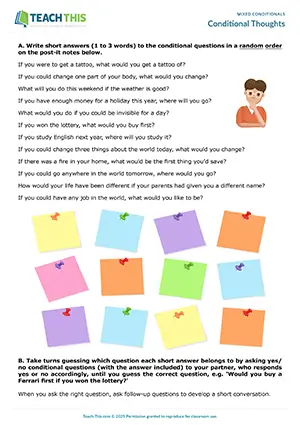
ESL Conditionals Review Activity - Grammar and Speaking: Writing Short Answers, Asking and Answering Questions, Freer Practice - Pair Work
In this insightful conditionals review activity, students practice asking and answering questions using different conditional forms. First, students answer the...
Conditional Chains
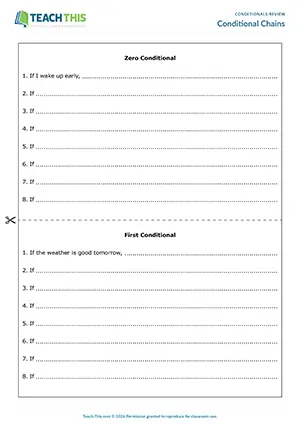
ESL Conditionals Review Activity - Grammar and Writing: Writing Sentences - Group Work
In this creative conditionals activity, students review the zero, first, second and third conditionals by writing chain sentences. In groups of four, students write a result clause for the first zero, first...
Countdown
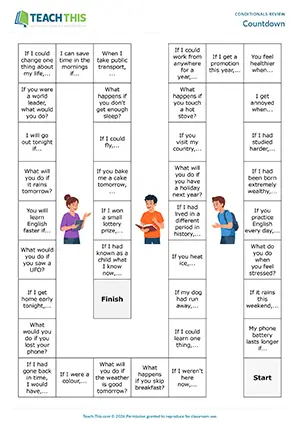
ESL Conditionals Review Board Game - Grammar and Speaking: Sentence Completion, Answering Questions, Freer Practice - Group Work
In this free conditionals review board game, students race to complete zero, first, second and third conditional sentences and answer conditional questions in a...
First to Third Conditionals Review
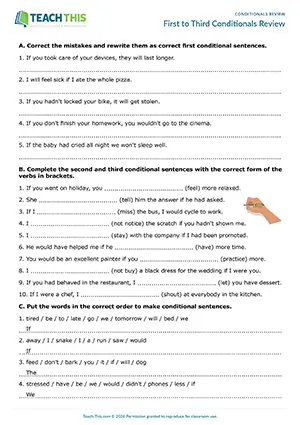
ESL Conditionals Review Worksheet - Grammar Exercises: Error Correction, Gap-fill, Unscrambling, Matching, Identifying, Sentence Completion
Here is a free conditionals review worksheet to help students practice or review first, second and third conditionals. Students begin by correcting mistakes in...
Make Your Own Dominoes
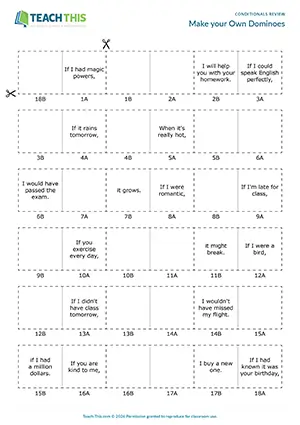
ESL Conditionals Review Game - Grammar: Sentence Completion, Matching - Group Work
In this enjoyable conditionals review game, students practice zero, first, second and third conditionals by completing sentences and playing games of dominoes. In groups, students read and complete...
Second vs. Third Conditional

ESL Second vs. Third Conditional Worksheet - Grammar Exercises: Error Correction, Sentence Completion - Speaking Activity: Asking and Answering Questions - Pair Work
This comprehensive second vs. third conditional worksheet helps students distinguish between and practice forming and using these two conditional...
The Conditionals Race

ESL Conditionals Review Game - Grammar: Matching - Speaking Activity: Discussion, Communicative Practice - Group Work
In this engaging conditionals review game, students play dominoes by matching halves of zero, first, second and third conditional sentences together. The first player tries to make a conditional sentence...
The Farmer and His Sons
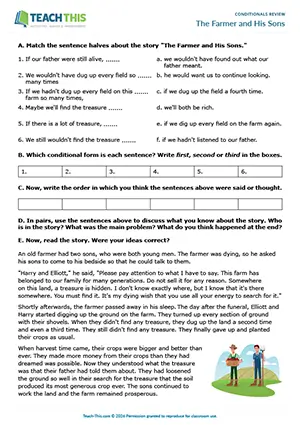
ESL Conditionals Review Worksheet - Grammar, Reading and Writing Exercises: Matching, Categorising, Writing Sentences - Pair Work
In this thought-provoking conditionals review worksheet, students work with an Aesop fable to practice the first, second and third conditionals. First, students...
Under What Condition?

ESL Real Conditionals Activity - Grammar and Writing: Writing Sentences, Guessing, Discussion - Pair Work
In this fun real conditionals activity, students guess the circumstances in which a partner did, does or will do certain things using past, present and future real conditionals. First, students write ten sentences...
We Will Finish First Unless...
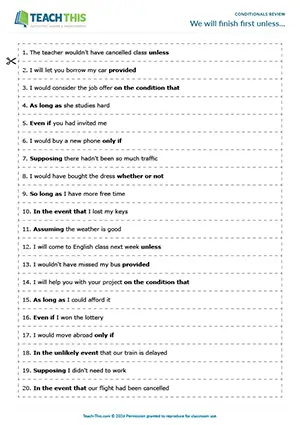
ESL Conditionals Review Game - Grammar: Sentence Completion - Group Work
In this lively conditionals review game, students race to complete first, second, and third conditional sentences with various conditional words and phrases such as 'unless' and 'as long as'. A member from each team runs to your desk...
Understanding Conditionals
Conditionals are sentence structures built around an 'if' clause and a result clause, and English uses four main types: one for general facts, one for real future possibilities, one for present hypotheticals, and one for imagined past situations that never happened. When students use the second conditional where the first belongs, they accidentally change a real future possibility into a hypothetical, which can make a confident plan sound like an impossible dream.
This page covers conditionals across B1 and B2 levels, with 16 activities spanning board games, card games, worksheets, pair work speaking activities, and group writing tasks, including two activities available as free downloads.
This table shows the four main conditional types taught at B1 and B2 level, with the required verb form for each clause and a plain example of each type in use.
| Conditional Type | If-Clause Form | Main Clause Form | Use | Example |
|---|---|---|---|---|
| Zero | present simple | present simple | general truths and facts | 'If you mix red and blue, you get purple.' |
| First | present simple | will + base verb | real future possibility | 'If it rains tomorrow, we will cancel the game.' |
| Second | past simple | would + base verb | present or future hypothetical | 'If I had a car, I would drive to work.' |
| Third | past perfect | would have + past participle | imagined past situation that did not happen | 'If she had left earlier, she would have caught the train.' |
When to Use Conditionals
Expressing Regret or Hindsight: A speaker chooses the third conditional when looking back on a past situation that cannot be changed, using it to reflect on what the outcome would have been if things had gone differently, as in 'If I had taken that job offer, I would have moved to London.'
Giving Instructions and Warnings: Writers use the zero conditional to state rules, procedures, or cause-and-effect warnings in technical or professional contexts where one event always produces the same result, as in 'If the system detects an error, it shuts down automatically.'
Making Offers and Negotiating: The first conditional works naturally in spoken negotiation or when one party sets a realistic future condition for the other to consider, as in 'If you can deliver by Friday, we will place the order today.'
3-Step Framework for Teaching Conditionals
1. Build Accuracy with Individual Forms: Before students can choose between conditional types, they need to produce each form correctly under pressure. A board game format works well here: players roll a die, land on a square marked for a specific conditional type, then pick up a verb card pairing such as 'exercise / stay' and produce a correct sentence using both verbs. The group votes on whether the sentence is accurate, so every player stays engaged even when it is not their turn.
2. Push Form-Switching with Peer Accountability: Once students handle individual types with some confidence, give them activities that force rapid switching between all three main conditionals while adding social pressure. A matching game with a built-in referee role is particularly effective: two players take turns turning over conjunction cards and sentence cards to form complex conditionals across first, second, and third forms, while a third student checks each answer against an answer key. The referee role rotates after every eight correct matches, so every student in the group holds all three positions before the game ends.
3. Unlock Generative Writing with Chain Sentences: The final step is getting students to write conditionals spontaneously, without prompts locking them into a single correct answer. A chain-writing activity moves the whole class into creative territory: each student writes a result clause for a given conditional sentence, then rewrites that result clause as a new if-clause by changing the verb form, and passes the card to the right so the next student continues the chain. Groups end up with eight linked conditional sentences that build on each other.
Common Mistakes with Conditionals
Using 'will' in the If-Clause: Students often put 'will' into the if-clause of a first conditional sentence, following the logic of their first language, when English requires the present simple instead. Wrong: 'If it will rain, we will cancel the trip.' Correct: 'If it rains, we will cancel the trip.'
Using 'would have' in the If-Clause of the Third Conditional: Students often write 'would have' in the if-clause of a third conditional sentence, treating both clauses as structurally identical, when only the main clause takes 'would have.' Wrong: 'If I would have studied harder, I would have passed the exam.' Correct: 'If I had studied harder, I would have passed the exam.'
Common Questions About Teaching Conditionals
What first and second conditional worksheet is suitable for intermediate students?
The free worksheet First vs. Second Conditional is well-suited to B1 intermediate students because it focuses on the core difference between a real future possibility and a hypothetical situation, which is the key conceptual challenge at that level. Students read sentences and circle whether each is first or second conditional, then rewrite first conditional sentences as second conditional sentences.
What is a fun game for practicing all the conditional forms?
A great game for reviewing all four conditional forms is the free Countdown board game. Players roll the dice and move around the board, and each player has just 15 seconds to complete a conditional sentence or answer a question on their square. Any mistake or time-out means moving back two squares.
What is an engaging speaking activity for practicing different conditional forms?
The activity Conditional Thoughts suits students who need to practice different conditional forms in a speaking context. Students write short answers to conditional questions in a random order, then swap with a partner and ask yes/no conditional questions to guess which question each answer belongs to. When they guess correctly, they ask follow-up questions to develop a short conversation.
Become a Teach This Member
Get unlimited access to the full library, plus new resources added every week.
Unlimited Resource Access
Download from 3000+ worksheets, activities, and games.
Save 5+ Hours Weekly
Cut lesson prep time with ready-to-use resources, plus teacher notes and answer keys.
Trusted Professional Quality
Classroom-tested, editable resources created by experienced ESL professionals.
Fresh Content Weekly
Get 5 new resources added to the library each week.
Here's what our members are saying...


