
Making Arrangements ESL Activities, Role-Plays, Games & Worksheets
Are you free?
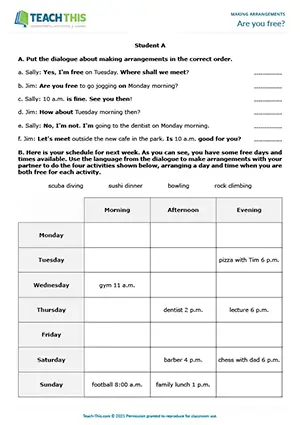
ESL Making Arrangements Activity - Speaking: Ordering, Role-Play, Communicative Practice - Pair Work
In this communicative making arrangements activity, students arrange days and times to do various activities with a partner. First, students put a making arrangements dialogue in the correct order and...
Scheduling and Rescheduling
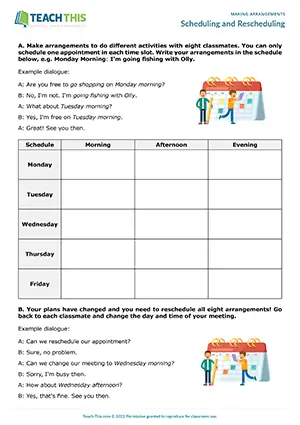
ESL Scheduling and Rescheduling Activity - Speaking: Role-Play, Communicative Practice - Pair Work
In this useful making arrangements speaking activity, students practice making arrangements and rescheduling. First, students go around the class making arrangements to do different...
Changing Reservations

ESL Changing Reservations Role-Plays - Speaking Activity: Role-Play, Controlled and Communicative Practice - Pair Work
In these productive changing reservations role-plays, students practice changing hotel, restaurant and transportation reservations over the phone. First, in pairs, students practice an example...
Let’s Make Plans!
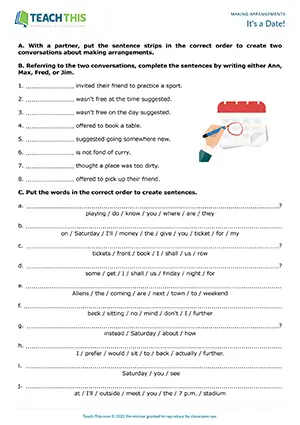
ESL Making Arrangements Worksheet - Grammar and Writing Exercises: Ordering, Gap-fill, Matching, True or False, Writing a Dialogue, Freer Practice - Pair Work
Here is a comprehensive making arrangements worksheet to help students practice language for making different types of arrangements. First...
Let's Meet!

ESL Making Arrangements Activity - Vocabulary, Writing and Speaking: Ordering, Matching, Gap-fill, Writing and Presenting a Dialogue - Pair Work
In this free making and rescheduling appointments activity, students order, complete and role-play dialogues for arranging and rescheduling...
Let's Hang Out
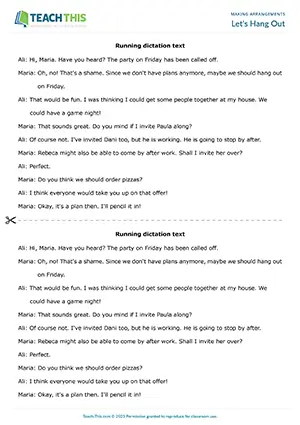
ESL Making Arrangements Activity - Vocabulary, Reading and Writing: Running Dictation, Identifying, Gap-fill, Writing and Presenting a Dialogue - Pair Work
In this engaging making arrangements activity, students practice phrasal verbs related to making and discussing arrangements. First...
Something's Come Up

ESL Making Arrangements Game - Vocabulary: Matching, Forming Sentences - Pair Work
In this enjoyable making arrangements game, students practice language related to making, changing, and cancelling plans. First, in pairs, students race to line up the sentence beginning cards and match...
Using Making Arrangements Language
Making arrangements is the language used to propose, agree on, or decline plans with another person, covering everything from suggesting a time and place to confirming or changing the details. When students rely on vague phrases like 'maybe we meet?' instead of standard arrangement language, they come across as uncertain or unclear, and the other person may not know whether a plan has actually been agreed.
This page covers making arrangements across A2, B1, and B2 levels, with seven resources including activities, role-plays, a worksheet, and a game, with one available as a free download.
The table below maps the key communicative moves in making arrangements, from opening the conversation to confirming, rescheduling, or cancelling.
| Situation | Function | Example Phrase |
|---|---|---|
| Opening a scheduling conversation | Checking availability | 'What does your week look like?' |
| Proposing a meeting time | Suggesting | 'Are you free on Friday afternoon?' |
| Original time does not work | Counter-suggesting | 'I can't make Monday. How about Wednesday instead?' |
| Both parties agree on a time | Confirming | 'Wednesday at two works for me. It's a date!' |
| Unable to keep an arrangement | Cancelling | 'Something's come up. I'm afraid I'll have to cancel.' |
| Need to change the time or date | Rescheduling | 'Could we push our meeting back to Thursday?' |
| Invitee cannot attend | Declining | 'I'd love to, but I'm not free that day. Can we try another time?' |
When to Use Making Arrangements Language
Making social plans with friends: When arranging informal plans with friends or peers, speakers use casual, direct language that would sound out of place in a professional context, such as 'Are you up for grabbing lunch on Saturday?'
Scheduling a professional meeting: In a work context, arranging a meeting with a colleague or client calls for more formal phrasing that signals respect for the other person's time, such as 'Would Thursday afternoon work for you?'
Changing or cancelling an existing arrangement: When circumstances force a change of plans, speakers need specific language to apologize, explain briefly, and propose an alternative without damaging the relationship, such as 'I'm really sorry, but something has come up. Could we reschedule for next week?'
3-Step Framework for Teaching Making Arrangements Language
1. Build the Language Before the Conversation: Start by giving students a model dialogue to study and practice with a partner so they can internalize the structure and phrasing of a real arrangement exchange. Once they have a feel for how the language works, move them on to a schedule-based activity where both students have different availability and have to find a day and time that works for them both, making every exchange genuinely communicative from the start.
2. Consolidate Through Written Practice: Before pushing students into freer production, give them time to work through the language in a more controlled written format. A sequence of exercises that moves from ordering conversations to gap-fill and unscrambling sentences about making arrangements for a concert builds accuracy and confidence before students attempt to produce the language on their own.
3. Remove the Scaffolding Gradually: Move students into role-plays where they change reservations in realistic contexts like hotels, restaurants, and transportation. Start with the full dialogue visible, then erase a section after each pair finishes a round until there is nothing left on the board and students are completing their role-plays unaided. This gradual removal of support builds genuine fluency rather than memorization.
Common Mistakes with Making Arrangements Language
Using the wrong tense to suggest a time: Students often use the present simple when making suggestions about future plans instead of modal or question forms, which makes the suggestion sound like a statement of fact rather than a proposal. Wrong: 'We meet on Friday.' Correct: 'Shall we meet on Friday?'
Omitting polite softeners when declining: Students often decline an arrangement too bluntly, saying only that they cannot make the time without offering an apology or an alternative, which sounds abrupt or rude to a native speaker. Wrong: 'I can't come on Tuesday.' Correct: 'I'm afraid I can't make Tuesday. Could we try Wednesday instead?'
Common Questions About Teaching Making Arrangements Language
What is a fun game for practicing making arrangements?
The game Something's Come Up gets students working with arrangement vocabulary at the sentence level. Pairs race to line up sentence beginning cards and match each one with a suitable ending card, then complete the sentences by joining the halves together with arrangement vocabulary cards. The first pair to correctly complete all their sentences wins the game.
What is an engaging making arrangements speaking activity?
Running dictation drives the activity Let's Hang Out, where pairs dictate a making arrangements dialogue to each other. Students then underline eight phrasal verbs in the dialogue and categorize them as separable or inseparable, before using them to complete a second conversation and write their own making arrangements dialogue for a given situation.
What is a good worksheet for teaching making arrangements?
Five sequenced exercises make the worksheet It's a Date! a practical choice for teaching making arrangements. Students order two conversations, complete sentences about them, unscramble sentences about making arrangements for a concert, decide if statements are true or false, and then write and present their own dialogue. The sequence moves from reading the language to producing it independently.
Become a Teach This Member
Get unlimited access to the full library, plus new resources added every week.
Unlimited Resource Access
Download from 3000+ worksheets, activities, and games.
Save 5+ Hours Weekly
Cut lesson prep time with ready-to-use resources, plus teacher notes and answer keys.
Trusted Professional Quality
Classroom-tested, editable resources created by experienced ESL professionals.
Fresh Content Weekly
Get 5 new resources added to the library each week.
Here's what our members are saying...


