Academic Style

Intermediate (B1) 45 minutes
EAP Academic Style Worksheet preview, Intermediate (B1), with vocabulary and reading exercises, matching, identifying, and synonym activities

EAP Academic Style Worksheet - Vocabulary and Reading Exercises: Matching, Identifying, Providing Synonyms

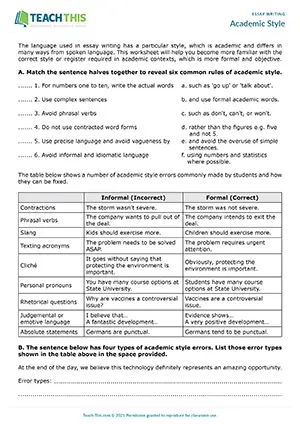
In this free academic style worksheet, students learn and practice some common rules of academic style for essay writing. First, students match sentence halves together to reveal six common...

EAP Academic Style Worksheet - Vocabulary and Reading Exercises: Matching, Identifying, Providing Synonyms In this free academic style worksheet, students learn and practice some common rules of academic style for essay writing. First, students match sentence halves together to reveal six common rules of academic style in essay writing. Next, students review a table that shows a number of academic style errors commonly made by students and how they can be fixed. Students then analyse an example sentence to identify and categorise the academic style errors. After that, students look at a table containing a number of informal words and phrases and replace them with appropriate formal words. Next, students read an essay to identify and underline academic style errors. Finally, students review the provided revised version of the essay that adheres to academic style rules.

Body Paragraphs

Intermediate (B1) 60 minutes
EAP Body Paragraphs Worksheet preview, Intermediate (B1), reading and writing exercises, sentence writing, paragraph outlining

EAP Body Paragraphs Worksheet -Reading and Writing Exercises: Writing Sentences, Creating a Paragraph Outline, Writing Paragraphs

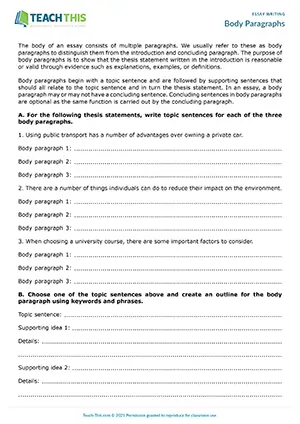
In this informative body paragraphs worksheet, students practice planning and writing body paragraphs that support a thesis statement. To begin, students...

EAP Body Paragraphs Worksheet -Reading and Writing Exercises: Writing Sentences, Creating a Paragraph Outline, Writing Paragraphs In this informative body paragraphs worksheet, students practice planning and writing body paragraphs that support a thesis statement. To begin, students read an introductory text about body paragraphs. Students then write topic sentences for body paragraphs that support a thesis statement. Next, students choose one of the topic sentences and create an outline for the body paragraph using keywords and phrases. After that, students use the paragraph outline to write a complete body paragraph. Finally, students read the first body paragraph from an essay and then write a follow-up paragraph that supports an additional and related point on the topic.

Concluding Paragraphs

Intermediate (B1) 60 minutes
EAP Concluding Paragraphs Worksheet preview, Intermediate (B1), paraphrasing, sentence writing and concluding paragraph activities

EAP Concluding Paragraphs Worksheet - Reading and Writing Exercises: Paraphrasing, Writing Sentences from Prompts, Writing a Concluding Paragraph

In this useful concluding paragraphs worksheet, students learn and practice writing concluding paragraphs that restate a thesis statement, summarise key...

EAP Concluding Paragraphs Worksheet - Reading and Writing Exercises: Paraphrasing, Writing Sentences from Prompts, Writing a Concluding Paragraph In this useful concluding paragraphs worksheet, students learn and practice writing concluding paragraphs that restate a thesis statement, summarise key points and end with a final statement. First, students read a short text explaining the elements that make up a concluding paragraph and examine an example concluding paragraph and its structure. Students then write concluding sentences by reading thesis statements and rewriting them so that the language is new but the ideas are unchanged. Next, students use notes from basic essay outlines to write the first two sentences of three concluding paragraphs. The first sentence is a concluding sentence and the second sentence summarises the main ideas of the body paragraphs. Finally, students use essay questions to write their own concluding paragraphs that contain a concluding sentence beginning with a transition, a summary of the key points from the body paragraphs and a final statement.

Essay Cohesion, Coherence and Unity

Intermediate (B1) 60 minutes
EAP Essay Cohesion, Coherence and Unity Worksheet preview, Intermediate (B1), categorising conjunctions, gap-fill, rewriting activities

EAP Essay Cohesion, Coherence and Unity Worksheet - Reading and Writing Exercises: Categorising, Gap-fill, Identifying, Rewriting a Paragraph

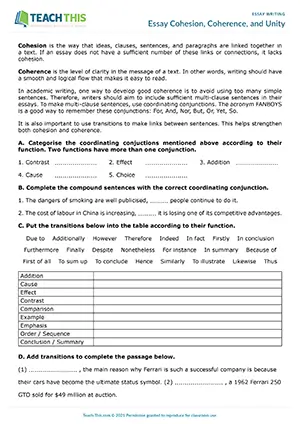
In this comprehensive essay writing worksheet, students learn and practice essay cohesion, coherence and unity. Students start by reading information about...

EAP Essay Cohesion, Coherence and Unity Worksheet - Reading and Writing Exercises: Categorising, Gap-fill, Identifying, Rewriting a Paragraph In this comprehensive essay writing worksheet, students learn and practice essay cohesion, coherence and unity. Students start by reading information about cohesion, coherence, coordinating conjunctions and transitions. Students then categorise coordinating conjunctions according to their function. Next, students complete compound sentences with the correct coordinating conjunction. After that, students place transitions into a table according to their function. Students then move on to complete a short passage with suitable transitions. Afterwards, students read about how pronouns can be used to improve coherence in writing. Students then rewrite a paragraph by replacing nouns with pronouns from a table to improve the paragraph's overuse of key terms. Next, students read a brief explanation of 'unity' and then identify the sentence in a paragraph that is off-topic and breaks unity. In the final exercise, students review an essay to identify and underline errors with cohesion, coherence and unity.

Essay Outlines

Intermediate (B1) 90 minutes
EAP Essay Outlines Worksheet preview, Intermediate (B1), identifying and brainstorming for essay outlines

EAP Essay Outlines Worksheet - Reading and Writing Exercises: Identifying, Brainstorming, Creating an Essay Outline, Writing an Essay

This productive essay outlines worksheet helps to teach students how to create outlines as part of the essay writing process. To start, students read about the...

EAP Essay Outlines Worksheet - Reading and Writing Exercises: Identifying, Brainstorming, Creating an Essay Outline, Writing an Essay This productive essay outlines worksheet helps to teach students how to create outlines as part of the essay writing process. To start, students read about the importance of an outline in the essay writing process. Students then read an example essay and use it to complete an essay outline. Next, students read and analyse an essay question and brainstorm ideas to include in an essay outline about the topic. After that, students create an outline for the essay based on their brainstormed ideas. In the last exercise, students write a complete essay based on the outline.

Essay Structure Running Dictation

Intermediate (B1) 50 minutes
EAP Essay Structure Running Dictation preview, Intermediate (B1), running dictation and discussion activities

EAP Essay Activity - Reading, Writing and Speaking: Comprehension Questions, Writing Explanations, Discussion, Freer Practice - Pair and Group Work

This essay writing running dictation activity helps students practice the key components of essay structure. First, one student in each pair stands up, runs to...

EAP Essay Activity - Reading, Writing and Speaking: Running Dictation, Comprehension Questions, Writing Explanations, Discussion, Freer Practice - Pair and Group Work This essay writing running dictation activity helps students practice the key components of essay structure. First, one student in each pair stands up, runs to paragraph text A, B, C or D, reads a sentence or two, runs back and dictates what they read to their partner, who writes it down. Halfway through the two students swap roles. When the paragraph has been dictated, pairs compare their text with the original. Pairs then read about different parts of an essay and write short answers about which part of an essay their paragraph is from and the elements that make it so. After that, pairs expand on their answers by writing a complete explanation. Next, go through the four paragraphs that form an essay and the students' explanations by having pairs read their dictated paragraphs in order starting with the introduction. After each paragraph has been read out, pairs read their explanations. Finally, in groups, students discuss two questions about the structure of essays.

Essay Writing Review

Intermediate (B1) 90 minutes
EAP Essay Writing Review Worksheet preview, Intermediate (B1), reading and writing exercises, error correction, matching, true or false

EAP Essay Writing Review Worksheet - Reading and Writing Exercises: Writing Paragraphs, Identifying, Error Correction, Matching, True or False Questions

In this handy essay writing review worksheet, students revise basic academic essay writing and practice the skills covered in previous worksheets in this series...

EAP Essay Writing Review Worksheet - Reading and Writing Exercises: Writing Paragraphs, Identifying, Error Correction, Matching, True or False Questions In this handy essay writing review worksheet, students revise basic academic essay writing and practice the skills covered in previous worksheets in this series. Students begin by adding a background to a thesis statement in order to create an introduction paragraph that follows a funnel structure. Next, students read the first body paragraph from an essay and write a second body paragraph that maintains unity and coherence with the first. Students then use a basic essay outline to help them write a concluding paragraph. After that, students identify academic style issues in a body paragraph and rewrite the paragraph so that it shows an appropriate register. Next, students rewrite sentences, so they are structurally and grammatically correct. Students then move on to read an essay that is missing cohesive devices such as transitions and sentence connectors. Students then match cohesive devices with the gaps to complete the essay. Students end by reviewing some basic knowledge about essay writing by answering true or false statements.

Fragments, Run-ons, and Comma Splices
Intermediate (B1) 30 minutes
EAP Fragments, Run-ons, and Comma Splices Worksheet preview, Intermediate (B1), identifying and correcting sentence errors

EAP Fragments, Run-ons, and Comma Splices Worksheet - Reading and Writing Exercises: Identifying, Categorising, Error Correction

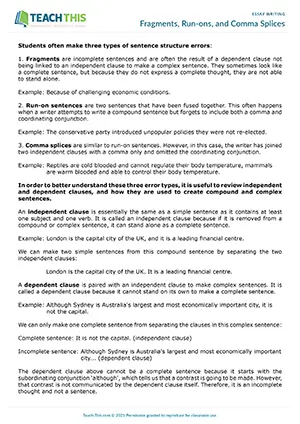
In this insightful sentence structure errors worksheet, students practice identifying and correcting fragments, run-on sentences, and comma splices. First...

EAP Fragments, Run-ons, and Comma Splices Worksheet - Reading and Writing Exercises: Identifying, Categorising, Error Correction In this insightful sentence structure errors worksheet, students practice identifying and correcting fragments, run-on sentences, and comma splices. First, students read explanations of fragments, run-on sentences and comma splices. Students also review independent and dependent clauses, and how they are used to create compound and complex sentences to better understand the three error types. Students then read sentences and identify coordinating conjunctions, subordinating conjunctions, subjects and verbs. Next, students identify independent clauses and dependent clauses in sentences and classify them as either compound or complex. Lastly, students identify three sentences with errors and rewrite them so that they are correct, categorising the errors as either being a fragment, run-on sentence, or comma splice.

Introduction Paragraphs

Intermediate (B1) 75 minutes
EAP Introduction Paragraphs Worksheet preview, Intermediate (B1), reading and writing exercises, thesis statement and paragraph writing

EAP Introduction Paragraphs Worksheet - Reading and Writing Exercises: Ordering, Writing a Thesis Statement, Paragraph Completion, Writing Introduction Paragraphs

In this engaging introduction paragraphs worksheet, students learn and practice how to write introduction paragraphs that have a background and thesis...

EAP Introduction Paragraphs Worksheet - Reading and Writing Exercises: Ordering, Writing a Thesis Statement, Paragraph Completion, Writing Introduction Paragraphs In this engaging introduction paragraphs worksheet, students learn and practice how to write introduction paragraphs that have a background and thesis statement and show a funnel type structure. First, students read a short passage, explaining the parts and structure of an introduction paragraph. Students also examine an example introduction paragraph and its organisation to reinforce introduction paragraph structure. Students then move on to reorder sentences so that they make a logical and coherent introduction paragraph that shows a funnel type structure. Next, students add a thesis statement to general statements in order to complete an introduction paragraph. Students then write a complete introduction paragraph by adding general statements to a thesis statement. After that, students use prompts to write an introduction paragraph that begins with general statements and ends with a thesis statement. In the final exercise, students are given freer practice to write an introduction paragraph on a specific topic without the guidance of prompts.

Paragraph and Essay Structure Comparison
Intermediate (B1) 45 minutes
EAP Paragraph and Essay Structure Worksheet preview, Intermediate (B1), table completion and short answer questions

EAP Paragraph and Essay Structure Worksheet - Reading and Writing Exercises: Table Completion, Short Answer Questions

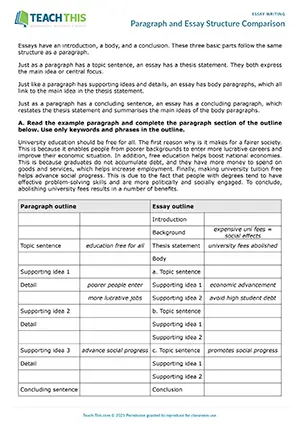
In this detailed paragraph and essay structure worksheet, students compare paragraph and essay structure to familiarise themselves with the basic parts of an academic essay. Students begin by reading...

EAP Paragraph and Essay Structure Worksheet - Reading and Writing Exercises: Table Completion, Short Answer Questions In this detailed paragraph and essay structure worksheet, students compare paragraph and essay structure to familiarise themselves with the basic parts of an academic essay. Students begin by reading about the similarities between paragraph structure and basic essay structure. Students then read an example paragraph and complete a paragraph outline to understand its structure. Next, students read an example essay and complete an essay outline to reinforce their understanding of essay structure. In the final exercise, students read the example essay one more time and answer questions about the essay's organisation.

Parts of an Essay

Intermediate (B1) 90 minutes
EAP Parts of an Essay Worksheet preview, Intermediate (B1), reading, matching, outlining and writing exercises

EAP Parts of an Essay Worksheet - Reading and Writing Exercises: True or False, Matching, Labelling, Brainstrorming, Creating an Essay Outline, Writing an Essay

In this free parts of an essay worksheet, students learn about the various parts that make up an academic essay and practice writing a structured, logical,...

EAP Parts of an Essay Worksheet - Reading and Writing Exercises: True or False, Matching, Labelling, Brainstrorming, Creating an Essay Outline, Writing an Essay In this free parts of an essay worksheet, students learn about the various parts that make up an academic essay and practice writing a structured, logical, and cohesive essay. Students start by answering three true or false statements to review some basic essay structure knowledge. Next, students unscramble letters to reveal the key terms used to describe the various parts of an academic essay and match them to their definitions. After that, students read an example essay to identify its key parts. In the last exercise, students create an essay outline on the topic of healthy eating and then use the outline to write a short essay that demonstrates all the parts of an academic essay.

Peer Feedback Workshop

Intermediate (B1) 45 minutes
EAP Peer Feedback Worksheet preview, Intermediate (B1), peer review and discussion activities

EAP Peer Feedback Worksheet - Reading and Writing Exercises: Writing Sentences, Peer Review - Speaking Activity: Discussion, Communicative Practice - Pair Work

This informative essay writing worksheet develops students' ability to give effective peer feedback for academic writing, focusing on content, organisation, and...

EAP Peer Feedback Worksheet - Reading and Writing Exercises: Writing Sentences, Peer Review - Speaking Activity: Discussion, Communicative Practice - Pair Work This informative essay writing worksheet develops students' ability to give effective peer feedback for academic writing, focusing on content, organisation, and language features. Students begin by reading a peer feedback advice table. In pairs, students then discuss why three feedback comments are unhelpful. After that, students categorise feedback phrases according to their function. Next, students rewrite the comments from Exercise B using the feedback phrases. Following that, students read feedback comments and label each as referring to either content, organisation, or language. Students then read an example essay introduction and write one positive feedback comment and one suggestion for improvement, focusing on two different aspects: content, organisation or language. After that, students choose an essay question and write a four-sentence introduction. Finally, students swap paragraphs with a partner and complete a form to give each other feedback using the advice and phrases from the worksheet.

Hedging Language

Upper-intermediate (B2) 25 minutes
EAP Essay Writing Worksheet preview, Upper-intermediate (B2), hedging language activities, identifying, rewriting, unscrambling

EAP Essay Writing Worksheet - Reading and Writing Exercises: Identifying, Rewriting Sentences, Unscrambling, Sentence Combining, Changing Sentence Structure

In this useful hedging language worksheet, students learn and practice words and phrases that can be used in academic writing and speaking to soften a claim...

EAP Essay Writing Worksheet - Reading and Writing Exercises: Identifying, Rewriting Sentences, Unscrambling, Sentence Combining, Changing Sentence Structure In this useful hedging language worksheet, students learn and practice words and phrases that can be used in academic writing and speaking to soften a claim and maintain academic integrity. To start, students compare four sentences and identify those that use hedging language, underlining the words that express caution. Next, students read the various parts of speech that can be used to hedge a claim. Students then choose from the words provided to rewrite each sentence, hedging claims that may be too strong or without evidence. After that, students unscramble each 'that clause' and use two sentences provided to make a single sentence that contains a claim that is hedged. In the last exercise, students use 'adjective + to clauses' to hedge the claims made.

Essay Writing Dominoes

Upper-intermediate (B2) 20 minutes
EAP Essay Writing Game preview, Upper-intermediate (B2), matching vocabulary dominoes for essay writing terms

EAP Essay Writing Game - Vocabulary: Matching - Group Work

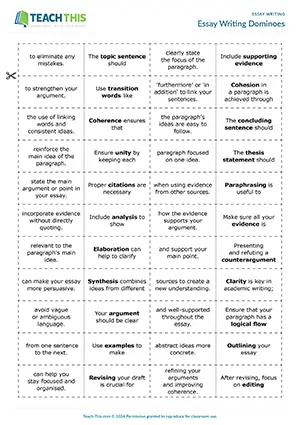
Here is a fun essay writing game to help students review and reinforce their understanding of key terms and concepts in essay writing. To begin, students turn over the top domino from the pile and place it face-up on the table. The first player...

EAP Essay Writing Game - Vocabulary: Matching - Group Work Here is a fun essay writing game to help students review and reinforce their understanding of key terms and concepts in essay writing. To begin, students turn over the top domino from the pile and place it face-up on the table. The first player then puts a domino down before or after the domino on the table, making sure that the two sentence halves match to form a sentence that expresses a key term or concept in essay writing. The other players then take turns matching their dominoes in the same way by putting them down at either end of the domino chain. If a player cannot put down one of their dominoes, they take one from the pile and put it down if they can. If there are no dominoes left in the pile, play passes to the next student. The first player to get rid of all their dominoes wins the game.

Understanding Academic Essay Writing

Academic essay writing involves developing a focused response to a question through logically organised paragraphs, relevant support and clear language. An effective essay makes the relationship between its central position and supporting points clear, so readers can follow and evaluate the reasoning.

This page contains fourteen resources across B1 and B2, including worksheets on planning, paragraph development, cohesion, sentence accuracy, academic style and peer feedback, alongside a running dictation activity and a dominoes game. Two worksheets are available as free downloads.

The table outlines common essay components and their purposes. Adapt the organisation to the assignment; an essay does not always require a fixed number of paragraphs or the same introduction pattern.

ComponentPurposePlanning or checking question
Essay outline Arrange relevant points before drafting 'How does each planned paragraph help answer the question?'
Introduction Establish the topic and the essay's focus or position 'Does the reader know what this essay will examine?'
Thesis statement Express the central position or controlling idea 'Is my main point specific enough to guide the essay?'
Body paragraph Develop a relevant point through support and explanation 'Have I explained how the support relates to my point?'
Connections between ideas Make relationships and references clear 'Does this connector express the relationship I intend?'
Conclusion Bring the response together in light of the discussion 'Does this conclusion follow from the points I developed?'

How to Develop Academic Essay Writing Skills

Read the task before choosing a structure: Ask students to identify what the question requires them to explain, compare or evaluate. Select and organise ideas around that purpose rather than fitting every task into a memorised essay pattern.

Develop support rather than length: When a paragraph feels thin, check whether it needs a relevant example, evidence or an explanation of the connection to the main point. Adding another sentence is useful only when it develops the reasoning. Where sources are required, use verifiable material and follow the assignment's referencing guidance.

Revise in separate passes: Review the response to the question and the organisation first, then check paragraph connections and sentence accuracy. This helps students avoid polishing sentences that they may later need to remove or substantially rewrite.

3-Step Framework for Teaching Essay Writing

Use this progression across B1 lessons to move from understanding organisation to developing paragraphs and revising a complete response.

1. Turn an essay question into a plan: Students use a model essay to complete an outline, then analyse a new question and brainstorm relevant ideas. They organise those ideas into their own outline before writing an essay. Use the relationship between the plan and the draft to identify points that need more development.

2. Develop points into connected paragraphs: Students write topic sentences that support a thesis statement, choose one and create a paragraph outline using keywords and phrases. They expand it into a paragraph, then write a follow-up paragraph that develops an additional related point. Apply this practice when strengthening the body of the earlier draft.

3. Review structure and language together: Students practice completing an introduction, writing a related body paragraph and using an outline to form a conclusion. They also revise register, correct sentences and select cohesive devices. After this guided review, ask them to apply the same checks to their own essay and explain one revision that makes their response clearer.

Common Mistakes with Academic Essay Writing

Joining complete sentences with only a comma: Two independent clauses need suitable punctuation or a conjunction. Choose the correction that preserves the intended relationship. Incorrect: 'The course is demanding, students need time to prepare.' Correct: 'The course is demanding, so students need time to prepare.'

Including a related detail that does not support the paragraph's point: A sentence can concern the broad topic and still break paragraph unity. In a paragraph explaining how public transport can reduce travel costs, a detail about bus colours needs a relevant connection or should be removed. Off-topic detail: 'The buses in my town are blue.' Better approach: Remove the colour detail and develop the cost point with relevant support.

Common Questions About Teaching Essay Writing

How can I teach students to give feedback on essays?

The worksheet Peer Feedback Workshop helps students replace vague comments with specific feedback on content, organisation and language. They examine unhelpful comments, practice feedback phrases and respond to an example introduction. Students then write their own short introduction and exchange feedback using a form, applying the guidance to a partner's writing.

What free worksheet helps teach essay structure?

The worksheet Parts of an Essay connects essay terminology with a model text. Students match key terms to definitions and identify the parts in an example essay. They then create an outline about healthy eating and write a short essay, moving from recognising the structure to organising their own ideas.

What game helps students review essay writing?

The game Essay Writing Dominoes asks students to match sentence halves that explain essay writing terms and concepts. Players add matching dominoes to either end of a chain, drawing from the pile when they cannot play. The first to use all their dominoes wins, giving concept review a clear game objective.

Become a Teach This Member

  • 3,000+ ESL activities, games and worksheets
  • Online teaching platform with unlimited student access
  • Full access to Game Maker, Worksheet Maker and Slide Maker
View Membership Plans

Here’s What Our Members Are Saying

Jose Pinto

★★★★★

ESL Teacher, Timor-Leste

"There are a lot of resources that are useful for teaching English. I downloaded the games which are handy and use them in my classes. With the games, my students never skip class or feel tired to learn English. The resources for teaching English helped my students progress in grammar, vocabulary, writing and comprehension. They also helped me a lot to guide my students to learn in a practical way."

Julia Lohla

★★★★★

English Instructor, United States

"Thank you for providing these incredible resources. Teach-This.com is always my go-to site for class activities, and I recommend it often. I love how it is organized. I can find resources for a specific grammar concept or language function by level and type of activity. Every time I visit your site, I discover a new classroom interaction strategy that's perfect for teaching the concept I'm focusing on! When I return after the holidays, yours will be the first subscription I restart."

Carrie Brooke-Mellor

★★★★★

ESOL Teacher, United Kingdom

"I am an ESOL teacher, and the resources have helped my classes enormously. In particular, the speaking activities were a great help for my intermediate students before their exam. The website is user-friendly, and I will continue to utilise the resources - next term is reading and comprehension, so I will be looking for more resources from you. Thank you for such helpful activities and worksheets. They save me a lot of time in class preparation."

Charlie Sanders

★★★★★

ESL Teacher, France

"Teach This is an absolutely brilliant website, offering a vast amount of high-quality content, much of it free. Everyone involved in its creation deserves commendation. The leadership's vision has my deepest respect and gratitude. It's undoubtedly the best resource for English teachers, with its clear layout, easy navigation, concise messaging, and lack of invasive advertising - rare qualities that Teach This has perfected."

Joy Tebow

★★★★★

English Teacher, Laos

"When I need to add or change an activity from my school's curriculum, I always turn to TeachThis. While our curriculum is usually very good, it sometimes doesn't fit well with my students. With TeachThis, I can easily find activities that match my topic and level, and the resources make my classes more interesting and varied. I look forward to the monthly newsletter and exploring new materials for inspiration. Please keep it up!"

Mina Zolfaghari

★★★★★

English Tutor, Australia

"I like the efficiency and organization of the website. The resources cater to various levels with topic-based options for higher levels. The worksheets are very engaging and the answer keys are particularly helpful for teacher. The resources are also highly specific to levels and outcomes, making planning much easier. Finding what I need is simple and time-saving with the keyword search feature. Everything is clear and straightforward."

Karin Kiss

★★★★★

ESL Teacher, Switzerland

"The easy and ready-to-go materials have helped me a lot during the last few years. Most of all I like the grammar games that activate my pupils and keep them engaged. My lessons have become way more playful and varied. Additionally, I like the grammar worksheets which I use to consolidate what I have worked on during class. The website is very user-friendly, and I have never had any difficulties finding what I was looking for."

David-Wonbae Lee

★★★★★

Business English Teacher, Canada

"A friend told me about the site, and it's awesome. I have found the Business English resources especially engaging and relevant for my students as the materials help them understand business writing and terms. My teaching experience has also improved from using the games on the site as they allow me to teach in a fun way. The user experience is outstanding. Great job!"

Daniela Garcia

★★★★★

English Teacher, Mexico

"I found Teach-This a long time ago when I started teaching. It's always had great resources. I really appreciate the grammar materials, board games, and group activities. They've saved me lots of time on lesson planning. The materials are easy to use and understand, making my job much simpler. The best thing is that many resources can be downloaded for free. I've used it for around 8 years, and it consistently offers great content."

Thomas Wilson

★★★★★

Primary School Teacher, United Kingdom

"I use the resources from the Games Section as part of my daily 30-minute morning warm-up activities, and I've received rave reviews for using them. The games help me maintain student interest and participation and leave the students feeling happy and awake. I like everything about the site, and customer support is very effective as they respond in time."

Eugenia Fernandez

★★★★★

EFL Teacher, Argentina

"Teach-This is one of the best EFL websites I've found. It's extremely user-friendly, and I always find what I need quickly. I like the design, and the content is fun, engaging and original. I am very thankful for all your work and generosity by making some resources free. I always recommend this website to my fellow teachers. Your work is really helpful, and I value it enormously."

Jakub Havlk

★★★★★

Language School Teacher, Czechia

"I like the grammar-focused resources the most as they save me time. The resources also inspire me. If I see an interesting grammar activity, I often rework it for other grammar rules. I like the fact that I simply pay a flat fee, and I can download whatever I want. Teach-This really is a great timesaver. I know that if I am in need of resources for my students, I can go to Teach-This and find something interesting."

Alice Dimpz

★★★★★

English Teacher, Kenya

"Getting familiar with the site and how to use the resources is not difficult. I found the writing skills resources to be the most valuable as they have enhanced my teaching of this skill. The website is elaborate and full of all types of resources to help me teach English. When I contacted customer support, they were super-fast to deal with my enquiry. So overall, I recommend it."

Ikrram Badaoui

★★★★★

ESL Teacher, Morocco

"I have found the grammar and vocabulary resources the most valuable. They have improved my teaching experience because they are easy to use and well-organized. The materials are very engaging for my students. The website is also very user-friendly. The best thing about Teach-This is that it offers ready-made worksheets for busy teachers, and the content is well-organized and full of information."

Tania Ahmed

★★★★★

High School Teacher, Kurdistan

"I'm really glad I found the Teach-This website. The materials in the General English section have proven to be really helpful and made my classes more engaging. The materials are well-structured and cover a wide range of topics, making it easy to keep my students interested and motivated. Overall, my experience using your resources has been great."

Khawla Orq

★★★★★

EFL Teacher, Yemen

"My first impression of the website was that it was amazing. The games and activities have really improved my teaching. The resources are engaging and relevant to my students' needs, and I find the website easy to use and navigate. Thanks."

Anika Yadav

★★★★★

English Teacher, India

"I would like to thank you for making a fantastic website. I particularly enjoy teaching the functional language materials, which have been very helpful in my classes. The resources have significantly improved my students' communication skills in daily life, so it was rewarding to see them benefit in this way. It feels great to be able to make a difference in my students' lives. Please keep up the good work."

Dr. Elena Petrov

★★★★★

Academic English Coordinator, Spain

"I've been teaching Academic English for over eight years, and Teach-This.com has become my go-to resource for university preparation classes. The academic vocabulary exercises and speaking test preparation activities are exceptionally well-designed for advanced learners. My students particularly appreciate the study skills resources and paragraph writing materials, which have significantly boosted their confidence and exam scores."

Suzanne Coleman

★★★★★

Volunteer English Teacher, England

"I like your resources because they are so interesting and attractive. Your resources help to maintain student interest. Your resources have helped with the planning and preparation of my lessons because I have often been able to find resources focusing on specific topics, grammar or vocabulary. I am particularly grateful for your free resources, which I use at the English Club where I am a volunteer and help to support internationals in the community who are learning English."