
Ordering Food & Drink ESL Restaurant Role-Plays, Activities & Worksheets
Can I take your order?
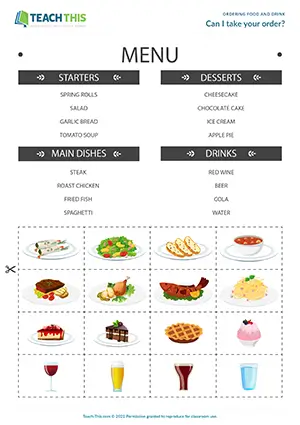
ESL Ordering Food and Drink Game - Speaking: Role-Play, Asking and Answering Questions, Communicative Practice - Group Work
This free ordering food and drink game helps students learn and practice phrases for ordering menu items. First, students read a menu, decide on a three...
At the Coffee Shop
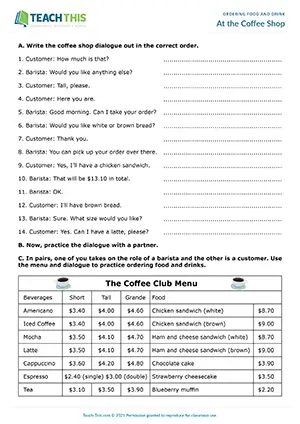
ESL Coffee Shop Role-Play - Speaking Activity: Ordering a Dialogue, Role-Play, Communicative Practice - Pair Work
In this useful coffee shop role-play activity, students practice ordering food and drink in a coffee shop. First, students write a coffee shop dialogue out in the correct order. After that, one student takes on...
At the Restaurant
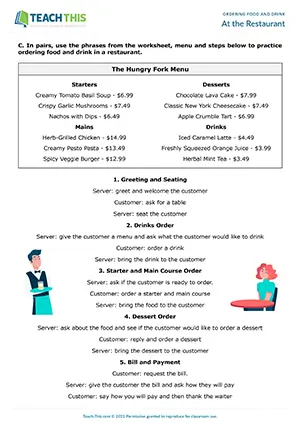
ESL Restaurant Role-Plays - Reading and Vocabulary Exercises: Ordering a Dialogue, Categorising, Gap-fill - Speaking Activity: Role-Play - Pair Work
These productive restaurant role-play activities help students practice various phrases used by a customer and server in a restaurant. First, in pairs...
Fussy Eaters
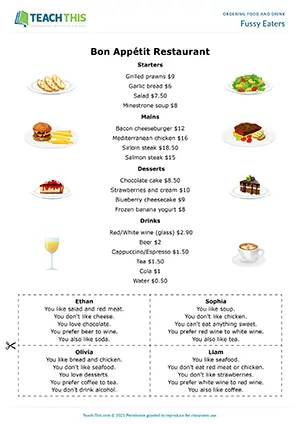
ESL Restaurant Role-Play - Speaking Activity: Role-Play, Communicative Practice - Group Work
In this fun restaurant role-play activity, students take on the role of fussy eaters and order food and drink according to preferences on cards. In groups, one student takes on the role of a waiter or waitress...
What's for lunch?
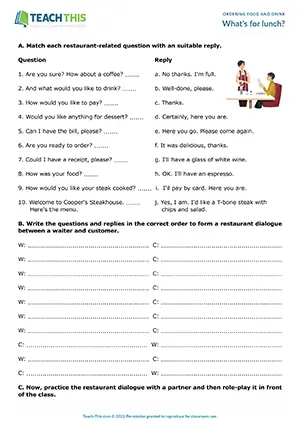
ESL Restaurant Language Worksheet - Vocabulary Exercises: Matching, Ordering - Speaking Activity: Role-Play - Pair Work
This informative restaurant language worksheet helps students learn and practice phrases for ordering food and drink in a restaurant. First, students match each restaurant-related question...
Dining Out
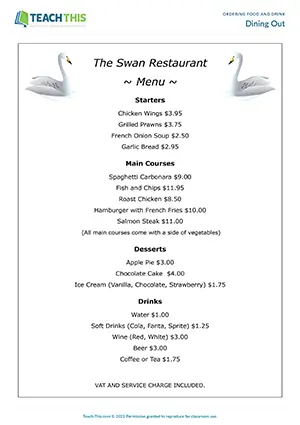
ESL Restaurant Role-Plays - Speaking Activity: Communicative Practice - Group Work
In this engaging restaurant role-play activity, students review language for dining out by role-playing various restaurant interactions. The role-play cards cover 20 interactions in chronological order that...
Let's Order!
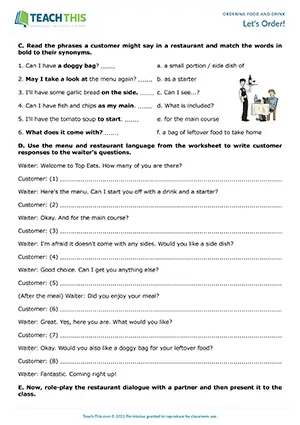
ESL Restaurant Language Worksheet - Vocabulary Exercises: Labelling, Matching, Dialogue Completion - Speaking Activity: Role-Play - Pair Work
In this free restaurant language worksheet, students learn and practice phrases to order food and drink in a restaurant. First, students complete menu headings...
Restaurant Role-Play
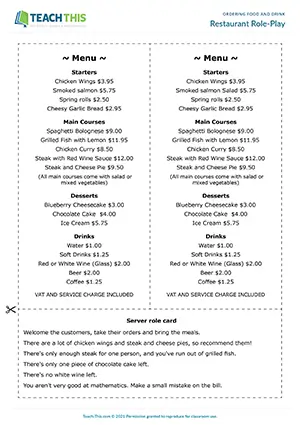
ESL Restaurant Role-Play - Speaking Activity: Communicative Practice - Group Work
Here is a communicative restaurant role-play to help students review phrases to order food and drink in a restaurant. In groups, one student takes on the role of a server, and the other two students are...
Sally's Sandwiches
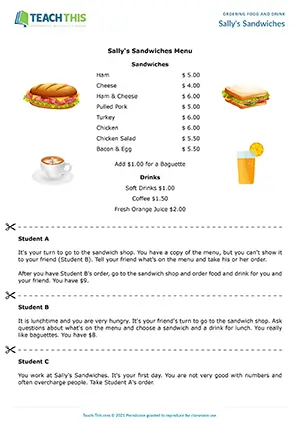
ESL Sandwich Shop Role-Play - Speaking Activity: Communicative Practice - Group Work
In this communicative sandwich shop role-play activity, students order food and drink from a sandwich shop at lunchtime. In groups of three, one student takes on the role of a person ordering food and...
Who said it?
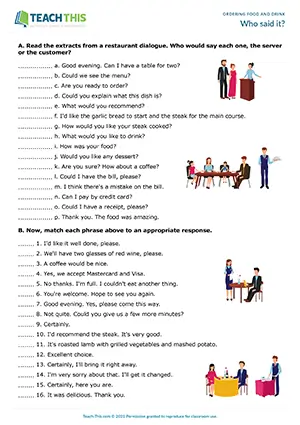
ESL Restaurant Worksheet - Vocabulary Exercises: Identifying, Matching
In this insightful restaurant language worksheet, students practice phrases said by a server and a customer in a restaurant. Students begin by reading extracts from a restaurant dialogue and deciding who said each one, the server or...
Using Restaurant Language
Ordering food and drink in English covers a broader range of language than most learners expect: beyond 'I'll have the pasta, please', a real restaurant visit involves making requests, asking about dishes, handling problems, and responding to a server's questions on the spot. Learners who only practice set phrases struggle the moment a server asks something unexpected like 'Would you like to hear our specials?' or 'How would you like that cooked?', because they have no language ready for anything outside the script they rehearsed.
This page covers ordering food and drink across A1-A2, A2, and B1 levels, with ten resources including role-plays, speaking activities, and worksheets, with two available as free downloads.
The table below maps the most common moments in a restaurant interaction to who typically speaks and an example phrase for each situation.
| Situation | Who Says It | Example Phrase |
|---|---|---|
| Welcoming a customer | Server | 'Good evening. Do you have a reservation?' |
| Asking to be seated | Customer | 'A table for two, please.' |
| Asking for the menu | Customer | 'Could we see the menu, please?' |
| Taking the order | Server | 'Are you ready to order?' |
| Ordering a dish | Customer | 'I'll have the pasta, please.' |
| Asking about a dish | Customer | 'What does the risotto come with?' |
| Making a recommendation | Server | 'The grilled salmon is very popular.' |
| Reporting a problem | Customer | 'Excuse me, I ordered the steak, not the chicken.' |
| Describing dietary needs | Customer | 'I'm allergic to nuts. Does this dish contain any?' |
| Asking for the bill | Customer | 'Could we have the bill, please?' |
| Responding to a bill query | Server | 'I'll just check that for you.' |
How to Use Restaurant Language
Modifying or customizing an order: When a learner wants to change a dish or request a substitution, they need specific softening language to avoid sounding demanding, as in 'Could I have the dressing on the side, please?' rather than 'Put the dressing on the side.'
Flagging a problem with the order: When the wrong dish arrives or something is missing, learners need a polite but clear way to raise the issue without sounding aggressive, as in 'Excuse me, I think there might be a mistake. I ordered the vegetarian option.'
Asking about unfamiliar items on the menu: When a learner encounters an unfamiliar dish or ingredient, asking the server directly is the natural and expected thing to do, and having a ready phrase prevents the awkward silence that often happens at this moment, as in 'Could you tell me what the tagine comes with?'
3-Step Framework for Teaching Restaurant Language
1. Introduce Phrases Through a Card Game: Open with a card game that gets learners using the core ordering phrases immediately in a low-pressure context. Learners try to collect four menu item cards by ordering from other group members using phrases like 'Can I have a salad, please?', and the cardholder responds in role, either handing it over with 'Certainly, here you are' or declining with 'I'm sorry. We don't have any... left.' Every exchange is a complete mini-transaction, so the phrases get repeated naturally across multiple rounds.
2. Build Both Sides of the Conversation: Once learners know the customer phrases, shift the focus to the full two-way exchange. Start with sentence strips that learners put in the correct order to form a dialogue between a customer and a server, then push further by having them categorise every phrase in the dialogue according to whether a customer or a server would say it. This dual focus means learners stop thinking of restaurant language as one-sided and start recognising the whole conversational script.
3. Sequence a Full Dining Experience: Round off the sequence with a set of scenario cards that walk learners through 20 interactions in chronological order, covering everything that happens between a customer and a server from the moment they arrive to the moment they leave. A student reads out each scenario card in turn, for example 'Invite your friend to a restaurant one evening', and the group performs it before moving to the next. Running the full sequence in order gives learners a mental map of how a real restaurant visit unfolds in English.
Common Mistakes with Restaurant Language
Using 'I want' instead of a polite request form: Students often translate directly from their first language and say 'I want the chicken' when ordering, not realising that in English this sounds blunt and impolite in a service context where 'I'll have' or 'Could I have' is the expected form. Wrong: 'I want the soup and the steak.' Correct: 'I'll have the soup, and could I have the steak, please?'
Confusing course names when ordering: Students often say 'first' and 'second' when ordering courses, translating directly from their first language, which leaves a server unsure what the learner is referring to and can result in dishes arriving in the wrong order or not at all. Wrong: 'For my first I want the soup and for my second I want the steak.' Correct: 'For my starter I'll have the soup, and for my main course I'll have the steak.'
Common Questions About Teaching Restaurant Language
What is a useful worksheet for ordering food and drink?
The free worksheet Let's Order! covers vocabulary, phrases, and dialogue in one sequence. Students label menu headings, match a waiter's questions to suitable responses, and match words in customer phrases to their synonyms, which builds the language they need. They then write customer responses in a dialogue and role-play it with a partner.
What is a fun restaurant role-play for practicing ordering food?
The activity Restaurant Role-Play puts students through the full dining experience. The server takes orders and calculates the bill while customers work out what they think it should come to. If the numbers do not match, customers challenge the server. At the end, every customer rates the server out of ten, keeping everyone invested throughout.
What is a good activity for practicing ordering food?
In the activity Fussy Eaters, each student plays a fussy eater with specific food and drink preferences on a card, while one student plays the waiter or waitress. Students cannot just recite a standard order and must ask questions, explain their likes and dislikes, and work through the menu until the waiter finds something that suits them.
Become a Teach This Member
Get unlimited access to the full library, plus new resources added every week.
Unlimited Resource Access
Download from 3000+ worksheets, activities, and games.
Save 5+ Hours Weekly
Cut lesson prep time with ready-to-use resources, plus teacher notes and answer keys.
Trusted Professional Quality
Classroom-tested, editable resources created by experienced ESL professionals.
Fresh Content Weekly
Get 5 new resources added to the library each week.
Here's what our members are saying...


