
Similes & Metaphors ESL Games & Worksheets
As Easy as ABC
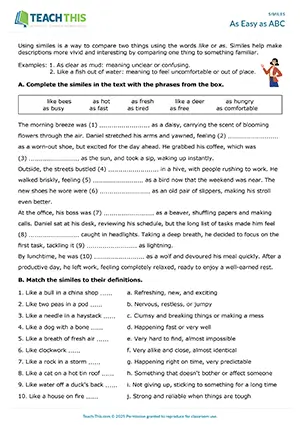
ESL Similes Worksheet - Reading and Vocabulary Exercises: Gap-fill, Matching - Writing Game: Short Story Writing, Freer Practice - Pair Work
In this useful similes worksheet and game, students learn and practice common English similes to help them understand how similes make descriptions more vivid...
Metaphor Bingo
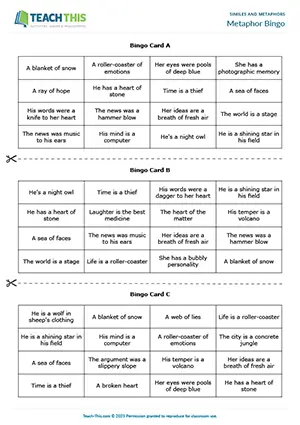
ESL Metaphors Game - Vocabulary: Bingo, Matching - Group Work
In this free metaphors game, students play bingo by matching metaphors with their meanings. In groups, the bingo caller reads a sentence explaining a metaphor at random from the caller's sheet, e.g. 'He is very kind and generous.' The players...
Mighty Metaphors
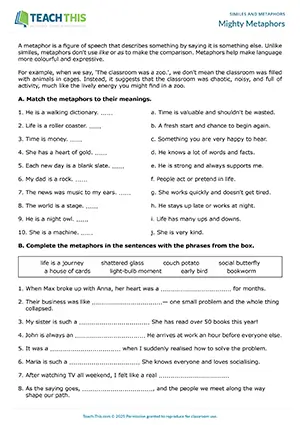
ESL Metaphors Worksheet - Reading and Vocabulary Exercises: Matching, Gap-fill, Identifying, Writing Definitions, Paragraph Writing
In this productive metaphors worksheet, students learn and practice common English metaphors. First, students read a short text explaining metaphors...
Similes Showdown
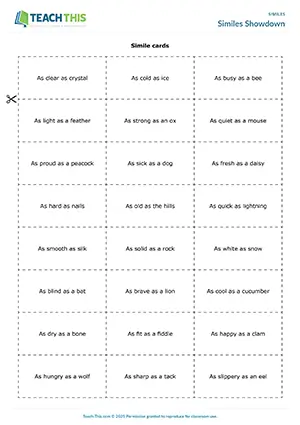
ESL Similes Games - Vocabulary and Speaking: Matching, Impromptu Speech, Freer and Communicative Practice - Pair Work
In these fun simile games, students match common English similes with their definitions and then use them in conversational contexts. First, students play a...
What Are Similes and Metaphors?
Similes and metaphors compare two things to create a vivid image: a simile uses 'like' or 'as,' as in 'She ran like the wind,' while a metaphor states that one thing is another, as in 'She was a tornado in the kitchen.' When students take metaphors literally or use similes when a stronger metaphor would fit better, their writing can lose clarity, color, and impact.
This page covers similes and metaphors for B2 learners, with four resources: one worksheet and game, one bingo game, one worksheet, and one pair-work speaking game. One resource includes a free PDF.
This table shows common types of similes and metaphors, how each one works, and a ready example for classroom reference.
| Type | How It Works | Common Use | Example |
|---|---|---|---|
| Simile with 'like' | Compares two things using 'like' | Describing an action or feeling clearly | 'She sings like an angel.' |
| Simile with 'as...as' | Uses a fixed pattern to compare a quality to a familiar image | Emphasizing a clear quality | 'He is as strong as an ox.' |
| Simple metaphor | States that one thing is another to create a direct image | Making a description stronger | 'She was a tornado in the kitchen.' |
| Extended metaphor | Develops one metaphor across several sentences or a whole text | Linking ideas in writing | 'Life is a journey, and we must all find our own path.' |
| Personification | Gives human qualities to a non-human subject | Making places, objects, or nature feel alive | 'The wind whispered through the trees.' |
| Conceptual metaphor | Maps one broad idea onto another | Explaining abstract ideas through familiar concepts | 'Time is money, so do not waste it.' |
| Dead metaphor | Uses a familiar metaphor that no longer feels very figurative | Naming everyday ideas | 'The foot of the mountain.' |
When to Use Similes and Metaphors
Softening a comparison: Use a simile when you want to make a vivid comparison without sounding too blunt or intense, since 'like' or 'as' shows that the idea is a comparison rather than a direct judgment, as in 'That meeting was like watching paint dry.'
Making a forceful image: Use a metaphor when you want the comparison to land with more impact, since it states the image directly instead of marking it as only similar, as in 'That meeting was a train wreck.'
Describing a sensation: Use a simile or metaphor when you want listeners to picture a physical or emotional feeling quickly, especially when the feeling is hard to explain literally, as in 'My legs felt like lead by the end of the race.'
3-Step Framework for Teaching Similes and Metaphors
1. Anchor the Language in Controlled Writing: Give students a worksheet that moves from recognition to production in one session. They start by filling in simile gaps and matching meanings, then the session opens into a writing race: pairs must write a short story using exactly three similes from a card, and the first pair to raise their hands reads their story aloud. If the story is coherent and uses the similes correctly, they score a point. If not, the pair is out of the round. That scoring pressure keeps the writing purposeful rather than casual.
2. Build Fast Metaphor Recognition: Before students can use metaphors, they need to recognize them quickly, and bingo gives them repeated exposure in a focused way. The caller reads a plain English explanation, for instance 'He is very kind and generous,' and players scan their cards for the metaphor that fits, such as 'He has a heart of gold.' Repeated rounds, changing bingo cards, and rotating callers help students meet the same metaphors from several angles in a short time.
3. Push Production into Spontaneous Speech: Seal the learning by asking students to use similes under real communicative pressure. In an impromptu speech game, students pick up a speech card and talk for 30 seconds in response to the prompt, weaving in an appropriate simile naturally. For the situation card 'Talk about how to explain directions to a tourist,' the appropriate simile is 'As clear as crystal.' Fitting a simile into live, unscripted speech is a higher bar than writing one into a story, and it helps students move toward confident, fluent use.
Common Mistakes with Similes and Metaphors
Missing the First 'as' in Fixed Similes: Students often drop the first 'as' in the pattern 'as...as,' which makes a common simile sound incomplete. Wrong: 'He is strong as an ox.' Correct: 'He is as strong as an ox.'
Creating a Mixed Metaphor: Students often combine two unrelated metaphors in the same sentence, which creates an image that contradicts itself and sounds confusing. Wrong: 'We need to iron out the stumbling blocks in this project.' Correct: 'We need to remove the stumbling blocks in this project.'
Common Questions About Teaching Similes and Metaphors
What is a good worksheet for teaching metaphors?
The worksheet Mighty Metaphors takes students from meaning recognition to written production in one lesson. Students match metaphors to meanings, complete gap-fill sentences, identify metaphors in context, and explain them in their own words. They then write a short story using at least five metaphors and get class feedback on their choices.
What is a fun game for practicing similes?
The game Similes Showdown gets students using similes in both matching and speaking practice. Students first match similes with definitions in a memory-style card game. They then choose speech prompts and speak for 30 seconds while fitting an appropriate simile naturally into what they say.
Become a Teach This Member
Get unlimited access to the full library, plus new resources added every week.
Unlimited Resource Access
Download from 3000+ worksheets, activities, and games.
Save 5+ Hours Weekly
Cut lesson prep time with ready-to-use resources, plus teacher notes and answer keys.
Trusted Professional Quality
Classroom-tested, editable resources created by experienced ESL professionals.
Fresh Content Weekly
Get 5 new resources added to the library each week.
Here's what our members are saying...


