Classroom Instructions Board Game

Beginner (A1) 30 minutes
ESL classroom language game preview, beginner A1, forming sentences from prompts, controlled practice, group work

ESL Classroom Instructions Board Game - Vocabulary and Speaking: Forming Sentences from Prompts, Controlled Practice - Group Work

In this fun classroom instructions board game, students review 12 common classroom verbs and phrases by making imperative sentences from prompts. In groups...

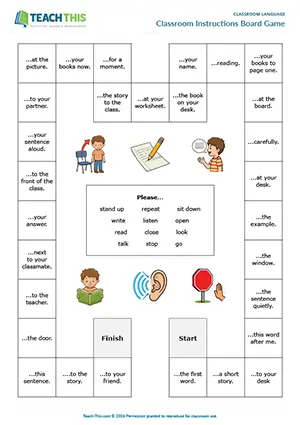
ESL Classroom Instructions Board Game - Vocabulary and Speaking: Forming Sentences from Prompts, Controlled Practice - Group Work In this fun classroom instructions board game, students review 12 common classroom verbs and phrases by making imperative sentences from prompts. In groups, players take turns rolling the dice and moving their counters along the board. When a player lands on a sentence-ending square, e.g. '...a short story', they use the ending and a suitable verb or phrase from the centre box to make a classroom instruction in the imperative, e.g. 'Please write a short story.' If the other students agree that the classroom instruction is correct and clear, the player stays on the square. If not, the player goes back to their previous square. The turn then passes to the next player. The first student to reach the finish wins the game. This resource can also be used with our 'Classroom Verbs Flashcards and Worksheet' and 'Classroom Instructions Pelmanism Game'.

Classroom Instructions Pelmanism Game
Beginner (A1) 20 minutes
ESL classroom language game preview, beginner A1, matching, pelmanism, forming sentences, freer practice, pair work

ESL Classroom Instructions Game - Vocabulary and Speaking: Matching, Pelmanism, Forming Sentences, Freer Practice - Pair Work

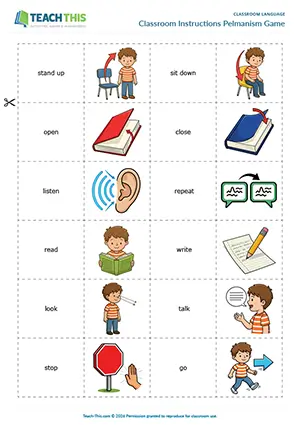
In this engaging classroom instructions game, students practice 12 common verbs and phrases used in classroom instructions. In pairs, the first player turns...

ESL Classroom Instructions Game - Vocabulary and Speaking: Matching, Pelmanism, Forming Sentences, Freer Practice - Pair Work In this engaging classroom instructions game, students practice 12 common verbs and phrases used in classroom instructions. In pairs, the first player turns over one picture card and one word card. If the verb or phrase matches the picture, the player makes a classroom instruction using the verb or phrase and one of the sentence frames on the board, e.g. 'Please sit down.' If the instruction is correct and appropriate, the student keeps the two cards and plays again. If the student cannot make a classroom instruction or the two cards don't match, the student turns them back over, keeping them in the same place. The turn then goes to the other player. The student with the most pairs of cards at the end of the game wins. This resource can also be used with our 'Classroom Verbs Flashcards and Worksheet' and 'Classroom Instructions Board Game'.

Classroom Verbs: Flashcards & Worksheet
Beginner (A1) 30 minutes
ESL classroom language flashcards and worksheet preview, beginner A1, eliciting, drilling, matching, multiple choice

ESL Classroom Verbs Flashcards and Worksheet - Flashcards: Eliciting, Drilling, Sentence Frames - Vocabulary Exercises: Matching, Multiple Choice

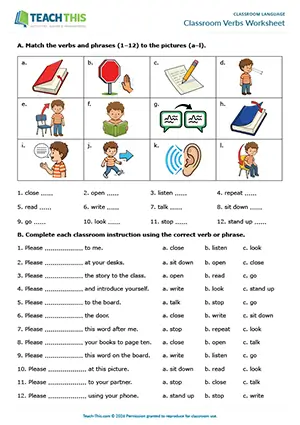
In this useful classroom vocabulary resource, students learn 12 common classroom verbs and phrases and practice them with flashcards and a worksheet...

ESL Classroom Verbs Flashcards and Worksheet - Flashcards: Eliciting, Drilling, Sentence Frames - Vocabulary Exercises: Matching, Multiple Choice In this useful classroom vocabulary resource, students learn 12 common classroom verbs and phrases and practice them with flashcards and a worksheet. To begin, hold up each flashcard. Point to the picture and elicit each classroom verb or phrase. Then model and drill pronunciation chorally and individually. Next, write the following frames on the board: 'What should I do?' 'Please...' 'Should I...?' 'Yes, please. / No, please don't.' Show the flashcards again and ask different students questions using the sentence frames on the board. Elicit suitable responses as you move around the class. On the worksheet, students then match the classroom verbs and phrases to pictures. Finally, students complete each classroom instruction with the correct verb or phrase. As an extension, play a quick review game using the flashcards, e.g. Simon Says, what's missing?, slap-the-card, or mime and guess. This resource can also be used with our 'Classroom Instructions Board Game' and 'Classroom Instructions Pelmanism Game'.

Classroom Objects Challenge

Elementary (A1-A2) 25 minutes
ESL classroom language games for A1-A2 elementary: matching, pelmanism, sentence practice, classroom vocabulary

ESL Classroom Language Games - Vocabulary and Speaking: Matching, Pelmanism, Forming Sentences, Freer Practice - Pair Work

Here are two engaging classroom object games to help students learn and practice the names of common classroom objects. First, students play a pelmanism...

ESL Classroom Language Games - Vocabulary and Speaking: Matching, Pelmanism, Forming Sentences from Prompts, Freer Practice - Pair Work Here are two engaging classroom object games to help students learn and practice the names of common classroom objects. First, students play a pelmanism game where they match the names of classroom objects to pictures. In pairs, students take turns turning over a word card and a picture card. If the classroom object word matches with the picture, the student keeps the two cards and has another turn. If the two cards don't match, the student turns them back over. The student with the most pairs of cards at the end of the game wins. Next, students play a game in which they make sentences using the classroom objects vocabulary. Students take turns picking up a word card and reading the classroom object to their partner, who has 20 seconds to make a meaningful sentence using the word. If the student makes an appropriate sentence, they keep the card. If not, the card is placed at the bottom of the pile. The student with the most cards at the end of the game is the winner.

Just Say It

Elementary (A1-A2) 25 minutes
ESL classroom language game for A1-A2 elementary: miming, guessing, forming sentences, classroom phrases and commands

ESL Classroom Language Game - Vocabulary and Speaking: Miming, Guessing, Forming Sentences, Freer Practice - Pair Work

Here is a free classroom language game to help students practice classroom phrases and commands. Teams take turns rolling the dice. If a team rolls an odd number, a team member picks up a classroom...

ESL Classroom Language Game - Vocabulary and Speaking: Miming, Guessing, Forming Sentences, Freer Practice - Pair Work Here is a free classroom language game to help students practice classroom phrases and commands. Teams take turns rolling the dice. If a team rolls an odd number, a team member picks up a classroom command card and mimes the command to their teammate who has 30 seconds to say what it is. If the student is successful, the team wins and keeps the card. If not, the other team has one chance to guess and win the card. If a team rolls an even number, a team member picks up a 'What do you say?' card and reads the classroom situation on the card to their teammate who has 30 seconds to say the corresponding classroom language shown on the card. If the student says the correct classroom language, the team wins and keeps the card. If not, the other team tries to guess the answer. The team with the most cards at the end of the game wins.

What a Student Says

Elementary (A1-A2) 25 minutes
ESL classroom language worksheet for A1-A2 elementary: gap-fill, matching, asking and answering, student classroom phrases

ESL Classroom Language Worksheet - Vocabulary and Grammar Exercises: Gap-fill, Matching - Speaking Activity: Asking and Answering Questions - Pair Work

In this useful classroom language worksheet, students learn and practice language used by a student during English class. Students begin by completing questions...

ESL Classroom Language Worksheet - Vocabulary and Grammar Exercises: Gap-fill, Matching - Speaking Activity: Asking and Answering Questions - Pair Work In this useful classroom language worksheet, students learn and practice language used by a student during English class. Students begin by completing questions a student might ask during class with question words from a box. Next, students read classroom situations and write down which question they would use from Exercise A for each one. Students then match sentence halves together to make sentences a student might say in class. After that, students match questions and answers together that they would hear a teacher or student say. In pairs, students then cover the answers to the questions and practice asking and answering the questions with their partner. Lastly, students complete a short dialogue between a teacher and student using the classroom language from the worksheet.

What a Teacher Says

Elementary (A1-A2) 25 minutes
ESL classroom language worksheet for A1-A2 elementary: matching, categorising, sentence completion, gap-fill, teacher expressions

ESL Classroom Language Worksheet - Vocabulary and Grammar Exercises: Matching, Categorising, Sentence Completion, Gap-fill

This comprehensive classroom language worksheet helps students learn expressions used by a teacher during a typical English lesson. Students start by...

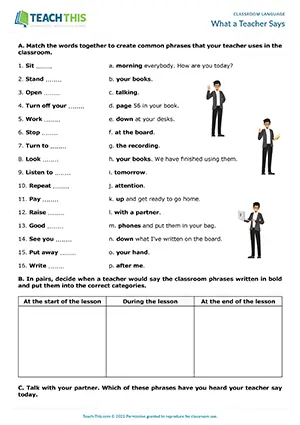
ESL Classroom Language Worksheet - Vocabulary and Grammar Exercises: Matching, Categorising, Sentence Completion, Gap-fill This comprehensive classroom language worksheet helps students learn expressions used by a teacher during a typical English lesson. Students start by matching words together to create common phrases that a teacher uses in the classroom. Next, in pairs, students decide when a teacher would say the classroom phrases and put them into three categories, at the start of the lesson, during the lesson, and at the end of the lesson. Students then try to remember which of the phrases they have heard their teacher say already during the lesson. After that, students complete sentences with classroom language. Finally, students complete sentences with classroom object words from a box.

Classroom Phrase Race

Pre-intermediate (A2) 25 minutes
ESL classroom language game for A2 pre-intermediate: vocabulary and speaking, gap-fill, impromptu speech, group work

ESL Classroom Phrases Board Game - Vocabulary and Speaking: Gap-fill, Impromptu Speech, Freer Practice - Group Work

In this rewarding classroom language board game, students practice essential classroom communication phrases and expressions. In groups, players take turns...

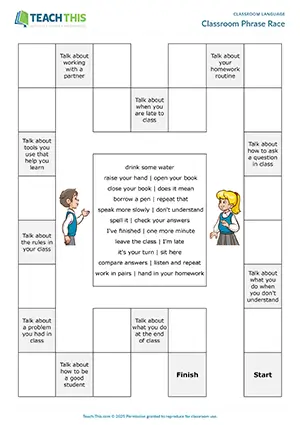
ESL Classroom Phrases Board Game - Vocabulary and Speaking: Gap-fill, Impromptu Speech, Freer Practice - Group Work In this rewarding classroom language board game, students practice essential classroom communication phrases and expressions. In groups, players take turns rolling the dice and moving their counters along the board. When a player lands on a square, another student picks up a card and reads out the sentence using the word 'blank' for the classroom language word or phrase in bold, e.g. 'If you want to speak during class, please BLANK.' The player listens to the sentence, chooses a classroom language phrase from the game board, and says it aloud to complete the sentence, e.g. 'raise your hand.' If the player says the correct phrase shown on the card in bold, they stay on the square. If not, they move their counter back two squares. If a player lands on a 'Talk about...' square, they talk for 20 seconds in response to the classroom discussion prompt to stay on the square. If a player can't think of anything to say or stops talking before the time is up, they go back two squares. The first player to reach the finish wins the game.

Classroom Vocabulary Crossword

Pre-intermediate (A2) 30 minutes
ESL classroom language activity for A2 pre-intermediate: writing and giving clues, defining, guessing, group and pair work

ESL Classroom Vocabulary Activity - Writing and Speaking: Writing and Giving Clues, Defining, Guessing - Group and Pair Work

In this enjoyable classroom vocabulary crossword activity, students complete a crossword by defining and guessing classroom and learning-related words. First, in two groups, students invent...

ESL Classroom Vocabulary Activity - Writing and Speaking: Writing and Giving Clues, Defining, Guessing - Group and Pair Work In this enjoyable classroom vocabulary crossword activity, students complete a crossword by defining and guessing classroom and learning-related words. First, in two groups, students invent and write down clues for the classroom and learning-related words written on their crossword. For example, if the word was subject, students might write 'Something that you study at a school or university.' Next, students pair up with someone from the other group and take turns asking their partner for a clue to one of their missing classroom-related words. Their partner reads out the clue for that word, and the other student tries to guess what it is. If the student guesses the word successfully, they write it on their crossword. If not, their partner continues to give more clues until the student is able to guess the word. Afterwards, students check their spelling by comparing crosswords.

Match Up and Speak Up

Intermediate (B1) 20 minutes
ESL classroom phrasal verbs game for B1 intermediate: matching, forming sentences, classroom vocabulary practice

ESL Classroom Phrasal Verbs Game - Vocabulary and Speaking: Matching, Forming Sentences, Freer Practice - Pair Work

In this fun classroom phrasal verbs game, students match verbs with prepositions to form classroom phrasal verbs and then use them in sentences. In pairs...

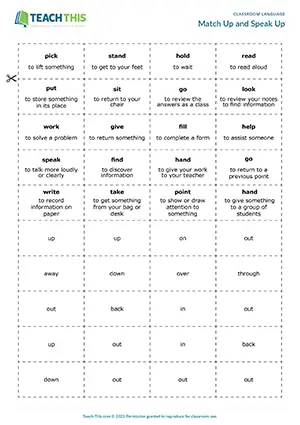
ESL Classroom Phrasal Verbs Game - Vocabulary and Speaking: Matching, Forming Sentences from Prompts, Freer Practice - Pair Work In this fun classroom phrasal verbs game, students match verbs with prepositions to form classroom phrasal verbs and then use them in sentences. In pairs, students take turns turning over one verb card and reading the verb and definition on the card. Next, the student turns over one preposition card to try to find a matching preposition. If the preposition matches the verb to form the classroom phrasal verb described in the definition, the student scores a point and keeps the two cards. The student then tries to score an extra point by using the phrasal verb in a meaningful sentence. If the student is able to make a suitable sentence, they score the extra point and have another turn. If the two cards don't match, the student turns them back over. The student with the most points at the end of the game wins.

Using Classroom Language

Classroom language is the specific set of everyday phrases, instructions, and questions that teachers and students use to manage what happens during an English lesson, such as 'Could you repeat that, please?' or 'Please open your books to page ten.' When students don't know these phrases, they struggle to follow instructions, ask for help, or take part in basic classroom routines, which slows down the lesson and leaves them relying on their first language instead of English.

This page covers classroom language across four levels from beginner to intermediate, with ten activities ranging from pelmanism and board games to crosswords and gap-fill worksheets, including one free download.

This table maps common classroom functions to the phrases teachers and students typically use for each one.

Classroom FunctionTeacher SaysStudent Says
Giving instructions 'Open your books to page ten.' 'Sorry, what do we have to do?'
Checking understanding 'Does everyone understand?' 'I don't understand.'
Asking and granting permission 'You may begin now.' 'Can I go to the bathroom, please?'
Asking for help 'Let me know if you need help.' 'Could you help me with this word?'
Ending the lesson 'That's all for today.' 'What's the homework?'

When to Use Classroom Language

Asking for Repetition When You Miss Something: A student uses 'Could you say that again, please?' instead of staying silent when they miss an instruction, because asking politely keeps the lesson moving without embarrassment.

Checking You've Understood a Task Correctly: A student says 'So, do we write the answers or just say them?' before starting work, because confirming the task avoids doing the whole exercise wrong.

Requesting a Short Break or Practical Need: A student raises a hand and asks 'Can I get some water, please?' rather than getting up without asking, because classroom routines expect a request first.

3-Step Framework for Teaching Classroom Language

1. Introduce Core Classroom Verbs and Phrases: Kick things off by presenting essential classroom verbs and phrases visually before students ever have to produce them on their own. Hold up a picture, elicit the verb or phrase, then drill the pronunciation chorally and individually so it sticks. Write simple frames like 'What should I do?' and 'Please...' on the board and use them to ask students questions until they can respond automatically with 'Yes, please' or 'No, please don't.'

2. Build Full Instructions Through Sentence Combining: Get students combining verbs with sentence endings to build complete classroom instructions under a bit of friendly game pressure. When a player lands on a square showing an ending like '...a short story', they pick a matching verb and turn it into a full instruction such as 'Please write a short story.' The rest of the group decides if it sounds correct and clear before the player advances.

3. Push for Speed and Spontaneous Recall: Once instructions feel natural, force students to produce classroom phrases on the spot instead of from memory. Read them a sentence with the word 'BLANK' standing in for the missing phrase, such as 'If you want to speak during class, please BLANK', and have them fill the gap correctly to stay on their square. Add a 'Talk about...' square that demands 20 seconds of impromptu speech to keep the pressure real.

Common Mistakes with Classroom Language

Missing Auxiliary Verb in Negatives: Students often drop the auxiliary 'do' when saying they don't understand something, producing an ungrammatical negative. Wrong: 'I no understand.' Correct: 'I don't understand.'

Wrong Word Order in Classroom Questions: Students often keep statement word order when asking a question, forgetting to invert the subject and verb. Wrong: 'Where the toilet is?' Correct: 'Where is the toilet?'

Common Questions About Teaching Classroom Language

What is a fun game for practicing classroom phrases and commands?

The game Just Say It mixes miming and quick-fire guessing to keep students engaged. Teams roll the dice: an odd number means a player mimes a classroom command card while their teammate has 30 seconds to name it, and an even number triggers a 'What do you say?' card that tests the matching classroom expression. A free PDF is available.

What is a worksheet for teaching students classroom language?

Students learn the language they need as a classroom learner in the worksheet What a Student Says. They start by completing common classroom questions with question words from a box, then match sentence halves and pair questions with answers. They finish by covering the answers and practicing the full exchanges with a partner.

What is a useful speaking activity for classroom vocabulary?

What makes the activity Classroom Vocabulary Crossword useful is that students explain classroom words themselves, one of the most reliable ways to make vocabulary stick. In two groups, they write clues for each word, for example 'Something that you study at a school or university' for subject, then pair up and take turns giving clues until their partner guesses correctly.

Become a Teach This Member

Get unlimited access to the full library, plus new resources added every week.

Unlimited Resource Access

Download from 3000+ worksheets, activities, and games.

Save 5+ Hours Weekly

Cut lesson prep time with ready-to-use resources, plus teacher notes and answer keys.

Trusted Professional Quality

Classroom-tested, editable resources created by experienced ESL professionals.

Fresh Content Weekly

Get 5 new resources added to the library each week.

Join Now Just $29.99 quarterly