
Adverbial Phrases ESL Games & Worksheets
Adverbial Phrase Frenzy
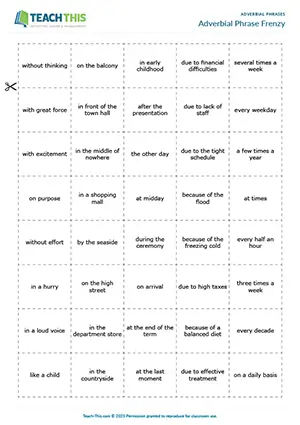
ESL Adverbial Phrases Game - Grammar and Speaking: Forming Sentences, Freer Practice - Group Work
In this entertaining adverbial phrases game, students practice forming sentences with adverbial phrases of manner, time, place, frequency, and reason. In groups, players take turns rolling a dice and...
Adverbial Phrase Adventure

ESL Adverbial Phrases Board Game - Grammar and Speaking: Forming Sentences, Freer Practice - Group Work
In this engaging adverbial phrases board game, students practice forming sentences with adverbial phrases in everyday situations. In groups, players take turns rolling the dice and moving their counters...
Adverbial Phrase Practice

ESL Adverbial Phrases Worksheet - Grammar Exercises: Error Correction - Speaking Activity: Asking and Answering Questions, Freer Practice - Pair Work
In this free adverbial phrases worksheet, students practice 12 adverbial phrases and use them to comment on specific situations. First, students complete...
Leaving That Aside...

ESL Adverbial Phrases Game - Grammar: Matching - Group Work
In this fun adverbial phrases game, students match pairs of clauses with adverbial phrases to make grammatically correct and logical sentences. Students take turns to be the dealer for the round, shuffling and dealing out three cards to each...
Understanding Adverbial Phrases
Adverbial phrases are groups of words that function like a single adverb, modifying a verb, adjective, or another adverb to say how, when, where, how often, or why something happens, as in 'without thinking' or 'because of the heavy traffic.' Students who default to single adverbs instead of phrases produce writing that feels thin and imprecise, and in speaking they miss the natural-sounding detail that phrases like 'on a regular basis' or 'without any hesitation' give to everyday language.
This page covers adverbial phrases at B1 and B2 levels, with four activities including a dice-based card game, a board game with three types of playing squares, a grammar and speaking worksheet, and a card-matching game, with one activity available as a free download.
The table below maps the main types of adverbial phrases, the question each type answers, common examples, and a sentence showing each type in use.
| Type | Question It Answers | Common Examples | Sentence Example |
|---|---|---|---|
| Manner | How? | with care, in a hurry, without thinking, in a calm voice | 'She explained the process in a calm voice.' |
| Time | When? | at midnight, in the morning, after a while, on time | 'The report needs to be submitted on time.' |
| Place | Where? | at the back, in the corner, near the entrance, on the left | 'Please wait near the entrance until we call your name.' |
| Frequency | How often? | on a regular basis, from time to time, once in a while | 'He checks his emails on a regular basis.' |
| Reason / Purpose | Why? | because of the rain, due to delays, for this reason, as a result | 'The flight was cancelled because of the rain.' |
| Degree | To what extent? | to a great extent, to some degree, by far, a little bit | 'This approach works to a great extent in large classes.' |
When to Use Adverbial Phrases
Adding Precision to Descriptions: A manner phrase lets a writer or speaker describe exactly how something happened rather than leaving it vague, which matters most in professional or instructional contexts where the how carries real weight, as in 'The technician completed the repair with great care.'
Softening or Qualifying a Statement: Degree phrases allow a speaker to hedge a claim or acknowledge limitations without undermining the main point, which is common in academic and business communication, as in 'This strategy works to a great extent, but results may vary.'
Explaining Cause in Formal Contexts: Reason phrases built around 'due to' or 'as a result of' are the standard way to signal causes in formal written English, where 'because' alone can sound too informal, as in 'The project was delayed due to unforeseen circumstances.'
2-Step Framework for Teaching Adverbial Phrases
1. Connect Phrase Types to Question Words: Start at B1 with a dice-and-card game that organizes adverbial phrases by the question word they answer: How?, When?, Where?, How often?, and Why? Players roll the dice to land on a question word, then find the matching phrase card from their hand and build a sentence using it. The mechanic is simple but focused: if a player rolls 'How?' and lays down the card 'without thinking', they then produce a sentence like 'You shouldn't speak without thinking', which ties every phrase directly to a real communicative purpose.
2. Raise the Stakes with Situational Production: Move students to a board game that challenges them to use adverbial phrases in realistic everyday situations. Three types of squares keep the game varied and unpredictable. Situation squares are the most demanding: a player draws a context card, reads it aloud to the group, and builds a sentence using a phrase from their hand, such as 'I'm late for the meeting because of the heavy traffic on the highway this morning', and the group decides whether the sentence is both grammatically correct and a genuine fit for the situation.
Common Mistakes with Adverbial Phrases
Wrong Word Order with Adverbial Phrases: Students often place an adverbial phrase between the verb and its object, which produces an unnatural sentence in English where the phrase should follow the object or open the sentence instead. Wrong: 'She completed with great care the report.' Correct: 'She completed the report with great care.'
Using 'Due to' Before a Full Clause: Students often use 'due to' to introduce a subject-plus-verb clause because it feels similar to 'because of', but 'due to' must be followed by a noun or noun phrase, not a full clause. Wrong: 'He was late due to he missed the bus.' Correct: 'He was late because he missed the bus.'
Common Questions About Teaching Adverbial Phrases
What is a fun game for practicing adverbial phrases?
The game Leaving That Aside... challenges students to match two clauses and an adverbial phrase that connects them into one logical sentence. Each student is dealt three cards and picks up and discards cards until they find a match. When they do, they say 'Match!' and show the cards to the group to confirm.
What is a good worksheet for teaching adverbial phrases?
The free worksheet Adverbial Phrase Practice covers 12 adverbial phrases through error correction, sentence completion, and structured conversation. Students find and fix mistakes in sentences, then complete sentences with their own ideas. In the final stage, they ask and answer conversation questions using adverbial phrases from a box, ticking off each one they use.
Become a Teach This Member
Get unlimited access to the full library, plus new resources added every week.
Unlimited Resource Access
Download from 3000+ worksheets, activities, and games.
Save 5+ Hours Weekly
Cut lesson prep time with ready-to-use resources, plus teacher notes and answer keys.
Trusted Professional Quality
Classroom-tested, editable resources created by experienced ESL professionals.
Fresh Content Weekly
Get 5 new resources added to the library each week.
Here's what our members are saying...


