
Classroom Objects ESL Worksheets, Games & Activities
Classroom Objects Bingo
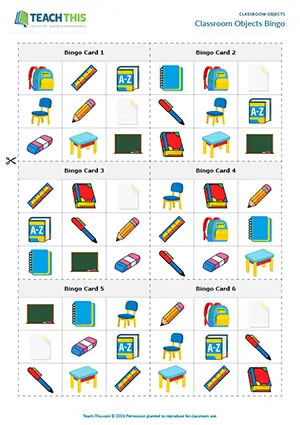
ESL Classroom Objects Game - Vocabulary: Bingo, Matching
In this engaging classroom objects game, students play bingo by listening to the names of classroom objects and matching them to pictures on their bingo cards. Begin the game by reading out a classroom object from the caller's sheet and putting...
Classroom Objects: Flashcards & Worksheet
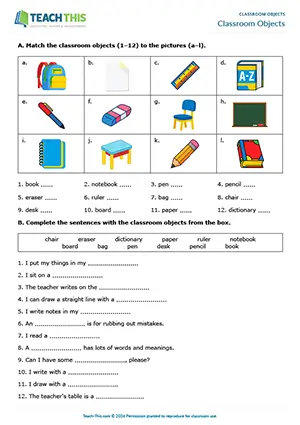
ESL Classroom Objects Flashcards and Worksheet - Flashcards: Eliciting, Drilling - Vocabulary Exercises: Matching, Gap-fill
In this free classroom objects resource, students learn the names of 12 common classroom objects and practice them with flashcards and a worksheet. To begin, hold up each flashcard. Point to the...
Classroom Object Riddles
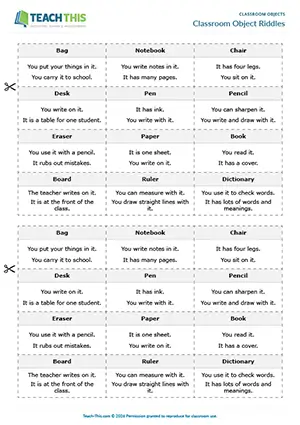
ESL Classroom Objects Game - Listening, Speaking and Vocabulary: Describing, Guessing - Pair Work
In this fun classroom objects game, students review the names of 12 common classroom objects by listening to clues and guessing the answers. In pairs, students take turns picking up a card and reading the first...
Using Classroom Objects Vocabulary
Classroom objects vocabulary gives beginners the words they need to follow lesson routines, manage materials, and ask for help with things on their desk or around the room, such as 'notebook', 'eraser', 'scissors', and 'ruler'. When students lack this vocabulary, even simple tasks like borrowing something, opening the right book, or finding a missing item can interrupt the flow of the lesson.
This page covers classroom objects at A1 level, with three resources: one bingo game, one flashcards and worksheet resource, and one listening and speaking vocabulary game, including one free download.
Use this quick reference table to connect classroom objects vocabulary with common lesson routines and student needs.
| Situation | Speaker | Example Phrase |
|---|---|---|
| Identifying an item | Student | 'It's a ruler.' |
| Asking what something is | Student | 'What's this?' |
| Checking possession | Teacher | 'Have you got a notebook?' |
| Following instructions | Teacher | 'Put your book under your chair.' |
| Requesting an item politely | Student | 'Can I borrow your pencil?' |
| Reporting a problem | Student | 'My pen doesn't work.' |
| Tidying materials | Teacher | 'Put the scissors in the box.' |
How to Use Classroom Objects Vocabulary
Follow lesson instructions: Use classroom object names when students need to take, open, close, move, or put away specific lesson materials, as in 'Open your notebook and put your pencil on the desk.'
Manage missing materials: Use classroom object vocabulary so students can explain what they need without stopping the lesson for gestures or first-language support, as in 'I don't have a ruler.'
Organize classroom jobs: Use object names when students hand out, collect, or tidy shared materials, as in 'Please collect the markers and put them in the box.'
3-Step Framework for Teaching Classroom Objects Vocabulary
1. Link Objects to Spoken Exchanges: Start with pictures and quick naming, then move straight into classroom questions. Frames such as 'What's this?', 'It's a/an...', and 'Have you got a/an...?' help learners say the object inside a useful sentence.
2. Check Listening Through Picture Matching: Once students know the words, make them listen and react. A strong routine has learners cross off matching pictures, say the word aloud, then shout 'Bingo!' after crossing off all nine pictures.
3. Turn Recall Into Guessing: Push students beyond simple naming by giving clues one at a time. The phrase 'It is a/an...' keeps answers controlled, while the two-point first guess rewards careful listening.
Common Mistakes with Classroom Objects Vocabulary
Treating plural classroom objects as singular: Students often use a singular verb or pronoun with classroom objects that usually appear in plural form, especially scissors, glasses, and headphones. Wrong: 'Where is the scissors?' Correct: 'Where are the scissors?'
Using paper for one sheet: Students often say paper when they mean one loose sheet, so a request can sound like they want an essay, a newspaper, or the material in general. Wrong: 'Can I have a paper?' Correct: 'Can I have a sheet of paper?'
Common Questions About Teaching Classroom Objects Vocabulary
What is a good game for practicing classroom objects?
The game Classroom Object Riddles has students pick up a card and read a clue aloud. Their partner guesses the object using 'It is a/an...' A correct first guess scores two points, so students listen carefully to every word. The two-clue format keeps the game moving and rewards attentive listening.
What is a free worksheet for teaching classroom objects?
The worksheet Classroom Objects: Flashcards & Worksheet is a free download that covers names, pronunciation, and short question frames in one sequence. Students match objects to pictures and complete sentences from a word box after practicing 'What's this?', 'It's a/an...', and 'Have you got a/an...?'
Become a Teach This Member
Get unlimited access to the full library, plus new resources added every week.
Unlimited Resource Access
Download from 3000+ worksheets, activities, and games.
Save 5+ Hours Weekly
Cut lesson prep time with ready-to-use resources, plus teacher notes and answer keys.
Trusted Professional Quality
Classroom-tested, editable resources created by experienced ESL professionals.
Fresh Content Weekly
Get 5 new resources added to the library each week.
Here's what our members are saying...


