
Paraphrasing Techniques EAP Worksheets & Activities
Joining or Splitting Ideas
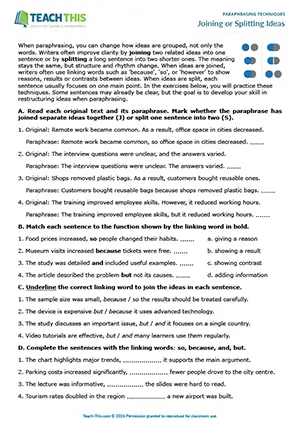
EAP Paraphrasing Techniques Worksheet - Reading, Vocabulary and Writing Exercises: Categorising, Matching, Gap-fill, Rewriting Sentences, Paraphrasing
In this productive paraphrasing techniques worksheet, students practice joining and splitting ideas using linking words and punctuation to keep the...
Paraphrasing Key Terms
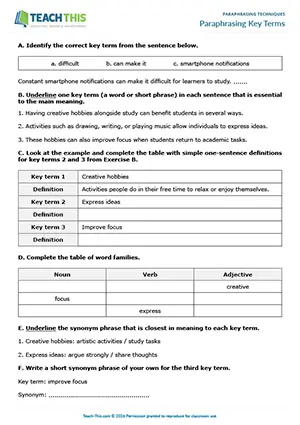
EAP Paraphrasing Techniques Worksheet - Reading, Vocabulary and Writing Exercises: Identifying, Writing Definitions, Paraphrasing, Peer Feedback
In this comprehensive paraphrasing techniques worksheet, students identify key terms in a short text and build a small glossary to help them rewrite...
Paraphrasing in Five Steps

EAP Paraphrasing Techniques Worksheet - Reading, Vocabulary and Writing Exercises: Using Synonyms, Paraphrasing, Peer Feedback
In this useful paraphrasing techniques worksheet, students use synonyms and follow a five-step process to paraphrase a short text while keeping the original...
Nominalisation for Paraphrasing
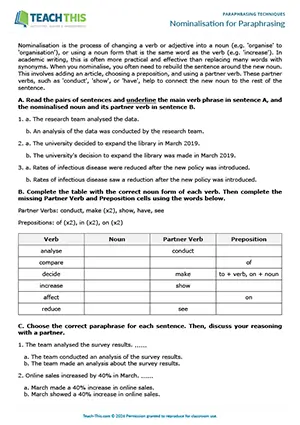
EAP Paraphrasing Techniques Worksheet - Reading, Vocabulary and Writing Exercises: Table Completion, Binary Choice, Gap-fill, Paraphrasing Peer Feedback
In this comprehensive paraphrasing techniques worksheet, students practice nominalisation by changing verbs into nouns and rebuilding sentence...
Paraphrasing Challenge
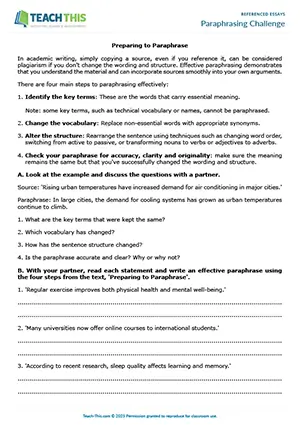
EAP Paraphrasing Game - Writing and Speaking Activity: Discussion, Writing Sentences - Game: Paraphrasing - Pair Work
This engaging paraphrasing game introduces students to a step-by-step method for academic paraphrasing in referenced essays before putting their skills to the test in a timed paraphrasing challenge...
Paraphrasing Numerical Data
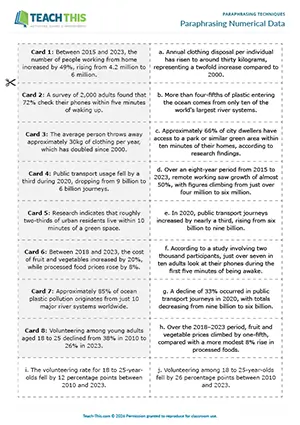
EAP Paraphrasing Activity - Reading and Writing: Matching, Table Completion, Paraphrasing - Pair Work
In this paraphrasing activity, students match original statements containing numbers and percentages with their paraphrases, then analyse changes in vocabulary and structure before writing three...
Paraphrasing with Reporting Verbs
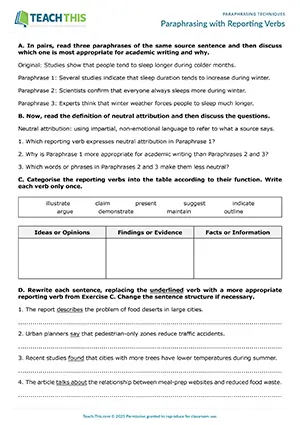
EAP Paraphrasing Techniques Worksheet - Reading, Vocabulary and Writing Exercises: Categorising, Sentence Transformation, Paraphrasing, Peer Feedback - Pair Work
In this useful paraphrasing techniques worksheet, students learn about neutral attribution and practice using reporting verbs to paraphrase information...
Understanding Paraphrasing Techniques
Paraphrasing means expressing a source's ideas in your own wording and sentence structure while preserving its meaning and important qualifications. An academic paraphrase still needs attribution because changing the expression does not make the borrowed idea your own.
This page contains seven resources across B1 and B2, including worksheets on key terms, sentence restructuring, nominalisation and reporting verbs, alongside a numerical-data activity and a paraphrasing game. No free downloads are currently listed.
The table illustrates ways to change expression without changing the message. These invented examples demonstrate language choices; they are not findings from published sources.
| Technique | Original wording | Possible paraphrase |
|---|---|---|
| Replace a phrase with an equivalent expression | 'The instructions were difficult to understand.' | 'The instructions were hard to follow.' |
| Join related ideas | 'The room was noisy. As a result, the group moved elsewhere.' | 'The group moved elsewhere because the room was noisy.' |
| Split a sentence while retaining the relationship | 'The task was demanding, but everyone completed it.' | 'The task was demanding. Nevertheless, everyone completed it.' |
| Change a verb into a noun phrase | 'The team analysed the results.' | 'The team carried out an analysis of the results.' |
| Express an equivalent proportion | 'Exactly 50% of the participants selected option A.' | 'Exactly half of the participants chose option A.' |
How to Paraphrase Academic Texts
Understand before rewriting: Identify the central message, relevant details and any limits on the claim. Explain the passage without looking at it before drafting, then compare your version with the original to check for omissions or added ideas.
Choose changes that preserve precision: A synonym must fit the context, and a grammatical transformation must retain relationships such as cause, contrast and time. Keep technical terms when alternatives would distort their meaning. Nominalisation is one option, not a requirement to make every sentence longer or more formal.
Check attribution and independence: Cite the source using the required style and check that your wording is not a lightly edited copy of the original. Mark any retained distinctive wording as a quotation where appropriate. A citation alone does not turn copied wording into a paraphrase.
3-Step Framework for Teaching Paraphrasing
Use the first two stages with B1 learners, then extend the work with reporting verbs at B2. The progression moves from accurate word choices to sentence restructuring and attributed paraphrases.
1. Establish the meaning of key terms: Students identify key terms in a text, write short definitions and build a glossary using word families and equivalent phrases. They use the glossary to rewrite sentences and exchange feedback. Ask them to justify why an alternative fits the particular context before moving to larger changes.
2. Rebuild sentences without changing relationships: Students compare originals with joined or split versions, identify linking-word functions and practice restructuring sentences and short paragraphs. They answer questions about their rewrites to check the result. Focus on preserving connections between ideas rather than changing the number of sentences for its own sake.
3. Attribute the paraphrase accurately: Students compare paraphrases of a source sentence, discuss neutral attribution and classify reporting verbs by function. They replace unsuitable verbs, write attributed paraphrases and use a partner checklist to review them. Ask them to check that the verb represents what the source actually does without adding certainty or judgement.
Common Mistakes with Paraphrasing
Removing a qualification: A paraphrase must preserve the strength and scope of a claim, not just its topic. Meaning changed: Rewriting 'The method may help some learners' as 'The method helps all learners.' Meaning preserved: 'Some learners might benefit from the method.'
Changing the relationship between ideas: Replacing a connector can turn a contrast into a cause or result that the original does not express. Meaning changed: Rewriting 'The task was difficult, but the group completed it' as 'The group completed the task because it was difficult.' Meaning preserved: 'Although the task was difficult, the group completed it.'
Common Questions About Teaching Paraphrasing
What worksheet helps teach paraphrasing step by step?
The worksheet Paraphrasing in Five Steps takes students from understanding a text to rewriting it with the original covered. They identify the main idea, prepare alternative wording and explain the text to a partner before drafting. A peer checklist then helps them review whether the paraphrase preserves the original ideas.
What activity helps students paraphrase numerical data?
The activity Paraphrasing Numerical Data asks pairs to match statements containing numbers and percentages with their paraphrases. They analyse changes in numerical wording, vocabulary, time expressions and sentence structure before rewriting three statements themselves. Comparing the models gives students ways to change the expression while checking that the numerical information stays accurate.
What game helps students practice academic paraphrasing?
The game Paraphrasing Challenge combines a four-step method with a timed writing challenge. Pairs examine a model and practice rewriting statements before paraphrasing new statements within three minutes. They read their versions aloud and earn points for accuracy, clarity and originality, so success depends on meaning and expression as well as speed.
Become a Teach This Member
Get unlimited access to the full library, plus new resources added every week.
Unlimited Resource Access
Download from 3000+ worksheets, activities, and games.
Save 5+ Hours Weekly
Cut lesson prep time with ready-to-use resources, plus teacher notes and answer keys.
Trusted Professional Quality
Classroom-tested, editable resources created by experienced ESL professionals.
Fresh Content Weekly
Get 5 new resources added to the library each week.
Here's what our members are saying...


