
Resumes, CVs & Email Cover Letter Worksheets & Activities
Resume Basics

Business English Resumes Worksheet - Reading and Writing Exercises: Identifying, True or False, Writing Sentences, Writing a Basic Resume
Here is a handy resume worksheet to help students learn basic resume conventions and practice writing a simple resume. Students begin by reading a job...
CV Basics

Business English CV Worksheet - Reading, Vocabulary and Writing Exercises: Matching, Comprehension Questions, Gap-fill, Writing a CV
This comprehensive CV worksheet helps students learn and practice language and vocabulary commonly used in a CV as well as how CVs are written and...
Cover Letter Clinic
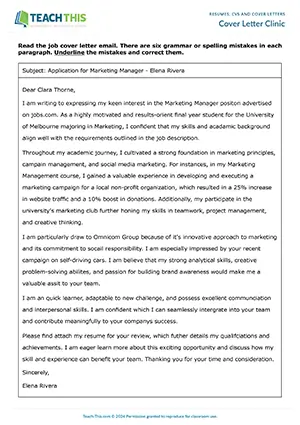
Business English Email Cover Letters Activity - Reading, Grammar and Vocabulary: Error Correction
In this free email cover letter activity, students identify and correct common grammar and spelling mistakes in a cover letter email. This activity provides practice in accuracy and a model for an email cover letter...
Email Cover Letters

Business English Email Cover Letters Worksheet - Reading, Vocabulary and Writing Exercises: Gap-fill, Matching, Sentence Completion - Speaking Activity
In this useful email cover letter worksheet, students learn and practice the key elements of writing an email cover letter. First, students read an email cover letter...
Internal Promotion Email Cover Letters
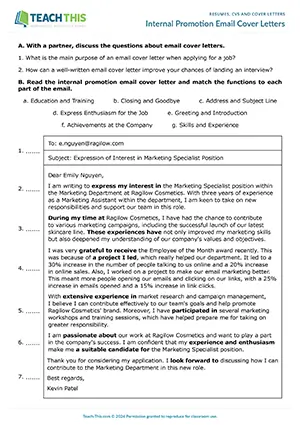
Business English Email Cover Letters Worksheet - Reading, Vocabulary and Writing Exercises: Matching, Gap-fill, Writing an Email
In this email cover letters worksheet, students learn phrases for writing internal promotion email cover letters and then practice them by writing the body of an email...
Tackling Tenses

Business English Email Cover Letters Activity - Grammar and Vocabulary: Gap-fill, Matching
Here is an insightful email cover letter activity to help students review tenses and standard phrases in an email cover letter. First, students read the phrase on their card, decide where to put it in the email cover letter,...
Writing CVs, Resumes and Email Cover Letters
CVs and resumes summarise an applicant's skills, education and experience, while an email cover letter explains their interest in a role and connects relevant experience to its requirements. For general job applications, CV is the usual UK term and resume is the usual US term, although document conventions vary by country and employer.
This page contains six resources across B1 and B2, including worksheets and activities for selecting relevant information, organising a CV, drafting email cover letters and checking language accuracy, with one free activity.
The table gives example wording for different parts of an application. Students should adapt the language to accurate information about themselves or to a clearly identified classroom scenario.
| Application element | Purpose | Example language |
|---|---|---|
| CV profile | Summarise relevant skills or experience. | 'Customer service assistant with experience handling enquiries and processing orders.' |
| Current responsibilities | Describe duties in a present role. | 'Respond to customer enquiries by email and telephone.' |
| Previous experience | Describe work completed in an earlier role. | 'Prepared weekly stock reports for the sales team.' |
| Cover letter opening | Identify the role being applied for. | 'I am writing to apply for the administrative assistant position.' |
| Relevant supporting detail | Connect experience with a requirement. | 'My experience arranging appointments is relevant to the scheduling duties in this role.' |
| Cover letter closing | Express interest in further discussion. | 'I would welcome the opportunity to discuss my application.' |
How to Structure CVs and Cover Letters
Group relevant information clearly: Use CV headings to help a reader locate skills, education and experience. Choose details that relate to the role, including relevant study or voluntary experience where appropriate. Treat a model as a guide to organisation rather than a format required by every employer.
Give the cover letter a clear purpose: Identify the role, explain the connection between the applicant's experience and its requirements, and close with an appropriate expression of interest. Develop selected details from the CV instead of copying every section into the email.
Keep time references and claims accurate: Make clear which responsibilities are current and which belong to previous roles. Check that dates, skills and experience agree across the documents, and use specific supporting details without inventing qualifications or achievements.
3-Step Framework for Teaching Job Application Writing
The first stage introduces relevant resume content at B1. The later B2 stages develop cover letter language and apply it to an internal promotion scenario. Use the stages across lessons according to learners' levels and writing needs.
1. Select Information for a Role: Students compare a job advertisement with a resume and identify three irrelevant details. They then evaluate statements about resumes, write a resume for another advertisement and discuss the applications in small groups. Use the comparison to establish why a detail belongs in an application before moving to the language that connects experience with a role.
2. Reconstruct Cover Letter Language: Students place a phrase from a card into a gapped email cover letter. After the cards are collected, they circulate and tell classmates their phrases without showing their worksheets, deciding where each phrase they hear belongs. The class then checks the completed letter and reviews tenses and standard phrases, preparing students to use these patterns in a draft.
3. Draft for a Specific Application: Students match functions to parts of a model internal promotion email and complete another example with useful phrases. They then write the body of a cover letter using supplied information and the worksheet language. This brings purpose, organisation and phrasing together in a defined scenario that does not require learners to have personal promotion experience.
Common Mistakes with Job Application Language
Using the wrong preposition after apply: Use apply for when naming a job or position. Incorrect: 'I am applying to the assistant position.' Correct: 'I am applying for the assistant position.'
Using present tense for a finished role: When describing duties in a job that has ended, use a past form to make the time reference clear. Incorrect: 'In my previous role, I manage customer accounts.' Correct: 'In my previous role, I managed customer accounts.'
Common Questions About Teaching CVs and Cover Letters
What worksheet helps teach CV writing?
The worksheet CV Basics connects CV structure with the language students need to describe themselves. Students add section headings to a model, answer questions about a personal profile and complete vocabulary exercises. They then write their own CV using prompts and the example, applying the structure and language they have examined.
What worksheet helps teach email cover letters?
The worksheet Email Cover Letters takes students from a model email to their own first draft. They complete collocations, match key terms with definitions and choose suitable wording in example sentences. Pair discussion then prepares them to write for a job they would like, using prompts and the model for support.
What activity helps practice proofreading cover letters?
The free activity Cover Letter Clinic asks students to find and correct six grammar or spelling mistakes in each paragraph of an email cover letter. Students work individually and earn points for identifying and correcting errors. The class answer check provides an opportunity to discuss corrections while reviewing a model cover letter.
Become a Teach This Member
Get unlimited access to the full library, plus new resources added every week.
Unlimited Resource Access
Download from 3000+ worksheets, activities, and games.
Save 5+ Hours Weekly
Cut lesson prep time with ready-to-use resources, plus teacher notes and answer keys.
Trusted Professional Quality
Classroom-tested, editable resources created by experienced ESL professionals.
Fresh Content Weekly
Get 5 new resources added to the library each week.
Here's what our members are saying...


