
Onomatopoeia ESL Games & Worksheets
What makes this sound?
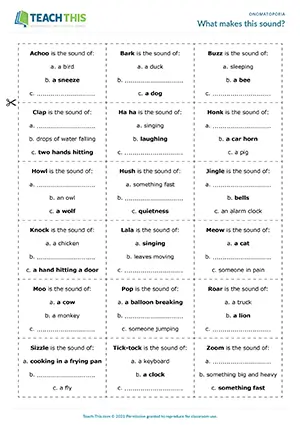
ESL Onomatopoeia Game - Vocabulary: Matching - Group Work
In this free onomatopoeia game, students guess what makes the sound of different onomatopoeic words while attempting to bluff their classmates with false answers. Each card shows an onomatopoeic word in bold, a correct answer in bold and a...
Introduction to Onomatopoeia
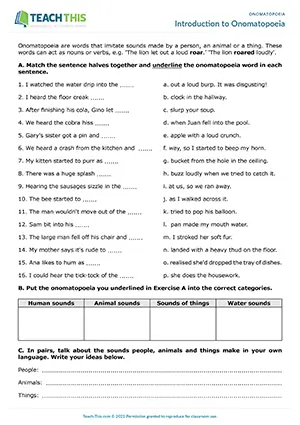
ESL Onomatopoeia Worksheet - Vocabulary Exercises: Matching, Categorising, Crossword, Listing - Speaking Activity: Discussion, Freer Practice - Pair Work
This useful onomatopoeia worksheet helps students learn about onomatopoeia and practice onomatopoeic sounds commonly used in English. To begin...
What's the Sound?
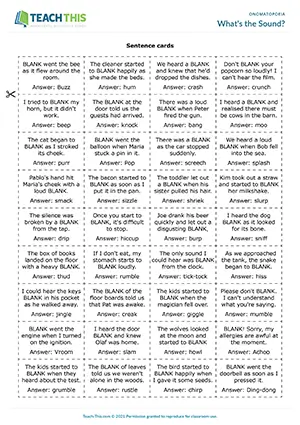
ESL Onomatopoeia Game - Vocabulary: Matching, Gap-fill - Group Work
In this fun onomatopoeia game, students race to complete sentences with onomatopoeia words often used in the English language. The reader turns over a card and reads the sentence aloud to the players using the word 'blank' for the missing...
Understanding Onomatopoeia
Onomatopoeia is the use of words that sound like what they describe, such as 'buzz,' 'crash,' or 'sizzle.' When students confuse an onomatopoeic word with a non-sound word or misapply one across contexts, their writing loses vividness and their descriptions fall flat in ways a native speaker immediately notices.
This page covers onomatopoeia across A2, B1, and B2 levels, with three activities including a bluffing group game, a multi-exercise worksheet, and a fast-paced card race, with one activity available as a free download.
When to Use Onomatopoeia
Creating atmosphere in creative writing: Writers reach for onomatopoeia when they want readers to almost hear a scene rather than just picture it, so a description like 'the fire crackled and hissed as the last log collapsed' does more sensory work than any neutral verb.
Making poetry musical: Poets choose onomatopoeic words because the sound of the word itself carries the meaning, so a line like 'the bees buzzed lazily through the afternoon heat' creates a mood that a factual synonym simply cannot.
Emphasising impact in informal writing: In comics, headlines, and social media captions, onomatopoeia signals energy and immediacy, making 'the ball smashed into the net' land with more force than 'the ball hit the net.'
3-Step Framework for Teaching Onomatopoeia
1. Build Awareness Through Bluffing: Start with the bluffing game, where students match onomatopoeic words to the sounds they represent. Before play begins, each student adds one more realistic incorrect answer to their cards to try to trick the other students. That creative writing step sharpens awareness of what each word actually sounds like before the guessing starts.
2. Develop Vocabulary Through Structured Practice and Discussion: Build vocabulary systematically with a worksheet that moves students through matching, categorising, and a crossword, then opens up into genuine personal production. Pairs name their favourite onomatopoeic sounds and the sounds that annoy them the most, which draws out real responses and makes the topic stick.
3. Consolidate With a Fast-Paced Retrieval Race: Lock in vocabulary with a listening and speed game. The reader reads a sentence aloud using the word 'blank' for the missing onomatopoeia word, and students race to grab the correct word card and say the sound aloud at the same time to win.
Common Mistakes with Onomatopoeia
Describing the sound instead of using the onomatopoeic word: Students often write a wordy description of a sound rather than using the onomatopoeic word itself, producing sentences that are less natural and less vivid than a single well-chosen word would be. Wrong: 'The door made a loud noise when it closed.' Correct: 'The door slammed.'
Importing the first-language sound word into English: Students often assume that onomatopoeic words are the same across languages and use the version from their first language in English writing, because different languages represent identical sounds with entirely different letter combinations. Wrong: 'The frog said kero kero in the pond.' Correct: 'The frog croaked in the pond.'
Common Questions About Teaching Onomatopoeia
What is a useful worksheet for teaching onomatopoeia?
The worksheet Introduction to Onomatopoeia builds vocabulary in stages, starting with matching sentence halves and underlining the onomatopoeic word in each sentence, then moving through categorising, a crossword, and a freer discussion where pairs share their favourite onomatopoeic sounds and the sounds that annoy them the most.
What is a fun game for practicing onomatopoeia?
The game What's the Sound? gets students competing to be the fastest in the room. Players listen to a sentence with a missing onomatopoeia word, then race to grab the correct word card and say the sound aloud to win and keep both cards. That combination of listening, speed, and performance makes every round feel high-energy.
Become a Teach This Member
Get unlimited access to the full library, plus new resources added every week.
Unlimited Resource Access
Download from 3000+ worksheets, activities, and games.
Save 5+ Hours Weekly
Cut lesson prep time with ready-to-use resources, plus teacher notes and answer keys.
Trusted Professional Quality
Classroom-tested, editable resources created by experienced ESL professionals.
Fresh Content Weekly
Get 5 new resources added to the library each week.
Here's what our members are saying...


