
Relative Clauses ESL Games, Worksheets & Activities
Defining Relative Clauses Practice
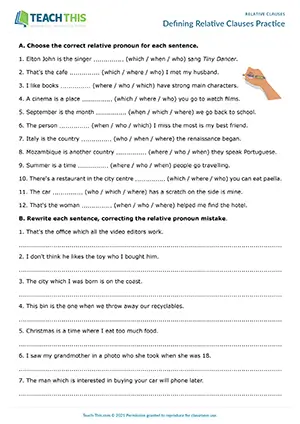
ESL Defining Relative Clauses Worksheet - Grammar Exercises: Gap-fill, Multiple Choice, Error Correction, Writing Sentences, Rewriting Sentences
This free defining relative clauses worksheet helps students practice defining relative clauses with who, which, where and when. First, students complete...
Fold your Arms
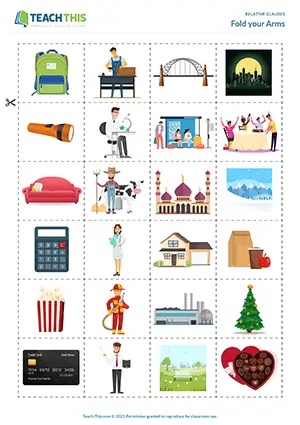
ESL Defining Relative Clauses Game - Grammar and Speaking: Describing, Forming Sentences, Guessing, Freer Practice - Group Work
In this fun defining relative clauses game, students describe pictures of objects, people, places and times with defining relative clauses. In groups, students...
I didn't know that!
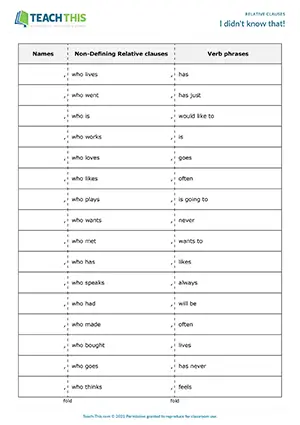
ESL Non-Defining Relative Clauses Activity - Grammar: Sentence Completion, Guessing, Error Correction, Reforming Sentences - Group Work
In this creative non-defining relative clauses activity, students write imaginary information about their classmates using non-defining relative clauses with 'who'...
Keep it going!
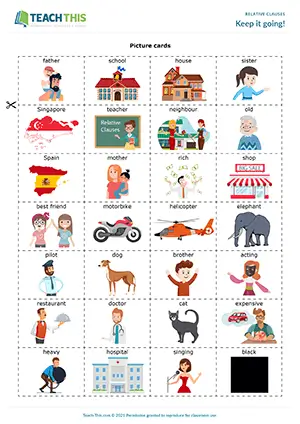
ESL Non-Defining Relative Clauses Game - Grammar and Speaking: Matching, Forming Clauses, Freer Practice - Group Work
In this challenging non-defining relative clauses game, students extend a sentence with non-defining relative clauses to make the longest sentence possible. The first player chooses one of their picture...
Relative Clause Bingo
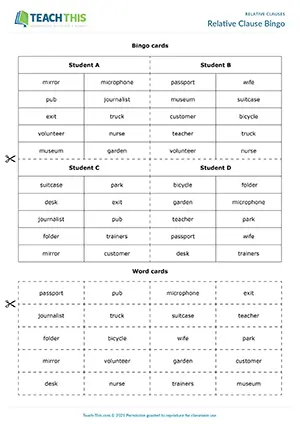
ESL Defining Relative Clauses Game - Grammar and Speaking: Forming Sentences, Guessing, Freer Practice - Group Work
In this engaging defining relative clauses game, students play bingo by describing people, places and things using defining relative clauses. In groups, students take turns picking up a word card...
What's the Word?
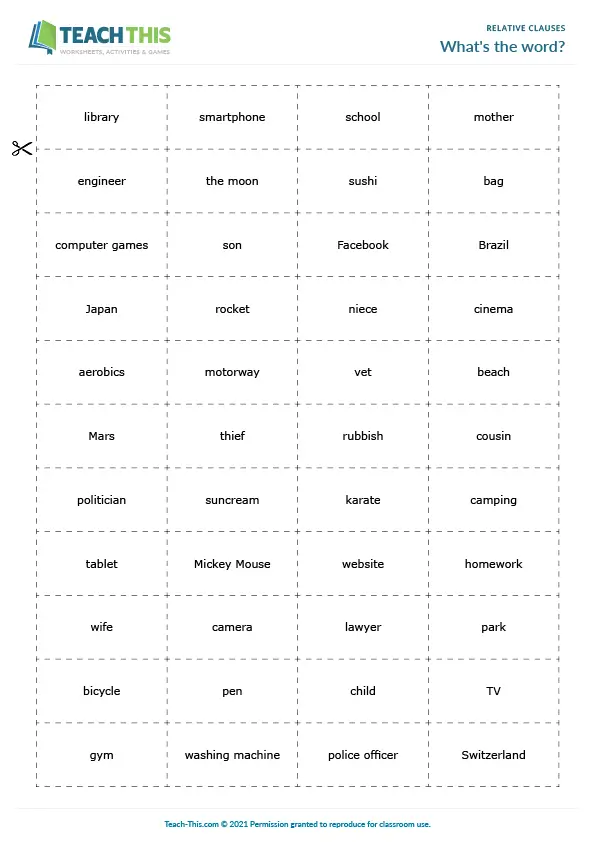
ESL Defining Relative Clauses Game - Grammar and Speaking: Describing, Forming Sentences, Guessing - Group Work
Here is an entertaining relative clauses game to help students practice defining relative clauses with who, which and where. In groups, students take turns picking up a word card (e.g. library) and...
Who, Which, When, Where
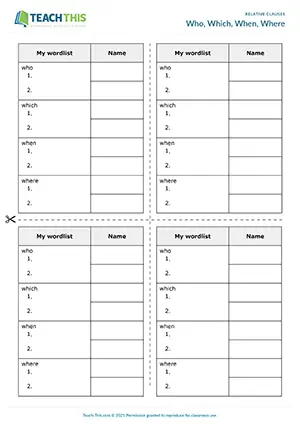
ESL Defining Relative Clauses Game - Grammar: Writing Sentences, Describing, Guessing - Group Work
In this imaginative defining relative clauses game, students practice describing people, things, places and times with defining relative clauses. Give each student a card containing the relative pronouns who...
Anita's Strange Day
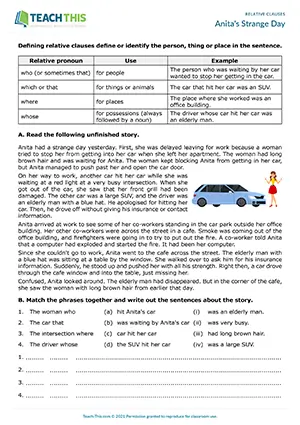
ESL Defining Relative Clauses Worksheet - Grammar Exercises: Matching, Gap-fill, Rewriting Sentences - Speaking Activity - Discussion - Group Work
Here is a free story-based relative clauses worksheet to help students practice or review defining relative clauses with who, whose, that, which and where...
Relative Clause Crossword
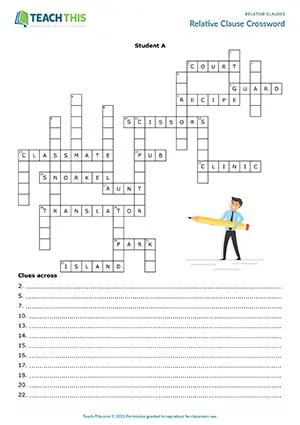
ESL Defining Relative Clauses Activity - Grammar and Speaking: Writing Clues, Describing, Guessing, Controlled and Freer Practice - Group and Pair Work
In this productive defining relative clauses activity, students practice describing words using defining relative clauses with who, where, which and that...
When will I be famous?
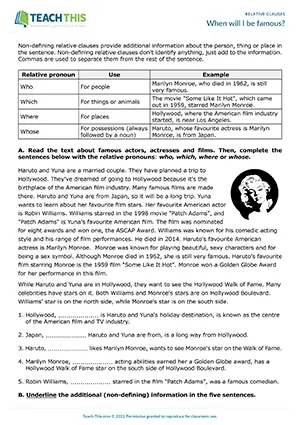
ESL Non-Defining Relative Clauses Worksheet - Grammar and Reading Exercises: Gap-fill, Identifying, Matching, Rewriting Sentences, Sentence Completion
This useful non-defining relative clauses worksheet helps students practice or review non-defining relative clauses while reading and writing about famous...
Word Bluff
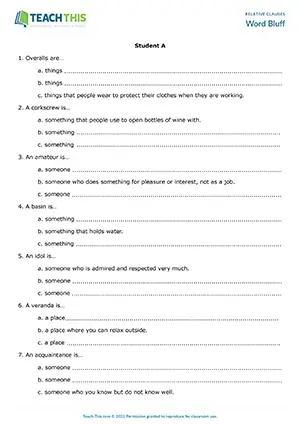
ESL Defining Relative Clauses Game - Grammar and Speaking: Writing and Reading Sentences, Guessing - Group and Pair Work
In this amusing defining relative clauses game, students invent false definitions for words using defining relative clauses and then guess which definition for a word is correct. The worksheets show the...
Understanding Relative Clauses
Relative clauses modify a noun using relative pronouns such as who, which, where, whose, or that, and they split into two types: defining clauses that pin down exactly which person or thing you mean, and non-defining clauses that add extra detail about a noun the reader or listener already knows. Students who mix up the two types can change the meaning of a sentence entirely, for example writing 'My sister who lives in Paris is a doctor' implies having more than one sister, while 'My sister, who lives in Paris, is a doctor' refers to one specific person.
This page covers relative clauses at Intermediate (B1) and Upper-intermediate (B2) levels, with 11 activities, games, and worksheets spanning error correction, guided writing, card games, and group speaking tasks, including two free downloads.
The table below maps each relative pronoun to its function, shows whether it appears in defining clauses, non-defining clauses, or both, and gives a short example sentence.
| Relative Pronoun | Used For | Defining or Non-defining | Example Sentence |
|---|---|---|---|
| who | people | Both | 'She is the teacher who helped me.' |
| whom | people (formal, object position) | Both | 'The candidate whom we hired starts Monday.' |
| which | things and animals | Both | 'This is the book which changed my view.' |
| that | people or things | Defining only | 'The car that I bought needs repairs.' |
| where | places | Both | 'That is the city where I grew up.' |
| when | times | Both | 'I remember the day when we first met.' |
| whose | possession | Both | 'The student whose essay won is here.' |
When to Use Relative Clauses
Defining a term within a sentence: A writer uses a defining relative clause to explain what a term means at the exact point it appears in the text, keeping the writing flowing without breaking off into a separate definition, as in 'This report examines the factors that contributed to the market collapse.'
Adding biographical detail in formal writing: A non-defining relative clause lets a writer slip background information about a named person into a sentence without interrupting the main point, as in 'The director, who joined the company in 2019, announced the restructure last Monday.'
Combining sentences for written fluency: A writer joins two related sentences into one by using a relative clause to carry the secondary information, as in turning 'The study produced results. The results surprised the team.' into 'The study produced results that surprised the team.'
3-Step Framework for Teaching Relative Clauses
1. Build the Foundation with Controlled Writing: Begin with a structured worksheet that moves students through the full range of defining relative clause work in a single sequence. After gap-fill and multiple choice exercises, students rewrite sentences by correcting relative pronoun mistakes, then write their own definitions for places, things, times, and people, for example 'A kitchen is a room where people store and cook food.' This progression from recognition to production cements accurate pronoun choice before students open their mouths.
2. Add a Competitive Edge with Sentence Building: Move to a collaborative card game that brings non-defining relative clauses to life through group play. The first player starts a sentence from a picture card, for example 'My father...', and each player in turn extends it by laying down a picture card or a relative pronoun card and adding a non-defining relative clause. The group with the longest grammatically correct sentence at the end of the game wins, which turns accuracy into a competitive goal that students genuinely care about.
3. Push for Independent Production with a Bluffing Game: Raise the stakes by asking students to produce defining relative clauses convincingly enough to fool a partner. Each student writes two false definitions for a word using defining relative clauses, alongside one correct definition provided on the worksheet, then reads all three aloud while their partner tries to identify the real one and scores a point for each correct guess. When students need their definitions to sound believable, they pay far closer attention to clause structure and word choice than any drilling exercise produces.
Common Mistakes with Relative Clauses
Using 'which' for people instead of 'who': Students often apply 'which' to people as well as things, not yet distinguishing that 'who' is reserved for people while 'which' describes objects and animals. Wrong: 'She is the teacher which helped me.' Correct: 'She is the teacher who helped me.'
Pronoun doubling after the relative pronoun: Students often add an unnecessary pronoun inside the relative clause, repeating the noun they have already referred to. Wrong: 'The book which I bought it is on the table.' Correct: 'The book which I bought is on the table.'
Common Questions About Teaching Relative Clauses
What is a fun game for practicing defining relative clauses?
The game Fold your Arms bans all miming and gestures, so students must describe objects, people, places, and times using defining relative clauses alone. One student picks up a picture card, places it face down, and folds their arms before describing the picture. The first student to guess the word wins the card.
What is a useful worksheet for practicing relative clauses?
The free worksheet Anita's Strange Day uses an unfinished story as its context. Students match phrases to write sentences with defining relative clauses, choose correct relative pronouns to complete further sentences, and combine sentences using relative pronouns. The activity ends with groups discussing possible endings for the story, connecting grammar practice to real communicative output.
What is an engaging activity for teaching non-defining relative clauses?
In the activity I didn't know that!, students sit in a circle, fold their worksheet to show only the 'Non-Defining Relative Clauses' column, and pass it to the person on their right, who adds a non-defining relative clause with 'who' however they like. Each student then reads their completed sentences aloud and says whether the information is true.
Become a Teach This Member
Get unlimited access to the full library, plus new resources added every week.
Unlimited Resource Access
Download from 3000+ worksheets, activities, and games.
Save 5+ Hours Weekly
Cut lesson prep time with ready-to-use resources, plus teacher notes and answer keys.
Trusted Professional Quality
Classroom-tested, editable resources created by experienced ESL professionals.
Fresh Content Weekly
Get 5 new resources added to the library each week.
Here's what our members are saying...


