
Making Invitations ESL Activities, Games & Worksheets
Come With Me!
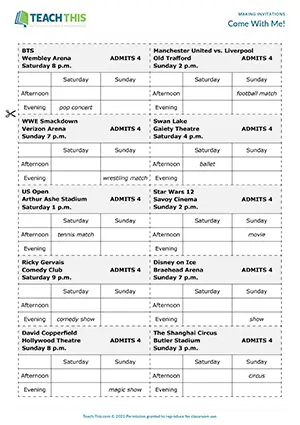
ESL Making Invitations Activity - Speaking: Asking and Answering Questions, Communicative Practice
In this communicative making invitations activity, students make, accept and decline invitations and make suggestions on where and when to meet. The aim of the activity is to invite three other students...
Would you like to...?

ESL Inviting Activity - Reading, Writing and Speaking: Ordering, Role-Play, Gap-Fill, Writing and Presenting Dialogues, Freer Practice - Pair Work
In this productive making invitations activity, students practice phrases for making and responding to invitations and making arrangements. First, students...
I'm sorry, I can't.
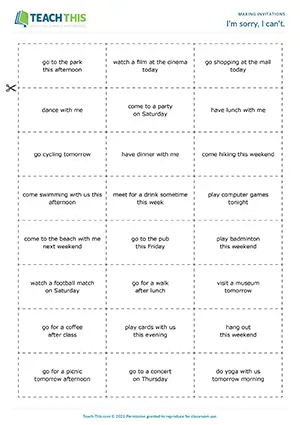
ESL Making and Declining Invitations Game - Speaking: Asking Questions and Responding, Communicative Practice - Group Work
In this free making and declining invitations game, students are invited to do various things and try to decline each invitation with a unique excuse. In groups...
Invitations Board Game

ESL Making Invitations Board Game - Speaking: Asking Questions, Making Statements and Responding - Group Work
In this fun making invitations board game, students practice making invitations and responding by declining and giving an excuse or expressing a possibility to accept. Players take turns rolling the dice...
Invite Only
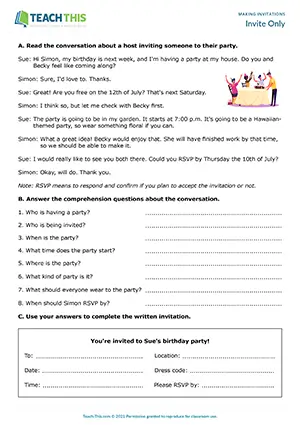
ESL Making Invitations Worksheet - Vocabulary Exercises: Reading Comprehension, Categorising, Gap-fill - Speaking Activity: Freer Practice
In this comprehensive making invitations worksheet, students practice language for making, accepting and declining spoken and written invitations. First...
Written Invitations
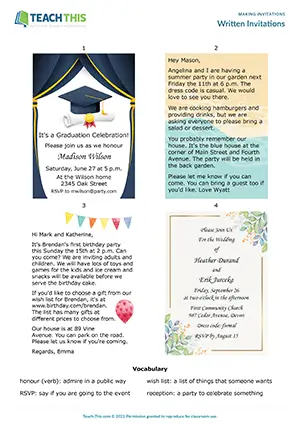
ESL Invitations Worksheet - Reading and Writing Exercises: Brainstorming, Matching, Identifying, Writing an Email, Discussion
In this useful written invitations worksheet, students learn about the contents of written invitations and practice writing one. First, in pairs, students brainstorm and write down what details should be...
You're Invited!
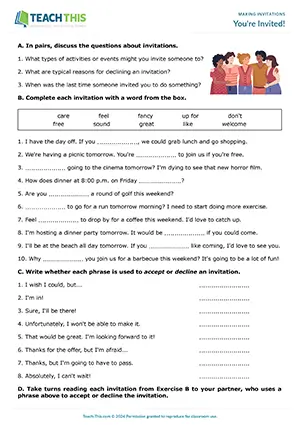
ESL Invitations Worksheet - Vocabulary and Writing Exercises: Gap-fill, Writing Sentences - Speaking Activities: Responding to Statements, Freer Practice - Pair Work
Here is an engaging making invitations worksheet to help students practice phrases for making, accepting, and declining informal invitations. First, students...
Using Invitations Language
Invitations language is the set of phrases and structures English speakers use to extend, accept, or decline a social or professional invitation, ranging from the casual 'Do you want to...?' to the more considered 'I was wondering if you'd like to...?' Register matters: 'Do you want to...?' sounds natural between friends but too casual in professional contexts, where 'Would you like to...?' or 'I was wondering if you'd like to...' carry the right tone. Learners who treat these phrases as interchangeable risk coming across as either too blunt or overly stiff, since register shifts significantly depending on the relationship and the setting.
This page covers invitations language across A2, B1, and B2 levels, with seven activities and worksheets covering both spoken and written invitations, including one free download.
This table maps the key functions and typical phrases used when making, accepting, and declining invitations in everyday English.
| Situation | Function | Example Phrase |
|---|---|---|
| Inviting a friend casually | Making an informal invitation | 'Do you want to come over on Saturday?' |
| Inviting someone politely | Making a polite invitation | 'Would you like to join us for dinner this evening?' |
| Inviting in a professional context | Making a formal invitation | 'I was wondering if you'd like to attend our company event next Friday.' |
| Accepting warmly | Accepting | 'That sounds great, I'd love to!' |
| Accepting tentatively | Accepting with conditions | 'I think so, but let me check my diary first.' |
| Declining with regret | Declining politely | 'I'm sorry, I can't make it. I have other plans.' |
| Declining and suggesting an alternative | Declining with counter-offer | 'I can't this weekend, but how about the following Saturday?' |
| Arranging details after acceptance | Making arrangements | 'Where shall we meet, and what time suits you?' |
When to Use Invitations Language
Professional Networking: When reaching out to a business contact or someone you have only just met, a polite invitation structure gives the other person a comfortable way to say yes or no without feeling pressured, as in 'I was wondering if you'd be interested in joining us for a networking lunch next week.'
Group Social Planning: When coordinating plans among several people at once, invitation phrases help establish who is coming, when, and where without creating awkward assumptions, as in 'Are you all free to come over this Saturday evening?'
Responding to an Invitation You Cannot Accept: When turning down an invitation from someone you want to keep a good relationship with, pairing a regret phrase with a reason and a counter-offer signals that the refusal is about timing rather than the person, as in 'I'd love to but I can't make Thursday. Could we do the following week instead?'
3-Step Framework for Teaching Invitations Language
1. Teach the Phrase Set: Learners need to know what phrases exist and how they differ before they can use them confidently. A worksheet that has students categorise phrases for making, accepting and declining invitations, then complete short conversations using those phrases, gives them a working map of the language. The sequence closes with students creating their own party invitation and using it to practice the full exchange with classmates.
2. Push Declining Under Pressure: Accepting an invitation is straightforward; declining one politely is where learners struggle most. A card game where students must come up with a unique excuse every time they decline, with the rule that no excuse may be repeated across the game, forces them to move beyond 'I'm busy' and build a genuine range of polite refusal language.
3. Extend to Written Form: Spoken and written invitations follow different conventions, and learners need to see both. Have students brainstorm what details a written invitation needs before reading examples and writing their own email invitation to a birthday party. A class discussion on which examples are the most and least formal sharpens their awareness of register across both modes.
Common Mistakes with Invitations Language
Declining Too Bluntly: Students often decline an invitation with a bare refusal and no expression of regret or reason, which sounds rude in English even when no rudeness is intended. Wrong: 'I can't come.' Correct: 'I'm sorry, I can't make it. I have other plans that evening.'
Accepting Without Warmth: Students often accept an invitation with a grammatically correct but communicatively flat response, which can come across as unenthusiastic or even reluctant to a native speaker. Wrong: 'OK, I will come.' Correct: 'That sounds great, I'd love to!'
Common Questions About Teaching Invitations Language
What is a good board game for practicing invitations?
The board game Invitations Board Game gives students a different invitation scenario every turn. A player lands on a square, picks up a response card, and must either decline the invitation with an excuse or express a possibility to accept. Other students judge the response, and a poor answer sends the player back two squares.
What is a useful worksheet for teaching invitation phrases?
The worksheet You're Invited! builds invitation phrases through a structured four-stage sequence. Students complete invitations with words from a box, identify whether phrases accept or decline, take turns reading invitations to a partner who responds in role, then write and role-play their own mini-dialogues using prompts. Every stage prepares students for the one that follows.
What is a fun activity for practicing invitations in class?
In the activity Come With Me!, every student gets a ticket for an event and a diary to fill. They move around the class inviting classmates, who only accept if they genuinely want to go and are free. Once an invitation is accepted, the two students agree on a time and place to meet, making every exchange purposeful.
Become a Teach This Member
Get unlimited access to the full library, plus new resources added every week.
Unlimited Resource Access
Download from 3000+ worksheets, activities, and games.
Save 5+ Hours Weekly
Cut lesson prep time with ready-to-use resources, plus teacher notes and answer keys.
Trusted Professional Quality
Classroom-tested, editable resources created by experienced ESL professionals.
Fresh Content Weekly
Get 5 new resources added to the library each week.
Here's what our members are saying...


