
Present Perfect Wh Questions ESL Games, Activities & Worksheets
Present Perfect Wh Questions
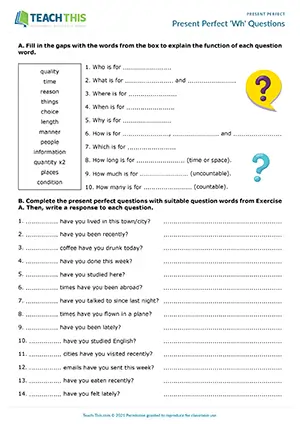
ESL Present Perfect Questions Worksheet - Grammar Exercises: Gap-fill, Writing Questions and Answers - Speaking Activity: Freer Practice - Pair Work
In this free present perfect Wh questions worksheet, students learn the functions of question words and how to form, ask and answer Wh questions in the...
Write, Ask and Answer

ESL Present Perfect Wh Questions Activity - Grammar and Speaking: Writing, Asking and Answering Questions, Controlled and Freer Practice - Group and Pair Work
In this insightful present perfect speaking activity, students write, ask and answer present perfect Wh conversation questions. First, in two groups, students...
Perfectly Played!
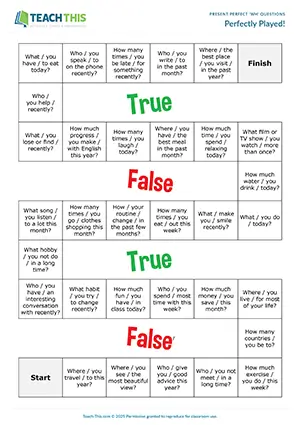
ESL Present Perfect Questions Board Game - Grammar and Speaking: Forming Questions, True or False, Guessing, Freer Practice - Group Work
In this fun present perfect Wh questions board game, students practice asking and answering Wh questions in the present perfect. In groups, players take turns...
Present Perfect Wh Question Time
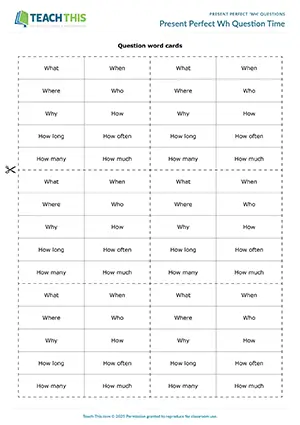
ESL Present Perfect Wh Questions Game - Grammar and Speaking: Forming Questions, Freer Practice - Group Work
In this entertaining present perfect Wh questions game, students race to make present perfect questions that elicit certain responses. In groups, students take turns taking an answer card from...
Who has asked the right question?
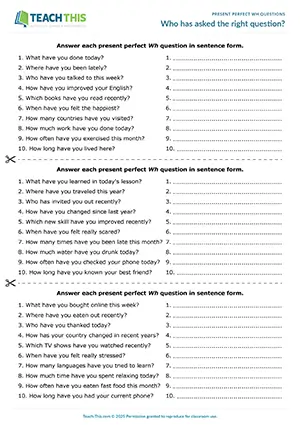
ESL Present Perfect Wh Questions Game - Grammar and Speaking: Writing Sentences, Guessing, Forming Questions, Freer Practice - Group Work
In this engaging present perfect Wh questions game, students guess questions from answers written by other students. First, students answer each present...
Understanding Present Perfect Wh Questions
Present perfect Wh questions use question words like who, what, where, when, why and how to ask for specific details about experiences or actions that connect to the present, for example 'Where have you lived?' or 'What have you eaten today?' When students default to simple past question forms instead, saying 'Where did you live?' rather than 'Where have you lived?', they shift the meaning from a present-connected experience to a finished past event, which changes what the conversation is actually about.
This page covers present perfect Wh questions across A2 and B1 levels, with five resources spanning a grammar worksheet, a pair speaking activity, and three group games, including one free download.
This table shows the structure of present perfect Wh questions and gives an example for each question word.
| Question Word | What It Asks About | Structure | Example |
|---|---|---|---|
| Who | a person | Who + have/has + subject + past participle | 'Who have you spoken to about this?' |
| What | a thing, action or experience | What + have/has + subject + past participle | 'What have you decided to do?' |
| Where | a place | Where + have/has + subject + past participle | 'Where have you travelled this year?' |
| When | a point in time | When + have/has + subject + past participle | 'When have you felt most confident?' |
| Why | a reason | Why + have/has + subject + past participle | 'Why have you chosen this course?' |
| How | manner or degree | How + have/has + subject + past participle | 'How have you been managing the workload?' |
| How long | duration | How long + have/has + subject + past participle | 'How long have you worked here?' |
| How many / How much | quantity | How many/much + noun + have/has + subject + past participle | 'How many countries have you visited?' |
When to Use Present Perfect Wh Questions
Showing Interest in Someone's Experiences: A speaker uses a present perfect Wh question to dig deeper into something someone has mentioned, signalling real curiosity rather than a simple yes/no check, as in 'What have you been working on lately?'
Requesting Specific Details in Formal Contexts: In interviews or formal discussions, present perfect Wh questions let a speaker ask for evidence or specifics without sounding confrontational, as in 'What experience have you gained in this field?'
Connecting a Past Action to the Present Moment: A writer or speaker uses a present perfect Wh question to bring a past event into the current discussion, making it feel immediately relevant, as in 'How has this decision affected your plans so far?'
3-Step Framework for Teaching Present Perfect Wh Questions
1. Build the Form from the Ground Up: Open with a worksheet that constructs the question form systematically. Students complete present perfect questions by choosing the correct question word and writing a response to each, then tackle the harder task of writing present perfect Wh questions to match the underlined information in a set of answers. Working backwards from answer to question sharpens students' awareness of how each question word targets a specific piece of information.
2. Put the Questions into Conversation: Move students into a structured speaking activity where they first write present perfect conversation questions from prompts in groups, then pair up with someone from the other group to ask their questions, note down answers, and ask follow-up questions to gain more information when possible. Reporting back to the class at the end gives the language a real communicative purpose.
3. Add Competition and Accuracy Stakes: Raise the stakes with a board game at B1 level where accuracy earns points. When a player lands on a square, they form a present perfect Wh question from the prompt, for example 'Where have you travelled to this year?', and score a point for getting it right. They then give a true or false answer as indicated on their card, and the rest of the group guesses which it is, scoring points for correct guesses.
Common Mistakes with Present Perfect Wh Questions
Failing to Invert the Auxiliary: Students often place the question word before the subject without inverting the auxiliary verb, treating it like a statement rather than a question. Wrong: 'Where you have been?' Correct: 'Where have you been?'
Using 'did' Instead of 'have/has': Students often reach for simple past question structure out of habit, dropping the present perfect auxiliary entirely. Wrong: 'What did you see?' Correct: 'What have you seen?'
Common Questions About Teaching Present Perfect Wh Questions
What is an engaging game for practicing present perfect Wh questions?
In the game Present Perfect Wh Question Time, a student reads an answer card, for example 'I have gone shopping,' and the rest race to form a present perfect Wh question to elicit that response, such as 'Where have you gone?' The first student to cross off all the question words on their card wins.
How can I get students to produce present perfect Wh questions?
Writing questions from prompts before using them in conversation is what makes the activity Write, Ask and Answer effective. Students form present perfect questions in groups, then ask them to a partner, note down the answers, and ask follow-up questions to find out more. They finish by reporting back to the class on what they found out.
What is a good present perfect Wh questions worksheet?
The free worksheet Present Perfect Wh Questions takes students from guided practice to independent speaking in one activity. Students complete present perfect questions with the correct question word, write responses, then tackle writing Wh questions from prompts. The final task has students ask and answer the Exercise D questions with a partner, putting the written practice to spoken use.
Become a Teach This Member
Get unlimited access to the full library, plus new resources added every week.
Unlimited Resource Access
Download from 3000+ worksheets, activities, and games.
Save 5+ Hours Weekly
Cut lesson prep time with ready-to-use resources, plus teacher notes and answer keys.
Trusted Professional Quality
Classroom-tested, editable resources created by experienced ESL professionals.
Fresh Content Weekly
Get 5 new resources added to the library each week.
Here's what our members are saying...


