
Telephoning ESL Role-Plays, Activities, Games & Worksheets
Ending a Phone Call
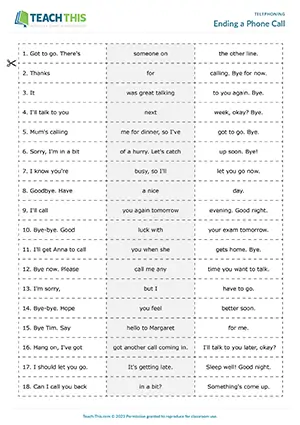
ESL Ending a Phone Call Games - Reading and Speaking: Matching, Forming Sentences - Pair Work
Here are two enjoyable telephoning games to help students practice phrases to end informal phone calls. First, in pairs, students race to arrange sentence beginning cards in order and then match them...
Telephone Language Game
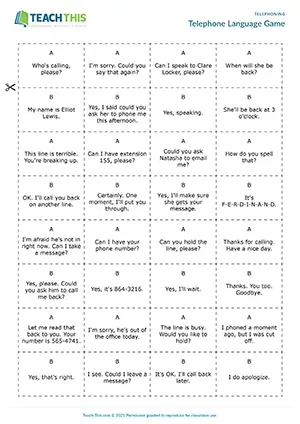
ESL Telephoning Game - Speaking: Matching - Group Work
In this free telephone language game, students race to match common telephone phrases with appropriate responses. The aim of the game is to race to find the students who have matching replies to common telephone phrases. One...
Who's calling, please?
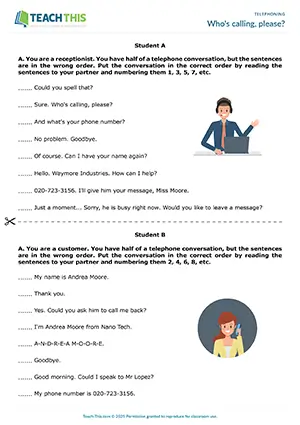
ESL Telephoning Activity - Reading, Writing and Speaking: Ordering, Matching, Writing Sentences, Role-Plays, Freer Practice - Pair Work
In this engaging telephoning activity, students learn telephone phrases and practice taking and leaving messages over the phone. First, in pairs, students put a...
Are You Following Me?
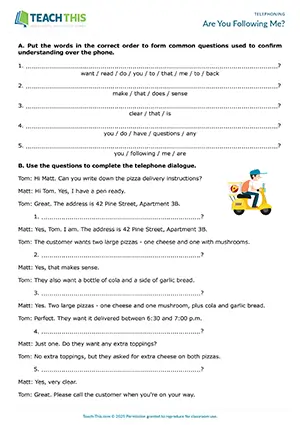
ESL Confirming Activity - Vocabulary: Unscrambling, Dialogue Completion - Speaking Activity: Role-Play, Communicative Practice - Pair Work
Here is a productive telephoning activity to help students practice confirming instructions and checking understanding during phone conversations. Students...
Arranging a Delivery

ESL Arranging Deliveries Role-Play - Vocabulary Exercise: Gap-fill - Speaking Activity: Role-Play, Communicative Practice - Group Work
Here is a communicative arranging deliveries role-play to help students practice arranging delivery times over the phone. First, students complete an arranging a...
Be Polite!

ESL Polite Telephone Language Worksheet - Writing and Speaking Activity: Rewriting and Role-Playing a Dialogue - Pair Work
In this free telephoning worksheet, students practice polite telephone phrases and requests by rewriting a telephone dialogue. First, students rewrite a telephone dialogue to make it more polite and...
Booking Tickets
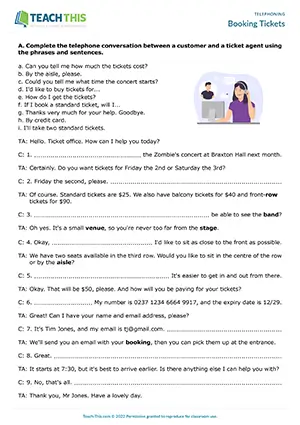
ESL Telephone Bookings Worksheet - Reading and Vocabulary: Gap-fill, Matching, Unscrambling - Writing and Speaking: Writing a Dialogue, Role-Play - Pair Work
Here is a comprehensive telephone bookings worksheet to help students practice vocabulary and phrases for booking tickets over the phone. Students begin...
Clarifying and Confirming
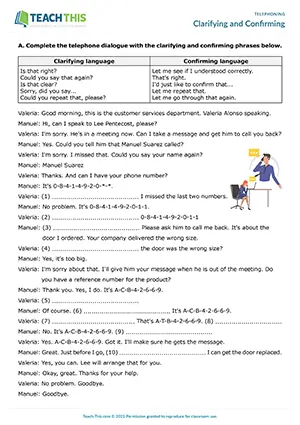
ESL Clarifying and Confirming Activity - Vocabulary and Speaking: Gap-fill, Role-Play, Asking and Answering Questions, Communicative Practice - Pair Work
In this clarifying and confirming worksheet and role-play, students learn and practice ten phrases for clarifying and confirming information over the phone...
Rescheduling an Appointment
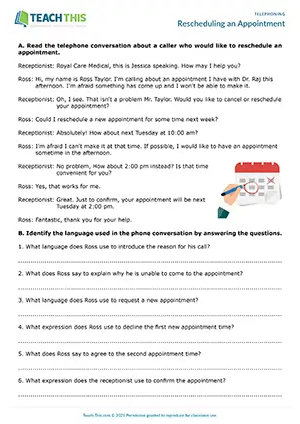
ESL Rescheduling Appointments Worksheet - Reading and Vocabulary Exercises: Answering Questions, Identifying, Matching - Speaking Activity: Role-Play - Pair Work
In this rescheduling appointments worksheet and role-play, students learn and practice phrases for rescheduling an appointment over the phone. First, students...
Telephone Role-Plays
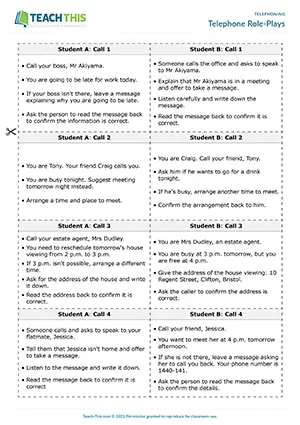
ESL Telephone Role-Plays - Speaking Activity: Communicative Practice - Pair Work
In these communicative telephone role-plays, students practice essential telephone phrases for taking and leaving messages, making and changing arrangements, and confirming information over the phone. In...
Ring, Ring!

ESL Telephone Phrasal Verbs Game - Vocabulary: Matching, Forming and Writing Sentences - Pair Work
This fun telephone phrasal verbs game helps students practice telephone phrasal verbs and common telephone expressions. In pairs, students use cards to make sentences connected with telephone...
Telephone Language Review

ESL Telephone Language Worksheet - Vocabulary Exercises: Matching, Categorising, Multiple Choice, Gap-fill, Role-Play
This useful telephoning worksheet helps students review common telephone expressions and phrasal verbs used over the phone. Students start by...
Telephone Phrasal Verb Frenzy
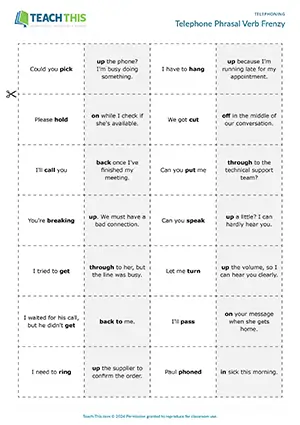
ESL Telephone Language Games - Vocabulary: Pelmanism, Matching, Forming Sentences - Pair Work
Here are two rewarding telephone phrasal verb games to help students practice telephone phrasal verbs and common telephone expressions. First, students play a pelmanism game where...
What Is Telephoning Language?
Telephoning is the functional language learners use to handle calls from start to finish, including saying who is speaking, asking for someone, taking messages, checking details, making arrangements, and closing politely. When learners skip these call routines, the conversation can sound abrupt and important details such as names, numbers, times, or messages can get lost.
This page covers telephoning across A2, B1, and B2 levels, with 13 resources ranging from role-plays and speaking activities to games and worksheets, including two free downloads.
Telephoning language helps learners choose phrases by call purpose, speaker role, and the level of politeness the situation needs.
| Situation | Speaker | Example Phrase |
|---|---|---|
| Opening a call | Caller | 'Hello, this is Maya Chen calling.' |
| Asking who is calling | Receiver | 'Who's calling, please?' |
| Asking for someone | Caller | 'Could I speak to Mr. Davis, please?' |
| Putting someone on hold | Receiver | 'Could you hold on a moment, please?' |
| Leaving a message | Caller | 'Could you ask her to call me back?' |
| Checking information | Caller or receiver | 'Could you repeat the address, please?' |
| Arranging a time | Caller or receiver | 'Would Tuesday morning work for you?' |
| Ending a call | Caller or receiver | 'Thanks for your help. Goodbye.' |
How to Use Telephoning Language
Set the call purpose early: State who you are and why you are calling so the other person can respond without guessing, as in 'This is Lena Martin calling about tomorrow's appointment.'
Manage waiting politely: Use holding phrases when you need time to check information or connect the caller, as in 'Could you hold on while I check that for you?'
Confirm the next action: Finish practical calls by naming the agreed action, time, or contact point, as in 'So I will send the form this afternoon.'
3-Step Framework for Teaching Telephoning Language
1. Organize Call Routines by Purpose: Start with a full telephone conversation and have learners order it from 1 to 16, then sort the phrases by function so they see how a call moves from opening to message-taking.
2. Build Confirmation Habits: Give students phone dialogues where they pause at several points to confirm understanding using questions, so checking information becomes part of the call rather than a repair after confusion.
3. Practice Information-Heavy Calls: Use service-call situations where students must confirm a name and order number, plus address, mobile number, and any details the driver needs to know about, so accuracy drives the conversation.
Common Mistakes with Telephoning Language
Starting Too Abruptly: Students often ask for someone straight away without identifying themselves or softening the request. Wrong: 'I want to speak to Mr. Davis.' Correct: 'Hello, this is Daniel Kim. Could I speak to Mr. Davis, please?'
Unclear Message Request: Students often ask someone to pass on a message without giving the action or contact detail the listener needs. Wrong: 'Tell her I called.' Correct: 'Could you ask her to call me back at 555-0184?'
Common Questions About Teaching Telephoning Language
What is a fun game for teaching telephone phrases?
The free game Telephone Language Game gives students a fast matching task with real call exchanges. One student reads a card, such as 'Who's calling, please?', and another looks for a matching reply, such as 'My name is Elliot Lewis.' The first student to get four matching pairs of cards wins the game.
What is a good worksheet for teaching polite phone language?
Use the free worksheet Be Polite! to move language learners from direct wording to more polite phone requests. Students rewrite a telephone dialogue to make it more polite and appropriate, compare what they have written with a partner, edit telephone phrases or requests, and role-play their dialogues in front of the class.
What speaking activity practices telephoning language?
For functional call practice, the activity Telephone Role-Plays has pairs take turns making and receiving calls using prompts on role cards. The scenarios cover taking and leaving messages, making and changing arrangements, and confirming information over the phone, so learners practice what they need to do in real calls.
Become a Teach This Member
Get unlimited access to the full library, plus new resources added every week.
Unlimited Resource Access
Download from 3000+ worksheets, activities, and games.
Save 5+ Hours Weekly
Cut lesson prep time with ready-to-use resources, plus teacher notes and answer keys.
Trusted Professional Quality
Classroom-tested, editable resources created by experienced ESL professionals.
Fresh Content Weekly
Get 5 new resources added to the library each week.
Here's what our members are saying...


