
Demonstrative Pronouns ESL Games, Worksheets & Activities
Pronoun Pair-Up
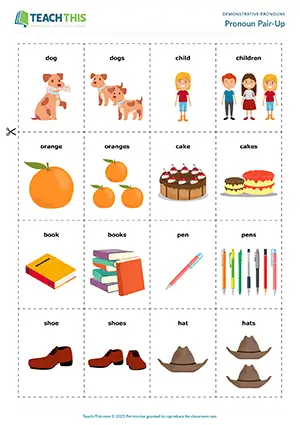
ESL This, That, These, Those Game - Vocabulary and Speaking: Pelmanism, Matching, Forming Sentences, Controlled Practice - Pair Work
Here is an enjoyable demonstrative pronouns game to help students practice making sentences with 'this', 'that', 'these', and 'those'. In pairs, students...
That is a Drawing
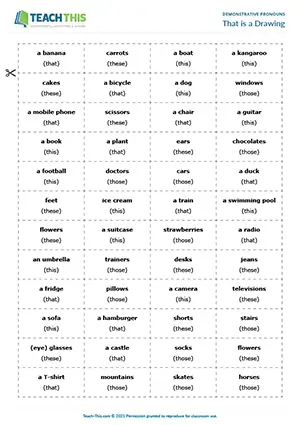
ESL Demonstrative Pronouns Game - Vocabulary: Drawing, Guessing, Making Sentences - Group Work
In this free demonstrative pronouns game, students draw pictures and compete to identify their classmates' drawings using 'this', 'that', 'these' and 'those'. In two teams, students take turns drawing...
This, That, These and Those
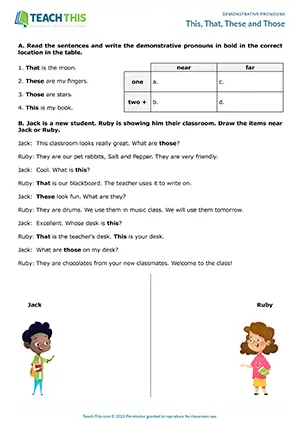
ESL This, That, These, Those Worksheet - Grammar Exercises: Categorising, Drawing, Binary Choice, Gap-fill
In this useful demonstrative pronouns worksheet, students explore a new classroom and a beach scene to practice identifying near and far objects with 'this', 'that', 'these' and 'those'. First, students...
Demonstrative Danger
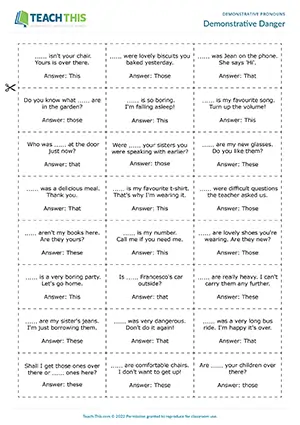
ESL This, That, These, Those Game - Vocabulary and Grammar: Gap-fill - Group Work
In this fun demonstrative pronouns game, students race to complete sentences with the demonstrative pronouns: these, those, this and that. The reader reads each sentence card to the players using...
This, That, These or Those?
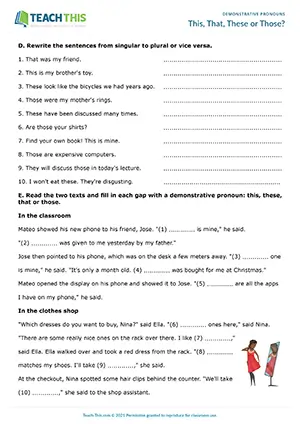
ESL Demonstrative Pronouns Worksheet - Vocabulary and Grammar Exercises: Sentence Completion, Binary Choice, Rewriting Sentences, Gap-fill
In this productive demonstrative pronouns worksheet, students practice how to use the pronouns: this, that, these and those. Students start by completing...
Whose is whose?
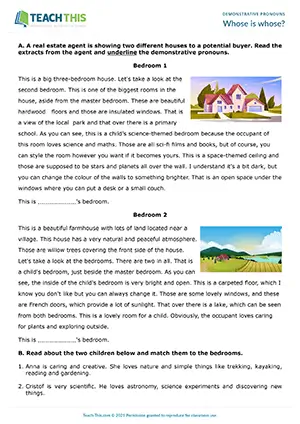
ESL Demonstrative Pronouns Activity - Grammar and Vocabulary: Identifying, Matching, Forming Sentences - Pair Work
This engaging demonstrative pronouns activity helps students practice the pronouns: this, that, these and those. First, students read house description extracts from a real estate agent and underline...
Understanding Demonstrative Pronouns
Demonstrative pronouns replace nouns to show distance: 'this' points to something nearby and singular, 'these' to something nearby and plural, 'that' to something distant and singular, and 'those' to something distant and plural. When students confuse them, they point their listener to the wrong object or the wrong number, which makes even simple sentences like 'Pass me that' come across as unclear or flat-out wrong.
This page covers demonstrative pronouns across Elementary (A1-A2), Pre-intermediate (A2), and Intermediate (B1) levels, with six resources spanning pelmanism card games, a Pictionary-style drawing game, worksheets, and a grammar card race, including one activity available as a free download.
The four demonstrative pronouns in English map onto two variables: how close the thing is and whether it is singular or plural.
| Proximity | Number | Pronoun | Example Sentence |
|---|---|---|---|
| Near | Singular | this | 'This is my bag.' |
| Near | Plural | these | 'These are my books.' |
| Far | Singular | that | 'That is a great idea.' |
| Far | Plural | those | 'Those are expensive shoes.' |
When to Use Demonstrative Pronouns
Pointing to something in the immediate environment: A speaker chooses 'this' or 'these' when holding something or standing right next to it, making physical closeness part of the meaning, as in 'This is the one you want.'
Referring to something at a visible distance: A speaker uses 'that' or 'those' when drawing attention to something they cannot physically touch, as in 'Can you pass me that from the shelf?'
Reacting to something just said: Speakers use 'that' to refer back to a statement or idea just shared, either to agree with it or push back on it, as in 'That's exactly what I was thinking.'
3-Step Framework for Teaching Demonstrative Pronouns
1. Start with Position: Get students to see distance as a physical reality by laying cards on the table in two zones. The cards in the two front rows prompt sentences with 'this' or 'these', while the cards in the two back rows prompt 'that' or 'those'. Using actual physical proximity to drive pronoun choice locks in the near/far rule faster than any explanation.
2. Add Visual Competition: Split the class into teams and push the distinction further with a divided board. Draw a horizontal line across the board, explain that the lower part represents things nearby and the upper part things further away, then have students draw items in the correct zone before their teammates race to make a sentence with the right pronoun. The spatial pressure sharpens accuracy quickly.
3. Move to Real Context: At B1 level, move students beyond simple pointing into a scenario where pronouns carry genuine communicative weight. Pairs work from a chart of object descriptions, and to score a point each student must produce two sentences, using 'this' or 'these' for objects on their own chart and 'that' or 'those' for objects on their partner's chart. That ownership logic mirrors exactly how speakers use these pronouns in real conversation.
Common Mistakes with Demonstrative Pronouns
Using a singular pronoun with a plural noun: Students often use 'this' or 'that' with a plural noun instead of switching to 'these' or 'those.' Wrong: 'This books are interesting.' Correct: 'These books are interesting.'
Using the wrong distance pronoun: Students often default to 'this' or 'these' regardless of how far away the thing is, ignoring the near/far distinction that English speakers use to signal physical or conversational distance. Wrong: 'This is my house over there.' Correct: 'That is my house over there.'
Common Questions About Teaching Demonstrative Pronouns
What is a fun demonstrative pronouns game?
In the game Demonstrative Danger, players race to grab the correct pronoun card while a reader reads sentences with 'blank' for the missing word. What makes it fun is the penalty rule: hand over a wrong card and you take it back along with every card already given to the reader, so the pressure builds with every round.
What is a good worksheet for teaching demonstrative pronouns?
The worksheet This, That, These and Those is a strong choice because it ties pronoun selection to a visual layout. Students read a classroom conversation and draw the items mentioned near each character on the page, so the near and far distinction becomes something they can see rather than just a rule to remember.
What is an engaging activity for teaching demonstrative pronouns in context?
The activity Whose is whose? puts demonstrative pronouns to work in a real-life ownership scenario. Students read object descriptions and make two sentences per answer, using 'this' or 'these' for items on their own chart and 'that' or 'those' for items on their partner's chart. That contrast between charts is what makes the pronoun choice feel meaningful.
Become a Teach This Member
Get unlimited access to the full library, plus new resources added every week.
Unlimited Resource Access
Download from 3000+ worksheets, activities, and games.
Save 5+ Hours Weekly
Cut lesson prep time with ready-to-use resources, plus teacher notes and answer keys.
Trusted Professional Quality
Classroom-tested, editable resources created by experienced ESL professionals.
Fresh Content Weekly
Get 5 new resources added to the library each week.
Here's what our members are saying...


