May I...?

Elementary (A1-A2) 20 minutes
ESL May I activity preview for A1-A2 elementary: asking, giving and refusing permission with cards, speaking practice

ESL May I Activity - Speaking: Asking and Answering Questions, Controlled and Communicative Practice

In this free asking for permission speaking activity, students practice asking for, giving and refusing permission using cards as prompts. On one side of the card is a permission prompt and on...

ESL May I Activity - Speaking: Asking and Answering Questions from Prompts, Controlled and Communicative Practice In this free asking for permission speaking activity, students practice asking for, giving and refusing permission using cards as prompts. On one side of the card is a permission prompt and on the other is a tick or cross. Students hold their cards so the permission prompt is facing towards them and the tick or cross is facing away. Students then go around the class asking for, giving and refusing permission with as many partners as possible. If students see a tick, they give permission. If there is a cross, students refuse permission. When the students have finished, they repeat the activity, but this time they hold their card the other way around so the permission prompt is facing away. Students then go around the class, asking for permission to do different things each time they speak to a classmate.

Picture This

Elementary (A1-A2) 30 minutes
ESL asking for permission game preview for A1-A2 elementary: drawing, guessing, forming 'Can I...?' questions, pair work

ESL Asking for Permission Game - Speaking: Drawing Pictures, Guessing, Forming Questions - Pair Work

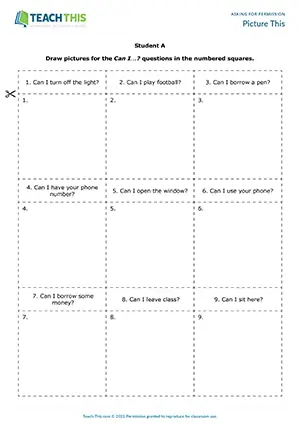
In this creative asking for permission game, students draw pictures of situations where people ask for permission and a partner tries to guess the 'Can I...?' question for each one. First, in two groups, students...

ESL Asking for Permission Game - Speaking: Drawing Pictures from Prompts, Guessing, Forming Questions - Pair Work In this creative asking for permission game, students draw pictures of situations where people ask for permission and a partner tries to guess the 'Can I...?' question for each one. First, in two groups, students draw pictures that illustrate 'Can I...?' questions in numbered squares. For example, if the question was 'Can I borrow a pencil?', the student might draw a picture of someone with a piece of paper and nothing in their hand. Students then cut the worksheet so the drawings and questions are separate. Next, students pair up with someone from the other group and give their partner the drawings. Students then take turns guessing the 'Can I...?' question for each of their partner's pictures. Students have three chances to guess the question for each picture. If a student guesses correctly the first time, they score three points. On the second try, they get two points. On the third try, they score one point. The student with the most points at the end of the game wins.

Can I...?

Pre-intermediate (A2) 20 minutes
ESL Can I game preview for A2 pre-intermediate: asking for permission, matching questions and answers, group speaking activity

ESL Can I Game - Speaking: Matching Questions and Answers - Group Work

In this engaging asking for permission game, students ask permission to do different things using 'Can I...?' and race to find the person who gives permission. Each card contains three 'Can I...?' questions that ask for permission and nine replies...

ESL Can I Game - Speaking: Matching Questions and Answers - Group Work In this engaging asking for permission game, students ask permission to do different things using 'Can I...?' and race to find the person who gives permission. Each card contains three 'Can I...?' questions that ask for permission and nine replies that give or refuse permission. In groups, students take turns asking a 'Can I...?' question on their card to one of the other group members, e.g. 'Can I try on these jeans?' The chosen student then looks for a matching reply on their card. If the student gives permission by saying 'Yes, of course...', the other student crosses off the question. If the student refuses permission by saying 'I'm sorry...', the other student waits until their next turn before asking permission from another person. The first student to cross off all their 'Can I...?' questions wins the game.

Can I... yes or no?

Pre-intermediate (A2) 20 minutes
ESL modals of permission game preview for A2 pre-intermediate: asking and answering, guessing, can may could, pair work

ESL Modals of Permission Game - Speaking: Asking and Answering Questions, Guessing, Communicative Practice - Pair Work

In this fun modal verbs of permission game, students ask for permission to do various things and guess whether their partner is going to grant or refuse permission. This game helps students...

ESL Modals of Permission Game - Speaking: Asking and Answering Questions from Prompts, Guessing, Communicative Practice - Pair Work In this fun modal verbs of permission game, students ask for permission to do various things and guess whether their partner is going to grant or refuse permission. This game helps students practice the modals of permission can, may and could as well as various phrases for granting and refusing permission. In pairs, students take turns picking up a permission card and using the modal verb of permission and prompt shown on the card to ask for permission to do something, e.g. 'May I use your computer?' The student then guesses whether their partner will grant or refuse permission. Their partner then picks up a response card and grants or refuses permission using the expression on the card, e.g. 'Yes, no problem.' If the student guessed correctly, they score a point. If not, their partner scores a point. The student with the most points at the end of the game wins.

Perfect Partners

Pre-intermediate (A2) 25 minutes
ESL asking for permission activity preview for A2 pre-intermediate: asking, giving, refusing permission, communicative practice

ESL Asking for Permission Activity - Speaking: Asking and Answering Questions, Communicative Practice

In this communicative asking for permission activity, students practice asking for, giving and refusing permission. Students imagine that they are going to try to find their perfect partner by asking, giving...

ESL Asking for Permission Activity - Speaking: Asking and Answering Questions from Prompts, Communicative Practice In this communicative asking for permission activity, students practice asking for, giving and refusing permission. Students imagine that they are going to try to find their perfect partner by asking, giving and refusing permission for the things on their card. If they find someone who asks or gives permission for all four items on their card, they have found their perfect partner. The students with card A sit down. Their task is to give or refuse permission. If a student asks permission for an item on their card, they give it. If a student asks permission for something that isn't on their card, they refuse permission and give a reason. The students with card B go around asking the students sitting down permission for the things shown on their card, e.g. 'Can I borrow a pen?' If a student gets permission for all four things on their card, they have found their perfect partner and sit down with them. If a student is refused permission for anything on their card, they move on and speak to another student. When everyone has found their partner, students swap roles to give them practice using all the language.

Asking for Permission Board Game

Intermediate (B1) 30 minutes
ESL asking for permission board game for B1 intermediate: forming questions from prompts, group speaking and permission practice

ESL Asking for Permission Board Game - Speaking: Forming Questions - Group Work

This free asking for permission board game helps students practice asking for, granting and refusing permission using a variety of phrases. In groups, players take turns rolling the dice and moving their counter along the board. When a player lands...

ESL Asking for Permission Board Game - Speaking: Forming Questions from Prompts - Group Work This free asking for permission board game helps students practice asking for, granting and refusing permission using a variety of phrases. In groups, players take turns rolling the dice and moving their counter along the board. When a player lands on a square, they pick up a card and ask for permission using the verb on the card and the phrase on the square. For example, if the player lands on the 'Do you think I could...?' square and picks up the 'have' verb card, the student might say 'Do you think I could have another cup of coffee?' The other students in the group judge whether the question has been phrased correctly and is appropriate. If it is, the students grant permission, e.g. 'Go right ahead.' If not, the students refuse permission (e.g. I'm afraid that's not possible.), and the player goes back two squares. The first player to reach the finish wins the game.

Do you mind if I...?

Intermediate (B1) 30 minutes
ESL asking for permission activity for B1 intermediate: Do you mind if I, asking and answering, communicative practice

ESL Asking for Permission Activity - Speaking: Asking and Answering Questions, Communicative Practice

Here is a communicative asking for permission activity to help students practice asking for permission with 'Do you mind if I...?' and responding by either granting or refusing permission. Students go...

ESL Asking for Permission Activity - Speaking: Asking and Answering Questions from Prompts, Communicative Practice Here is a communicative asking for permission activity to help students practice asking for permission with 'Do you mind if I...?' and responding by either granting or refusing permission. Students go around the class asking permission for the things shown on their worksheet using 'Do you mind if I...?' Students only give permission if they genuinely think they don't mind. If students do mind, they refuse permission and explain why. When a classmate gives or refuses permission, the student writes down their name and answer on the worksheet. This continues until each student has two responses for each item. Afterwards, students give feedback to the class on the people who gave and refused permission.

12 Ways to Ask Permission

Intermediate (B1) 20 minutes
ESL asking for permission game for B1 intermediate: gap-fill, guessing missing words, pair work, practice questions

ESL Asking for Permission Game - Speaking: Gap-fill, Guessing - Pair Work

In this enjoyable asking for permission game, students practice 12 ways to ask permission by guessing missing words in questions. In pairs, one student begins by guessing the missing words in the first question that asks for permission. Their partner...

ESL Asking for Permission Game - Speaking: Gap-fill, Guessing - Pair Work In this enjoyable asking for permission game, students practice 12 ways to ask permission by guessing missing words in questions. In pairs, one student begins by guessing the missing words in the first question that asks for permission. Their partner listens and tells them if they are correct or not. If the student guesses correctly the first time, they score three points and write the words in the gaps. On the second try, they get two points. On the third try, they score one point. After the missing words have been guessed correctly or three chances have passed, their partner guesses the missing words in the second question, and so on. The student with the most points at the end of the game is the winner.

Is it alright if I connect four?

Upper-intermediate (B2) 25 minutes
ESL asking for permission game for B2 upper-intermediate: Connect Four, forming permission questions, situation prompts, pair work

ESL Asking for Permission Game - Vocabulary and Speaking: Forming Questions, Freer Practice - Pair Work

In this useful asking for permission game, students play Connect Four by using common phrases to form questions that ask for permission. To begin, the first player chooses a square. The other player...

ESL Asking for Permission Game - Vocabulary and Speaking: Forming Questions from Prompts, Freer Practice - Pair Work In this useful asking for permission game, students play Connect Four by using common phrases to form questions that ask for permission. To begin, the first player chooses a square. The other player then picks up a situation card and reads it aloud. The first player then uses the phrase from the square to form a relevant question based on the situation that asks for permission. For example, for the square 'Is there any chance...' and the situation 'You have been invited to a party and would like to bring a guest', the player could say 'Is there any chance I could bring a guest to the party?' If the other player agrees that the question is correct and appropriate, the player marks the square with an 'X' or an 'O', and the situation card is set aside. If not, the player doesn't mark the square, and the situation card is placed at the bottom of the pile. It is then the other player's turn to choose a square. The first player to get four squares in a row wins the game. Afterwards, pairs play a second game using the remaining situation cards.

Permission Granted!

Upper-intermediate (B2) 20 minutes
ESL asking for permission worksheet for B2 upper-intermediate: writing permission questions, completing phrases, speaking activity

ESL Asking for Permission Worksheet - Vocabulary Exercises: Writing Sentences, Word Completion - Speaking Activity - Pair Work

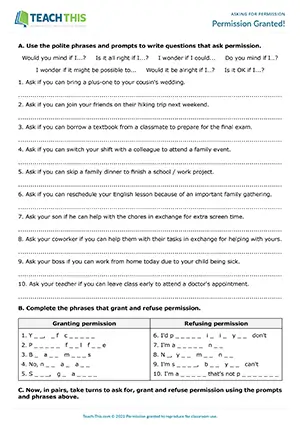
Here is a productive asking for permission worksheet to help students practice language for asking, granting and refusing permission. First, students use polite...

ESL Asking for Permission Worksheet - Vocabulary Exercises: Writing Sentences from Prompts, Word Completion - Speaking Activity - Pair Work Here is a productive asking for permission worksheet to help students practice language for asking, granting and refusing permission. First, students use polite phrases and prompts to write questions that ask for permission. Students then complete phrases that grant and refuse permission. Finally, in pairs, students take turns to ask for, grant and refuse permission using the prompts and polite phrases.

Permission to Play

Upper-intermediate (B2) 30 minutes
ESL asking for permission games for B2 upper-intermediate: miming, guessing, matching, pair speaking activity

ESL Asking for Permission Games - Vocabulary: Miming, Guessing, Matching - Pair Work

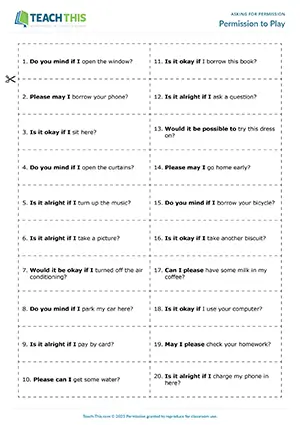
Here are two entertaining asking for permission games to help students practice a variety of common phrases that ask for permission. In pairs, students begin by playing a miming game where they...

ESL Asking for Permission Games - Vocabulary: Miming, Guessing, Matching - Pair Work Here are two entertaining asking for permission games to help students practice a variety of common phrases that ask for permission. In pairs, students begin by playing a miming game where they mime questions that ask permission for a partner to guess. Students take turns picking up a question card and saying the asking for permission phrase written in bold, e.g. 'Do you mind if I..' The student then mimes the rest of the question to their partner, who has 30 seconds to guess what it is. If the student guesses correctly (e.g. Do you mind if I open the window?), they win and keep the card. If not, their partner keeps the card. The student with the most cards at the end wins. Next, students play a game where they match each question that asks for permission with a suitable response. Students take turns turning over a question card and a response card. If the response matches the question, the student keeps the two cards and has another turn. If not, the student turns both cards back over and play passes to the other student. The student with the most cards at the end of the game wins.

Would it be alright if I...?

Upper-intermediate (B2) 30 minutes
ESL asking for permission worksheet for B2 upper-intermediate: gap-fill, categorising, forming questions, rewriting, pair work

ESL Asking for Permission Worksheet - Vocabulary Exercises: Gap-fill, Categorising, Forming Questions and Answers, Rewriting Sentences - Speaking Activity - Pair Work

In this comprehensive asking for permission worksheet, students practice phrases for asking, giving and refusing permission. First, students read two...

ESL Asking for Permission Worksheet - Vocabulary Exercises: Gap-fill, Categorising, Forming Questions and Answers, Rewriting Sentences - Speaking Activity - Pair Work In this comprehensive asking for permission worksheet, students practice phrases for asking, giving and refusing permission. First, students read two dialogues and complete them with words from a box. Students then identify the phrases used to ask for, give and refuse permission in the two dialogues and write them in a table, adding other phrases they can think of in the empty squares. Next, students write questions that ask for permission using the phrases from the table and write a response to each question, giving or refusing permission. After that, students rewrite short dialogues that ask for permission to make them more polite. Finally, students write questions that ask for permission and then practice asking for, giving and refusing permission with a partner.

Using Permission Language

Permission language covers the words and phrases people use to request the right to do something, from casual everyday requests like 'Can I borrow your pen?' to more formal expressions like 'Would it be alright if I left early?' Students who rely on only one or two of these phrases, typically just 'Can I...?', risk sounding blunt or inappropriately casual in situations where a more careful form is expected, such as when speaking to a manager or addressing someone they have just met.

This page covers asking for permission across A1-A2, A2, B1, and B2 levels, with twelve resources including speaking games, card activities, and worksheets, with two available as free downloads.

The phrases below show how permission requests shift in formality, from the most casual classroom expressions to the kind of careful language students need in professional or formal situations. The table below maps the most common permission phrases from least to most formal, with an example and a note on when each one fits naturally.

Formality LevelPermission PhraseExampleTypical Context
Very informal Can I...? 'Can I have a look at that?' Friends, classmates, informal settings
Informal Could I...? 'Could I use your phone for a second?' Acquaintances, relaxed workplace exchanges
Neutral May I...? 'May I come in?' Neutral, polite situations with a slight formal edge
Polite Do you mind if I...? 'Do you mind if I open the window?' Colleagues, strangers, situations needing care
More formal Would it be alright if I...? 'Would it be alright if I brought a colleague?' Managers, authority figures, formal requests
Formal Is there any chance I could...? 'Is there any chance I could take Friday off?' Senior colleagues, workplace negotiations
Very formal Do you think I could...? 'Do you think I could have a moment of your time?' High-stakes formal situations, unfamiliar authority figures

When to Ask for Permission

Informal and Everyday Situations: Speakers use casual permission phrases when they need a quick, low-stakes answer from someone they know well, and 'Can I...?' signals informality and familiarity, as in 'Can I grab a seat here?'

Workplace Requests: In professional settings, speakers shift to more careful phrasing to show respect for authority and avoid coming across as presumptuous, as in 'Would it be alright if I worked from home on Friday?'

Politely Softening a Sensitive Request: When a request might inconvenience someone or feels awkward to raise, speakers use longer and more tentative structures to give the listener an easy way to refuse, as in 'Do you think I could possibly leave a little early today?'

3-Step Framework for Teaching Permission Language

1. Build Confidence With a Controlled Card Activity: Before students can circulate freely, they need a structured first encounter with permission phrases where students get clear prompts and responses stay simple. A card activity where one side shows the permission prompt and the other shows a tick or cross handles this well: students know immediately whether to grant or refuse permission, so all their attention goes on producing the request phrase correctly rather than worrying about what to say in response.

2. Add a Guessing Element to Make the Language Stick: Once students are comfortable with basic permission phrases, introduce a game that adds a prediction layer. A card game where students pick up a permission card with a modal verb and prompt, form a question, then guess whether their partner will grant or refuse before the partner picks up a response card to reply, rewards students for reading social cues as well as producing accurate language, which is exactly the real-world skill that permission language requires.

3. Push Students Into More Formal and Varied Phrasing: At the top of the level range, students need to move beyond 'Can I...?' and handle a full range of permission expressions fluently. A Connect Four game that forces students to form a permission question using the specific phrase on a chosen square, triggered by a situation card read aloud by their partner, makes students practice phrases like 'Is there any chance...' in context rather than in isolation, and gives them immediate peer feedback on whether the question is correct and appropriate before they can claim the square with an X or O.

Common Mistakes with Permission Language

Using 'Can I...?' in Formal Situations: Students often use 'Can I...?' regardless of the social context, not realizing it sounds too casual or even rude when addressing someone in authority or making a sensitive request. Wrong: 'Can I leave work early today?' Correct: 'Would it be alright if I left work early today?'

Answering 'Do you mind if I...?' with 'Yes': Students often answer 'Yes' to mean they agree, not realizing that 'Yes, I do mind' signals refusal, which causes confusion when they intend to give permission. Wrong: 'Do you mind if I open the window?' 'Yes, go ahead.' Correct: 'Do you mind if I open the window?' 'No, not at all.' or 'No, go ahead.'

Common Questions About Teaching Asking for Permission

What is a fun game for practicing asking for permission?

In the game Picture This, students draw pictures to represent 'Can I...?' questions and a partner guesses what each one is, scoring three points for a correct first guess, two for a second, and one for a third. Turning permission phrases into visual puzzles gives students a reason to think carefully about what each request actually means.

What is a good board game for asking for permission?

For practicing asking for permission, the free board game Asking for Permission Board Game is a good choice because it forces variety: students must combine a verb card with the permission phrase on the square they land on rather than repeating the same question. If the group decides the phrasing is wrong, the player goes back two squares.

What is an effective worksheet for teaching asking for permission?

An effective choice for this is the worksheet Would it be alright if I...?, which builds systematically. Students first identify and produce permission phrases from two model dialogues, then write their own questions and responses, then rewrite short dialogues to make them more polite, moving from recognition to production in a single activity.

Become a Teach This Member

Get unlimited access to the full library, plus new resources added every week.

Unlimited Resource Access

Download from 3000+ worksheets, activities, and games.

Save 5+ Hours Weekly

Cut lesson prep time with ready-to-use resources, plus teacher notes and answer keys.

Trusted Professional Quality

Classroom-tested, editable resources created by experienced ESL professionals.

Fresh Content Weekly

Get 5 new resources added to the library each week.

Join Now Just $29.99 quarterly