
Greetings & Introductions ESL Role-Plays, Worksheets, Games & Activities
Excuse me, are you...?
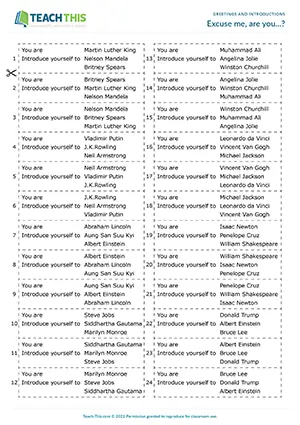
ESL Introducing Yourself Role-Play - Speaking Activity: Asking and Answering Questions, Communicative Practice
In this engaging introducing yourself role-play activity, students find famous people and introduce themselves as another famous person. First, students take on the role of the famous person marked on...
Greetings

ESL Greetings Worksheet - Vocabulary Exercises: Matching, Unscrambling, Sentence Completion, Gap-fill - Speaking Activity: Dialogue Practice - Pair Work
In this useful greetings worksheet, students learn and practice language used to greet people. First, students match greetings and introductory questions...
Meeting People

ESL Introducing Yourself and Others Role-Play - Speaking Activity: Forming Sentences, Asking and Answering Questions, Freer Practice - Group Work
Here is a free introducing yourself and others speaking activity to help students practice greetings and introducing themselves and others. Students take on...
Nice to Meet You
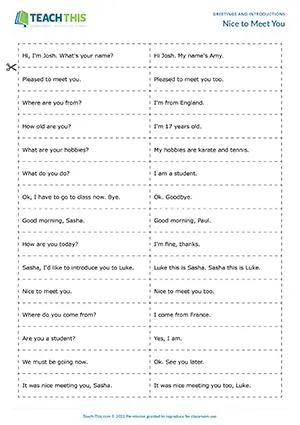
ESL Greetings and Introductions Game - Vocabulary and Reading: Matching, Ordering - Pair Work
This productive greetings and introductions game is ideal for introducing phrases for greetings, making introductions and saying goodbye. In pairs, students take turns turning over two cards. If the...
Portraits

ESL Introducing Yourself Activity - Speaking: Drawing, Asking and Answering Questions, Labelling, Freer Practice - Group Work
Here is a fun introducing yourself speaking activity to help students introduce themselves and find out each other's names on the first day of class. In groups, students begin by randomly drawing a portrait...
Hi! It's Nice to Meet You!
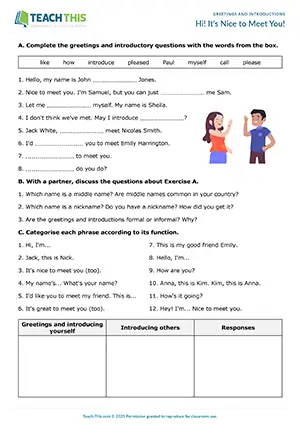
ESL Greetings and Introductions Worksheet - Reading and Vocabulary Exercises: Gap-Fill, Categorising, Ordering - Speaking Activity: Role-Play, Freer Practice - Group Work
In this comprehensive greetings and introductions worksheet helps students learn and practice formal and informal phrases for greeting others, making...
It's Good to See You
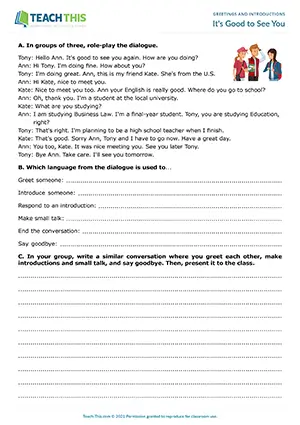
ESL Greetings and Introductions Role-Play - Reading, Writing and Speaking Activity: Categorising, Delivering a Dialogue, Controlled and Freer Practice - Group Work
This enjoyable greetings and introductions role-play activity helps students to learn and practice language for greetings, introductions, making small talk and ending...
Meet and Greet Role-Play
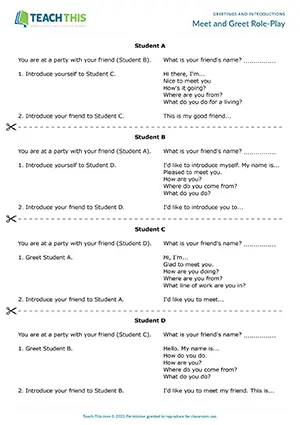
ESL Greetings and Introductions Role-Play - Speaking Activity: Communicative Practice - Group and Pair Work
This communicative greetings and introductions role-play activity helps to teach students various formal and informal phrases for greetings and introductions. In two pairs, students write their partner's...
Pleased to Meet You
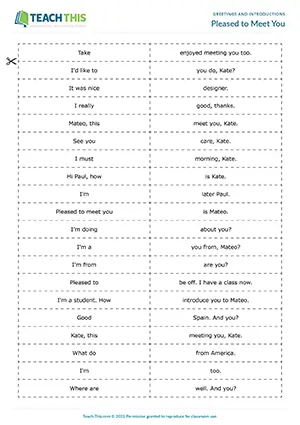
ESL Greetings and Introductions Game - Grammar and Vocabulary: Pelmanism - Speaking Activity: Ordering a Dialogue, Role-Play, Controlled Practice - Group Work
Here is an engaging greetings and introductions game to help students practice formal and informal phrases for greetings, making introductions and...
Warm Welcomes

ESL Greetings and Introductions Worksheet - Vocabulary and Reading Exercises: Gap-fill, Ordering a Dialogue, Comprehension Questions
This free greetings and introductions worksheet helps students learn phrases for greetings and introductions in different settings. Students begin...
Sociable Dominoes

ESL Greetings and Introductions Game - Vocabulary: Matching - Group Work
In this rewarding greetings and introductions game, students match language for greetings, introductions and saying goodbye with suitable responses. The first player puts down one of their dominoes on either side of the domino on the table...
Casual Greetings
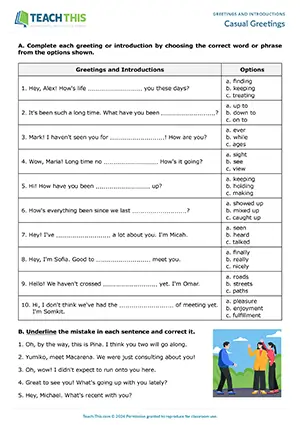
ESL Greetings and Introductions Worksheet - Vocabulary and Writing Exercises: Multiple Choice, Error Correction, Gap-fill, Writing Sentences
This informative greetings and introductions worksheet helps students practice informal phrases for greeting and introducing people. First, students complete...
Using Greetings and Introductions Language
Greetings and introductions cover the functional phrases people use to meet someone for the first time, acknowledge someone they already know, and introduce people to each other. Students who rely on a single formula such as 'Hello, my name is...' for every situation risk sounding awkward or inappropriate, since English greetings shift significantly depending on whether the context is formal, informal, or somewhere in between.
This page covers greetings and introductions from A1 to B2 level, with 12 worksheets, games, and role-plays, including two free downloads.
The table below shows common situations in which greetings and introductions language is used, with example phrases for each.
| Situation | Speaker/Role | Example Phrase |
|---|---|---|
| Meeting someone for the first time in a professional setting | New acquaintance or business contact | 'How do you do? I'm very pleased to meet you.' |
| Meeting someone for the first time in a social setting | New acquaintance at a social event | 'Hey! I'm Tom. Great to meet you.' |
| Introducing yourself to a group or class | Student or new team member | 'Hi everyone, I'm Maria. I've just moved here from Madrid.' |
| Introducing one person to another | Mutual acquaintance | 'James, this is my colleague Priya. Priya, this is James.' |
| Responding to an introduction | Either party | 'Pleased to meet you.' or 'Nice to meet you too.' |
| Greeting someone you already know after a period of time | Friend or colleague | 'Good to see you again! How have you been?' |
| Saying goodbye after a first meeting | Either party | 'It was lovely meeting you. I hope to see you again soon.' |
When to Use Greetings and Introductions Language
Meeting someone for the first time in a professional context: When you meet a new client, colleague, or business contact for the first time, formal greetings and introductions signal respect and professionalism, as in 'How do you do? I'm very pleased to meet you, Mr. Okonkwo.'
Introducing two people who don't know each other: When you are with two people who have not yet met, it falls to you to make the introduction, and getting the order right matters since you typically introduce the junior person to the more senior one first, as in 'Professor Lee, I'd like you to meet our new intern, David Park.'
Reconnecting with someone after a gap: When you run into someone you know but haven't seen for a while, a simple 'Hello' is too bare, so you reach for phrases that acknowledge the time passed and invite them to catch up, as in 'It's so good to see you again! It's been ages.'
3-Step Framework for Teaching Greetings and Introductions Language
1. Build a Phrase Bank Before Students Speak: Start by giving students a solid base of target language to work from before any speaking happens. A well-sequenced worksheet takes students from recognition to controlled production, matching greetings and introductory questions with responses, then unscrambling words to form greetings, then completing phrases with words from a box, before finishing with a short dialogue built from those phrases and the student's own personal information. That progression means every student enters speaking practice with the language already in their head.
2. Consolidate Phrase Knowledge Through a Game: Reinforce what students have learned with a card game that makes accurate recall the price of entry. The aim is to find the beginning and ending of a phrase for greeting, introducing, or saying goodbye, and when a student matches a beginning and ending successfully, they say the phrase aloud and earn another turn. Once the game ends, the same cards become a second resource: students sort them into a conversation between three people, which sets them up directly for the role-play stage.
3. Push Students to Produce and Notice at the Same Time: Close with a task that combines production and language awareness. Students first role-play a greetings and introductions dialogue, then write down the language used to greet someone, introduce someone, make small talk, end the conversation, and say goodbye, and they also suggest other possible phrases for each function. That noticing step gives students genuine ownership of the language before they write and perform their own dialogue.
Common Mistakes with Greetings and Introductions Language
Responding to 'How are you?' too literally: Students often respond to 'How are you?' with a detailed or overly honest answer, not realising that in most English greetings exchanges it functions as a social ritual rather than a genuine question, and a brief positive response is expected. Wrong: 'How are you?' 'I am tired and I have a headache.' Correct: 'How are you?' 'Fine, thanks. And you?'
Answering 'How do you do?' as a real question: Students often reply to 'How do you do?' with information about how they feel, treating it as a genuine enquiry rather than a fixed formal greeting that requires the same phrase in return. Wrong: 'How do you do?' 'I'm fine, thank you.' Correct: 'How do you do?' 'How do you do?'
Common Questions About Teaching Greetings and Introductions Language
What is a good worksheet for teaching formal and informal greetings?
The free worksheet Warm Welcomes presents greetings and introductions through two different contexts. Students complete a conversation where two roommates meet each other for the first time, then put a second conversation in order by indicating who says each line as three people greet each other and make introductions at a party. Comprehension questions follow.
What is a fun game for practicing greetings and introductions?
The game Sociable Dominoes has students match language for greetings, introductions, and saying goodbye with suitable responses, building a domino chain around the table. If a player cannot place a domino, they draw from the pile and play it if they can. The pressure of keeping the chain going pushes students to process each phrase and its appropriate response quickly.
What is an interesting activity for introducing people?
Every student in the free activity Meeting People has a specific introduction to make, not just their own. Students take on an identity and must find two people from their task card to introduce to each other. Because all the names and jobs are very similar, students have to listen carefully throughout.
Become a Teach This Member
Get unlimited access to the full library, plus new resources added every week.
Unlimited Resource Access
Download from 3000+ worksheets, activities, and games.
Save 5+ Hours Weekly
Cut lesson prep time with ready-to-use resources, plus teacher notes and answer keys.
Trusted Professional Quality
Classroom-tested, editable resources created by experienced ESL professionals.
Fresh Content Weekly
Get 5 new resources added to the library each week.
Here's what our members are saying...


