
Giving Directions ESL Activities, Games & Worksheets
My Map
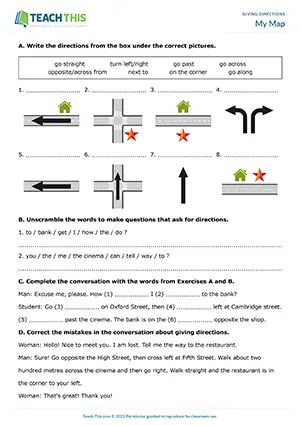
ESL Giving Directions Worksheet - Vocabulary Exercises: Matching, Unscrambling, Error Correction, Drawing - Speaking Activity: Freer Practice - Pair Work
In this productive giving directions worksheet, students learn and practice language for asking and giving directions. Students begin by writing directions from...
Where is it?
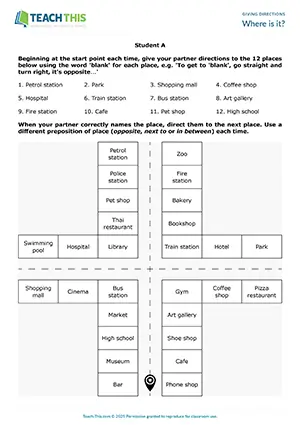
ESL Giving Directions Activity - Speaking: Giving Directions, Communicative Practice - Pair Work
In this communicative giving directions activity, students practice giving basic directions and using the prepositions of place: next to, opposite, and in between. In pairs, one student begins by giving...
Can you tell me the way to ...?

ESL Directions Activity - Speaking: Asking For and Giving Directions, Communicative Practice - Pair Work
In this useful giving directions speaking activity, students practice asking for and giving directions to places on a map. In pairs, one student goes first and asks for directions to one of the places in the box...
Directions Language Worksheet
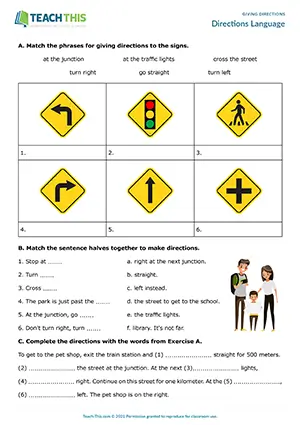
ESL Giving Directions Worksheet - Vocabulary Exercises: Matching, Gap-fill, Binary Choice, Writing Sentences, Comparing
Here is a free giving directions worksheet to help students learn and practice phrases and prepositions related to giving directions. Students begin by matching...
Draw the Directions

ESL Giving Directions Activity - Vocabulary: Reading Comprehension, Drawing, Writing Directions - Pair Work
In this creative giving directions activity, students draw simple pictures that match a set of directions and then write directions for a partner to draw. First, students read the directions in each box and...
Excuse me, where is...?

ESL Giving Directions Activity - Speaking: Giving and Following Directions, Communicative Practice - Pair Work
This enjoyable giving directions speaking activity helps to teach students how to ask for and give directions. Starting from the pinned location, one student asks their partner for directions to the first place...
Gold Star Directions Game
ESL Giving Directions Game - Reading and Writing: Following and Writing Instructions, Freer Practice - Group Work
In this rewarding giving directions game, students give and follow directions to the locations of hidden gold stars in the building and classroom. First, teams do a dictation activity that gives...
How do I get to...?

ESL Giving Directions Activity - Speaking: Giving and Following Directions, Communicative Practice - Pair Work
In this free giving directions speaking activity, students practice giving and following directions to places on a map. In pairs, students take turns asking their partner how they get to the places...
Place to Place
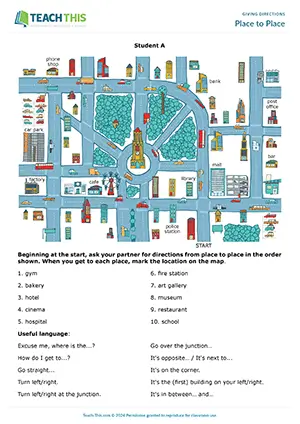
ESL Giving Directions Activity - Speaking: Asking For and Giving Directions, Communicative Practice - Pair Work
In this communicative giving directions activity, students ask for and give directions to different places in a town. In pairs, Student A goes first and asks their partner for directions to the first place on the...
Destination Unknown
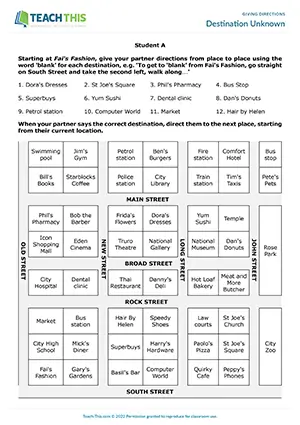
ESL Giving Directions Activity - Speaking: Giving and Following Directions, Communicative Practice - Pair Work
Here is an engaging giving directions speaking activity to help students review how to give directions. One student begins by giving their partner directions from place to place on their map using...
Could you direct me to...?

ESL Giving Directions Worksheet - Vocabulary Exercises: Error Correction - Speaking Activities: Giving Directions, Communicative Practice - Pair Work
This comprehensive giving directions worksheet helps students practice language for giving complex directions. First, students discuss questions...
Using Giving Directions Language
Giving directions in English means using specific words and phrases to guide someone from one place to another, such as 'Turn left at the traffic lights', 'Go straight on', 'Take the second right', and 'It's on your left opposite the bank.' Students who only know vague location words like 'near' or 'over there' cannot complete one of the most basic real-world communication tasks, which is helping a stranger find their way, making this one of the most immediately useful areas of functional language to get right.
This page covers giving directions across A1-A2, A2, B1, and B2 levels, with fourteen activities including pair map tasks, classroom movement games, worksheets, and writing activities, with two resources available as free downloads.
The table below maps the most common English phrases for giving and asking for directions by function, giving teachers and students a clear reference for the full range of language used in a typical directions exchange.
| Function | Phrase or Expression | Example |
|---|---|---|
| Starting directions | From here... / Start by... | 'From here, walk along the high street.' |
| Going straight | Go straight on / Keep going straight | 'Go straight on until you reach the roundabout.' |
| Turning | Turn left / Turn right | 'Turn right at the traffic lights.' |
| Taking a specific road | Take the first/second left or right | 'Take the second left after the bridge.' |
| Indicating distance | It's about 200 metres / It's not far | 'It's about 200 metres down the road on your left.' |
| Using landmarks | It's next to / opposite / in between | 'It's opposite the supermarket, next to the bank.' |
| Confirming arrival | You can't miss it / You'll see it on your left or right | 'You'll see it on your right just after the junction.' |
| Asking for directions | Excuse me, how do I get to...? / Can you tell me the way to...? | 'Excuse me, how do I get to the nearest train station?' |
| Checking understanding | Is it far? / How long does it take? | 'Is it far? How long does it take on foot?' |
How to Use Giving Directions Language
Helping a stranger in the street: When someone asks for directions face to face, sequence your instructions clearly from the starting point and use landmarks to anchor each step, as in 'Go straight on, take the second left, and it's opposite the post office.'
Giving directions remotely: Without gesture or visual cues, your words carry all the weight. Use precise landmark phrases and ordinal numbers so nothing is left to guesswork, as in 'Take the first right after the traffic lights, then it's the third building on your left.'
Describing a multi-step route: When directions involve several turns, use sequencing words to keep the listener oriented at every stage, as in 'First, go straight on until you reach the roundabout, then take the third exit and it's about 100 metres on your left.'
3-Step Framework for Teaching Giving Directions Language
1. Build the Language Foundation First: Before students can give directions in a real exchange, they need the core phrases and prepositions in their heads. A worksheet that works through matching, gap-fill, and error correction tasks gets that vocabulary locked in, and the final stage asks students to write directions to the nearest hospital and bank and compare answers with a partner, checking whether they can deploy the language independently and not just recognize it in exercises.
2. Put the Language to Work on a Map: A pair map activity creates the clearest possible simulation of a real directions exchange. One student asks how to get to a place on the map, for example 'How do I get to the hotel?', and their partner gives directions while the asker traces the route and marks the location. Comparing maps at the end gives both students immediate feedback on whether the directions were clear enough to follow.
3. Make Accuracy Matter with a Physical Challenge: A classroom maze game raises the communicative stakes in a way no worksheet can. One player is blindfolded and brought to the entrance of a desk maze, and their team must direct them through it in the shortest possible time, with penalty points for errors. When getting the directions wrong has a visible, physical consequence, students pay close attention to both giving and following them accurately.
Common Mistakes with Giving Directions Language
Using 'you go' instead of the imperative: Students often describe directions as if narrating a route rather than instructing someone, producing sentences like 'you go straight and you turn left' instead of the direct imperative forms that English directions require. Wrong: 'You go straight and you turn left at the lights.' Correct: 'Go straight and turn left at the lights.'
Forgetting ordinal numbers with left and right: Students often say 'take the left' when they mean a specific turning, omitting the ordinal number that tells the listener which one to take. Wrong: 'Take the left after the school.' Correct: 'Take the second left after the school.'
Common Questions About Teaching Giving Directions Language
What is a fun game for practicing giving directions?
The game Star Wars Directions Game splits the class into the Dark Side and the Jedi. Each round, a blindfolded player carries an inflatable lightsaber while a teammate calls out directions like 'turn left' and 'go straight.' When the player gets close enough, the caller shouts 'hit' and they try to strike their opponent. First to land a hit scores the point.
What is a good worksheet for practicing giving directions?
The worksheet Could you direct me to...? covers the full range of giving directions vocabulary through binary choice, error correction, and gap-fill exercises. Students finish by writing down six real places in their city that they both know, then take turns secretly choosing one and giving directions while their partner tries to identify the destination.
What is an interesting giving directions activity?
In the activity Destination Unknown, students give directions between named places on the map but say 'blank' instead of the destination, so the listener has to follow the directions and work out where they end up. Once the partner names the correct place, the student directs them onward to the next location from there.
Become a Teach This Member
Get unlimited access to the full library, plus new resources added every week.
Unlimited Resource Access
Download from 3000+ worksheets, activities, and games.
Save 5+ Hours Weekly
Cut lesson prep time with ready-to-use resources, plus teacher notes and answer keys.
Trusted Professional Quality
Classroom-tested, editable resources created by experienced ESL professionals.
Fresh Content Weekly
Get 5 new resources added to the library each week.
Here's what our members are saying...


