
Be Going To Yes/No Questions ESL Games, Activities & Worksheets
Are You Going to Match with Me?
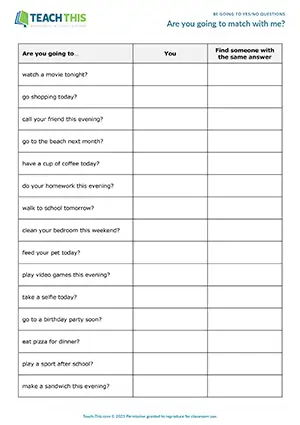
ESL Are You Going To Questions Activity - Grammar and Speaking: Asking and Answering Questions, Freer Practice
In this insightful 'be going to' yes/no questions activity, students practice asking 'Are you going to…?' questions about future plans and finding classmates with matching answers. First, students answer....
Asking About Future Plans
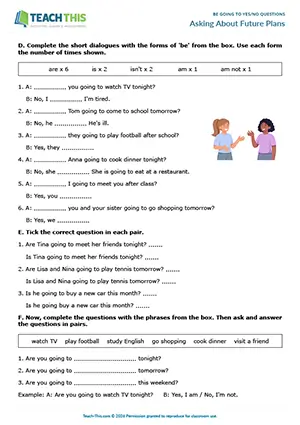
ESL Are You Going To Yes/No Questions Worksheet - Grammar Exercises: Matching, Gap-fill - Speaking: Asking and Answering Questions, Freer Practice - Pair Work
In this 'be going to' yes/no questions worksheet, students practice forming and answering 'be going to' questions about future plans using 'am', 'is', 'are'....
Unwanted Questions
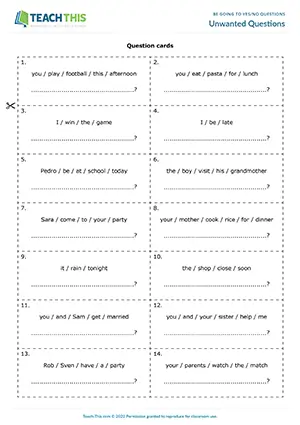
ESL Be Going To Yes/No Questions Game - Grammar: Writing Questions, Matching - Group Work
In this fast-paced 'be going to' game, students race to match 'be going to' yes/no questions with short answers. To begin, students look at their question cards and write 'be going to' yes/no...
What Are Your Plans?
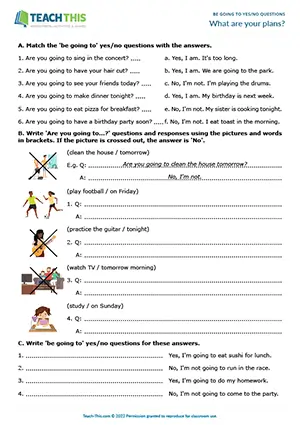
ESL Are You Going To Worksheet - Grammar Exercises: Matching, Writing Questions and Answers, Gap-fill, Crossword
Here is a free 'be going to' yes/no questions worksheet that helps students practice forming 'Are you going to...?' questions and short answers about future plans. First, students match....
Are You Going to Guess Right?
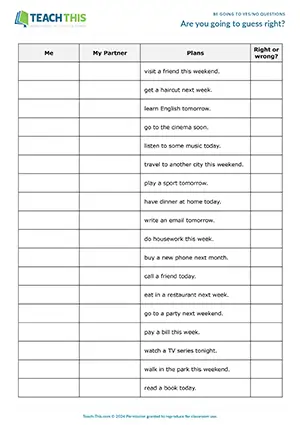
ESL Are You Going To Game - Grammar and Speaking: Sentence Completion, Guessing, Asking and Answering Questions - Pair Work
In this enjoyable 'be going to' guessing game, students use 'Are you going to…?' questions and short answers to guess their partner's plans. First, students read each plan and write 'I'm going to' or 'I'm not...
Be Going To Survey
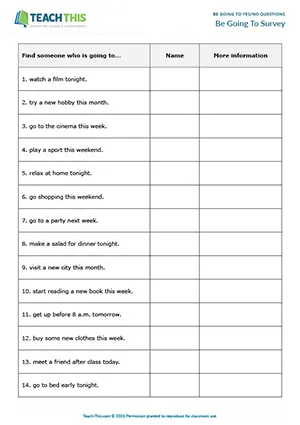
ESL Being Go To Yes/No Questions Activity - Grammar and Speaking: Forming, Asking and Answering Questions from Prompts, Controlled and Freer Practice
In this 'be going to' activity, students practice forming, asking and answering 'Are you going to...?' questions about future plans. First, students review the items on...
Don't Forget to Knock!
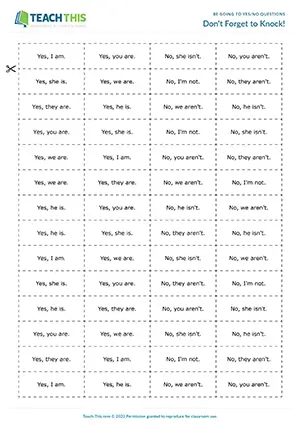
ESL Be Going To Yes/No Questions Game - Grammar and Speaking: Forming Questions, Freer Practice - Group Work
In this fun 'be going to' game, students race to create 'be going to' yes/no questions that include a given prompt word and match specific short answers. In groups, students take turns picking up...
Sun and Fun Resort
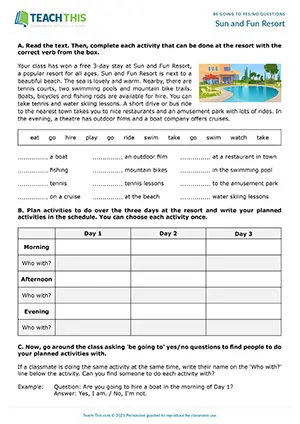
ESL Going To Yes/No Questions Activity - Reading and Vocabulary Exercise: Gap-fill - Speaking Activity: Asking and Answering Questions, Table Completion, Freer Practice
In this productive 'be going to' yes/no questions activity, students plan activities to do at a resort and then ask and answer questions to find people to...
Why Not?

ESL Be Going To Yes/No Questions Game - Grammar: Forming Questions, Matching - Group Work
In this engaging 'be going to' yes/no questions game, students race to find and make yes/no questions with 'be going to' that match certain answers. In groups, students take turns picking up...
Yes/No Questions with Be Going To

ESL Be Going To Yes/No Questions Worksheet - Grammar Exercises: Unscrambling, Matching, Writing Questions
This useful 'be going to' yes/no questions worksheet helps students practice yes/no questions with 'be going to' and short answers. First, students put words in the correct order to create...
Understanding Be Going To Yes/No Questions
'Be going to' yes/no questions follow the structure am/is/are + subject + going to + base verb, as in 'Are you going to visit your family this weekend?' and require short answers that match the auxiliary used in the question, such as 'Yes, I am.' or 'No, she isn't.' Students who keep statement word order, forget to invert the auxiliary, or give incomplete short answers break the question-answer exchange entirely.
This page covers be going to yes/no questions at A1-A2 and A2 levels, with ten activities including worksheets, speaking activities, and classroom games, with one activity available as a free download.
The table below maps the three main subject forms used in 'be going to' yes/no questions, the structure for each, and the correct short answers.
| Subject | Structure | Example | Short Answer (Yes) | Short Answer (No) |
|---|---|---|---|---|
| I | Am + I + going to + base verb? | 'Am I going to be late?' | 'Yes, you are.' | 'No, you aren't.' |
| He / She / It | Is + he/she/it + going to + base verb? | 'Is she going to take the job?' | 'Yes, she is.' | 'No, she isn't.' |
| You / We / They | Are + you/we/they + going to + base verb? | 'Are they going to announce the results today?' | 'Yes, they are.' | 'No, they aren't.' |
When to Use Be Going To Yes/No Questions
Checking a Known Plan: Use this form when you already know or suspect someone has a plan and want to confirm it. The question signals that you expect a yes or no based on something you already know, as in 'Are you going to apply for the promotion?'
Asking About Personal Intentions: Use this form to find out what someone intends to do, especially in casual or semi-formal conversation where no fixed arrangement has been made yet, as in 'Is the team going to present the findings at the conference?'
Checking Shared Plans: Use this form to check whether someone's plan matches yours before making arrangements together, as in 'Are you going to come to the office on Friday, or are you working from home?'
3-Step Framework for Teaching Be Going To Yes/No Questions
1. Build the Form with Controlled Writing: Start with the free What Are Your Plans? worksheet, where students match 'Are you going to...?' questions to answers, write questions and answers from picture prompts, then complete a crossword using a weekly schedule. This range of exercise types locks in the question structure and the short answer forms before any spoken production begins.
2. Develop Accuracy Across All Forms: Move to the Asking About Future Plans worksheet, which uses matching, binary choice, unscrambling, gap-fill, and sentence completion in sequence. Students then complete 'be going to' yes/no questions with phrases from a box and ask and answer those questions in a speaking stage. The range of exercise types forces students to confront every point where the form can break down.
3. Extend to Real Communication with a Survey: Introduce the Be Going To Survey activity, where students form an 'Are you going to...?' question for each item on the worksheet, then mingle and ask the questions to find someone who answers 'Yes, I am.' When a student finds a match, they record the person's name and ask a follow-up question such as 'What film are you going to watch?' for more detail. This step moves students from controlled accuracy to genuine information exchange.
Common Mistakes with Be Going To Yes/No Questions
Keeping Statement Word Order: Students often forget to invert the subject and auxiliary, producing a statement rather than a question. The auxiliary must move before the subject to signal a yes/no question. Wrong: 'You are going to finish the project tonight?' Correct: 'Are you going to finish the project tonight?'
Mismatching the Short Answer: Students frequently give a short answer that does not match the auxiliary in the question, especially with third-person singular. The short answer always echoes the form of 'be' used in the question, never 'will'. Wrong: Q: 'Is he going to call back?' A: 'Yes, he will.' Correct: Q: 'Is he going to call back?' A: 'Yes, he is.'
Common Questions About Teaching Be Going To Yes/No Questions
What is an effective speaking activity for practicing be going to yes/no questions?
In the activity Are You Going to Match with Me?, students write their own short answers to 'Are you going to...?' questions first, then go around the class asking the same questions to find classmates with matching answers. When a match is found, both students write each other's names in the final column.
What is an engaging game for practicing be going to yes/no questions?
The game Unwanted Questions gives students a competitive reason to produce the form accurately. Players write questions from prompts on their own cards, then race to match a question card to a short answer card turned face up. The first student to place a matching card and say the question aloud wins the round.
What be going to yes/no questions worksheet works well for pre-intermediate students?
The worksheet Yes/No Questions with Be Going To takes students through unscrambling, matching, and writing exercises before finishing with a dialogue completion task. Each exercise targets a different point where the form can break down, giving students thorough practice with yes/no questions and short answers before they use the structure independently.
Become a Teach This Member
Get unlimited access to the full library, plus new resources added every week.
Unlimited Resource Access
Download from 3000+ worksheets, activities, and games.
Save 5+ Hours Weekly
Cut lesson prep time with ready-to-use resources, plus teacher notes and answer keys.
Trusted Professional Quality
Classroom-tested, editable resources created by experienced ESL professionals.
Fresh Content Weekly
Get 5 new resources added to the library each week.
Here's what our members are saying...


