
Punctuation ESL Worksheets & Games
End of Sentence Punctuation
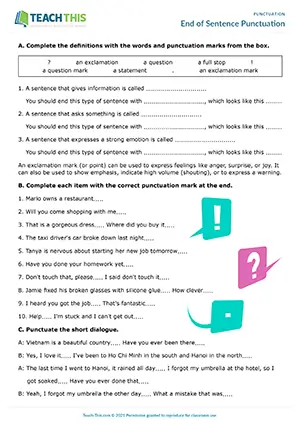
ESL Ending Punctuation Worksheet - Reading and Writing Exercises: Sentence Completion, Gap-fill, Categorising
In this useful ending punctuation worksheet, students learn and practice how to use full stops (periods), exclamation marks and question marks. Students begin by completing definitions with words...
Pausing Points

ESL Pausing Points Worksheet - Reading and Writing Exercises: Matching, Ordering, Gap-fill, Sentence Completion
This insightful pausing points worksheet helps students learn and practice how to indicate a pause or break in a sentence using periods, commas, semicolons, dashes and ellipses. Students start by choosing...
Apostrophes and Quotation Marks

ESL Apostrophes and Quotation Marks Worksheet - Reading and Writing Exercises: Matching, Error Correction, Rewriting Sentences, Adding Punctuation
Here is a free quotation marks and apostrophes worksheet for intermediate students. First, students match situations in which quotation marks...
Dashes and Hyphens

ESL Dashes and Hyphens Worksheet - Reading and Writing Exercises: Matching, Gap-fill, Sentence Completion, Rewriting Sentences
This comprehensive dashes and hyphens worksheet helps students learn and practice how to use hyphens and dashes. To begin, students match usage...
Academic Citations
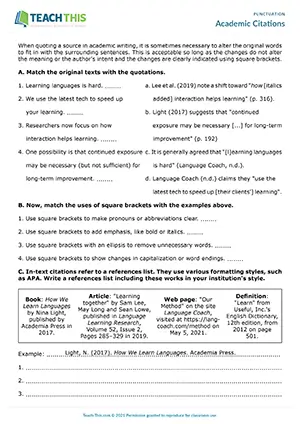
Academic Citations Worksheet - Reading and Writing Exercises: Matching, Writing References and Quotations
In this informative academic citations worksheet, students learn and practice how to cite sources in academic writing, including using square brackets to modify quotations, in-text citations and references...
Academic Parentheses

Academic Punctuation Worksheet - Reading and Writing Exercises: Gap-fill, Matching, Error Correction, Rewriting Sentences
In this handy parentheses worksheet, students learn how to use parentheses in academic writing. First, students complete a text that explains the use of parentheses in academic writing using...
Honest Ellipsis

ESL Ellipses Worksheet - Writing Exercise: Rewriting Sentences - Speaking Activity: Discussion, Categorising - Pair Work
This detailed ellipses worksheet helps to teach students how to use ellipses to remove unnecessary words from quotations in an intellectually honest way. To start, students rewrite shortened quotes...
Parentheses Race

ESL Parentheses Game - Writing: Adding Punctuation - Pair Work
In this engaging punctuation game, students race to add parentheses (round brackets) to sentences. One student from each pair comes to your desk and picks up sentence card 1. The student then goes back to their partner with the card and the...
Understanding Punctuation
Punctuation is the system of marks used in writing to show readers where sentences end, where to pause, and how ideas relate to each other. Without accurate punctuation, even a well-constructed sentence can change its meaning entirely, so a missing comma or a misplaced apostrophe can leave a reader confused about who owns what or where one thought ends and another begins.
This page covers seven punctuation worksheets and one game across A2, B1, and B2 levels, ranging from end-of-sentence marks and pausing punctuation to academic citations and ellipses, with one worksheet available as a free download.
The table below maps the most commonly taught punctuation marks in English to their primary function and a short example.
| Mark | Name | Primary Function | Example |
|---|---|---|---|
| . | Period (full stop) | Ends a declarative sentence | 'She left early.' |
| ? | Question mark | Ends a direct question | 'Where did she go?' |
| ! | Exclamation mark | Ends an exclamatory sentence or shows strong feeling | 'Watch out!' |
| , | Comma | Separates items in a list or clauses in a sentence | 'I bought eggs, milk, and bread.' |
| ; | Semicolon | Links two closely related independent clauses | 'She studied hard; she passed the exam.' |
| : | Colon | Introduces a list, explanation, or quotation | 'She had three goals: study, travel, and rest.' |
| ' | Apostrophe | Shows possession or marks a contraction | 'the teacher's book' or 'don't' |
| " " / ' ' | Quotation marks | Encloses direct speech, titles, or terminology | 'He said, "I will be there."' |
| ( ) | Parentheses | Adds supplementary or clarifying information | 'The study (published in 2020) found no link.' |
| ... | Ellipsis | Shows omitted words from a quotation or a trailing thought | 'The report states that "the results ... were inconclusive."' |
| - | Hyphen | Joins words or word parts to form a compound | 'a well-known author' |
| – | En dash (medium dash) | Shows a range or connects two related items | 'pages 10–20' or 'the London–Paris route' |
| — | Em dash (long dash) | Adds a strong pause or sets off a parenthetical element | 'The meeting ran late — no decisions were made.' |
When to Use Punctuation
Linking Equally Weighted Ideas: A writer chooses a semicolon when two independent clauses are so closely connected that a full stop would feel abrupt but a comma alone would be grammatically wrong, as in 'The presentation ran long; no one seemed to mind.'
Setting Up What Follows: A colon signals to the reader that what comes next directly fulfills a promise made by the first part of the sentence, making it the natural choice in professional writing to introduce a list or a key explanation, as in 'The contract has three requirements: a deposit, a signature, and proof of identity.'
Easing into the Main Clause: A writer places a comma after an introductory phrase or subordinate clause to signal where the scene-setting ends and the main point begins, which helps readers process information in the right order, as in 'After a long delay, the results were finally announced.'
3-Step Framework for Teaching Punctuation
1. Start with Sentence-Ending Marks: Begin with the most basic layer of punctuation: the marks that tell a reader when a sentence is finished. A task that asks students to punctuate a short dialogue using full stops, exclamation marks, and question marks gives them an immediate, visible reason for each mark and keeps the cognitive load low while they build their first instincts.
2. Expand to Pausing and Linking Marks: Once students can close a sentence correctly, broaden their view to the marks that shape what happens inside one. Having students add appropriate punctuation to a story rather than isolated sentences pushes them to read for sense and rhythm, not just to apply a rule they have just seen on a page.
3. Tackle the Marks Students Confuse Most: The marks that cause the most confusion at intermediate level are the ones that look similar but serve very different purposes. A matching task that asks students to pair usage rules for short hyphens, medium en dashes, and long em dashes with examples forces them to distinguish the three on the basis of function rather than length, which is exactly the distinction their writing needs.
Common Mistakes with Punctuation
Comma Splice: Students often join two complete sentences with only a comma, not realizing that a comma alone cannot connect two independent clauses. Wrong: 'I finished the report, I sent it to my manager.' Correct: 'I finished the report, so I sent it to my manager.'
Confusing 'its' and 'it's': Students often write 'it's' when they mean the possessive form and 'its' when they mean the contraction, mixing up a distinction that has no direct equivalent in many first languages. Wrong: 'The company lost it's best client.' Correct: 'The company lost its best client.'
Common Questions About Teaching Punctuation
What is a useful worksheet for teaching apostrophes and quotation marks?
Accurate use of apostrophes and quotation marks matters most when students write formally. The free worksheet Apostrophes and Quotation Marks asks students to read a passage and rewrite sentences containing direct quotations, titles or terminology, adding quotation marks and apostrophes as necessary in the American or British style, giving them practice with both systems.
What is a good game for practicing parentheses?
Speed and accuracy together give students real pressure to apply a rule correctly. In the game Parentheses Race, one student from each pair comes to the teacher's desk and picks up sentence card 1, then both students race to add parentheses to the sentences on the card. The first pair to complete all 15 sentences correctly wins.
What is an effective activity for teaching ellipses?
The worksheet Honest Ellipsis builds awareness of how ellipses can alter the meaning of a quotation, which is a key skill in academic writing. Students rewrite shortened quotes and decide whether each has been shortened honestly, writing 'yes' under 'Honest?' if the meaning is unchanged or 'no' if it has been changed.
Become a Teach This Member
Get unlimited access to the full library, plus new resources added every week.
Unlimited Resource Access
Download from 3000+ worksheets, activities, and games.
Save 5+ Hours Weekly
Cut lesson prep time with ready-to-use resources, plus teacher notes and answer keys.
Trusted Professional Quality
Classroom-tested, editable resources created by experienced ESL professionals.
Fresh Content Weekly
Get 5 new resources added to the library each week.
Here's what our members are saying...


