
Complimenting ESL Games, Worksheets & Activities
What Would You Say?

ESL Complimenting Game - Vocabulary: Matching, Pelmanism - Pair Work
Here is a free giving and accepting compliments game for students to play in class. In groups, students take turns turning over one situation card and one response card. If the situation matches the response, the student reads it aloud...
You're a Great Student!
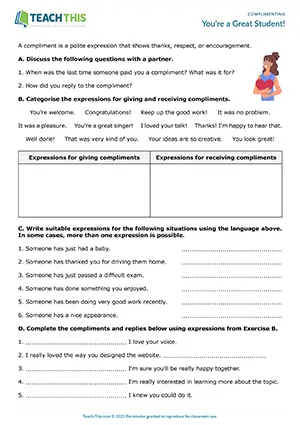
ESL Complimenting Worksheet - Vocabulary Exercises: Categorizing, Matching, Gap-fill - Speaking Activities: Asking and Answering Questions - Pair Work
In this useful complimenting worksheet, students practice language for giving and responding to compliments. To begin, in pairs, students discuss questions...
Compliments Board Game
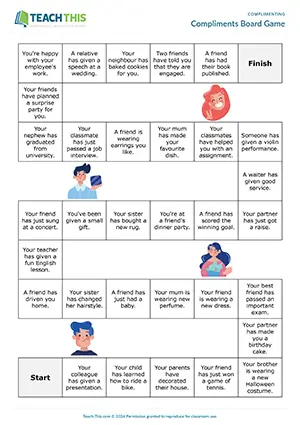
ESL Giving Compliments Board Game - Speaking: Forming Sentences, Writing Sentences, Freer Practice - Group Work
In this engaging giving compliments board game, students practice giving compliments in a variety of situations. In groups, players take turns rolling the dice and moving their counter along the board. When a...
I Love Your Outfit
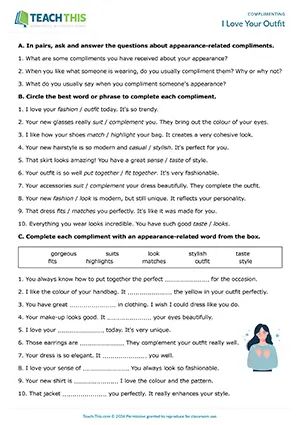
ESL Giving Compliments Worksheet - Vocabulary and Writing Exercises: Writing Sentences - Speaking Activity: Answering Questions, Freer Practice - Pair Work
In this productive giving compliments worksheet, students practice language for giving compliments about personal appearance. First, in pairs...
Why, Thank You!
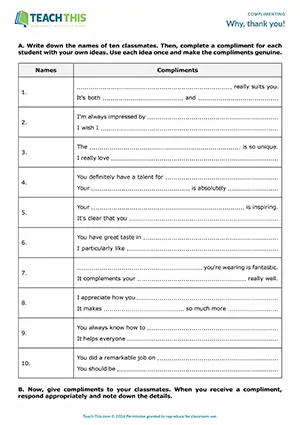
ESL Giving Compliments Activity - Vocabulary and Speaking: Sentence Completion, Making and Responding to Statements, Freer Practice
In this enjoyable giving compliments speaking activity, students practice giving and responding to compliments. First, students write down the names of...
Using Complimenting Language
Complimenting language covers set phrases for praising someone, such as 'What a great presentation!' or 'I love your haircut!', along with response patterns for accepting the compliment gracefully, like 'Thank you, that's kind of you to say.' Students who translate their own culture's habit of downplaying or rejecting compliments directly into English can come across as awkward or insincere to a listener who simply expects a straightforward acceptance.
This page covers complimenting across three levels from pre-intermediate to upper-intermediate, with five activities ranging from a pelmanism matching game to a board game and a mingling speaking activity, with one activity available as a free download.
This table maps common situations to the phrases typically used for giving a compliment and responding to one.
| Situation | Giving a Compliment | Responding to a Compliment |
|---|---|---|
| Appearance | 'I love your dress, where did you get it?' | 'Oh, thanks! I got it at a little shop downtown.' |
| Skill or achievement | 'You did a great job on that presentation!' | 'Thanks, I really appreciate that.' |
| Possession | 'What a beautiful car!' | 'Thank you, I'm glad you like it.' |
| Cooking or food | 'This is delicious, did you make it yourself?' | 'Thank you, I'm happy you enjoyed it.' |
| Effort or improvement | 'You've really improved since last time!' | 'Thanks, that means a lot to me.' |
When to Use Complimenting Language
Building Rapport with a New Acquaintance: A speaker opens a conversation with a genuine compliment to put a stranger at ease and signal friendliness before diving into small talk, as in 'I really like your bag, where's it from?'
Encouraging Someone After an Achievement: A speaker praises specific effort or progress rather than just the outcome to motivate someone who worked hard for a result, as in 'You've come so far with your English since we started.'
Softening a Request by Complimenting First: A speaker leads with a compliment before asking for a favor because it makes the listener more receptive to helping, as in 'You're so good at this, could you help me with mine too?'
3-Step Framework for Teaching Complimenting Language
1. Match Compliment Openers to Natural Responses: Start by helping students recognize which response actually fits which compliment, since matching the two correctly builds the foundation for everything else. Turn over a situation card and a response card together, and if the pair genuinely matches, have the student read both aloud and keep going, so students absorb the rhythm of compliment and reply as a single unit rather than two separate skills.
2. Push Students to Produce Compliments on the Spot: Once students know the patterns, force them to generate a compliment live instead of just recognizing one. Land on a square like 'Your friend is wearing a new dress' and require an original response such as 'What a beautiful dress! Where did you get it?', then have the rest of the group judge whether it sounds correct and appropriate before the player moves on.
3. Refine Accuracy and Make It Personal: Finish by tightening grammar and pushing compliments toward genuine, individual language rather than stock phrases. Have students hunt for and correct mistakes in sample compliments first, then write one real compliment for each of three classmates and read them aloud without naming names, letting the class guess who each compliment belongs to.
Common Mistakes with Complimenting Language
Confusing "So" and "Such" Before a Noun: Students often use "so" directly before a noun instead of switching to "such a" when the compliment includes a noun rather than just an adjective. Wrong: 'You are so nice person!' Correct: 'You are such a nice person!'
Wrong Preposition After "Good At": Students often say "good in" instead of "good at" when complimenting someone's skill or ability. Wrong: 'You are very good in English!' Correct: 'You are very good at English!'
Common Questions About Teaching Complimenting Language
What is a fun board game for practicing giving compliments?
In the board game Compliments Board Game, students practice giving compliments across a range of everyday situations. Players land on a square, give a compliment, and the group judges whether it sounds correct and appropriate before the teacher reviews every situation and compliment together as a class for feedback.
What is a useful worksheet for teaching students to give and respond to compliments?
A useful option is the worksheet You're a Great Student!, which takes learners from sorting compliment language to producing it. Students categorize expressions for giving and receiving compliments, apply them to different situations, then write three original compliments for their partner and exchange them aloud, building toward genuine spoken use.
What is an engaging speaking activity for compliments?
The activity Why, Thank You! works because students compliment real classmates rather than fictional ones. Students write an original compliment for each of ten classmates, then move around the room delivering and receiving them before reporting back on their favorite. That personal investment keeps students motivated and produces more natural language than scripted practice.
Become a Teach This Member
Get unlimited access to the full library, plus new resources added every week.
Unlimited Resource Access
Download from 3000+ worksheets, activities, and games.
Save 5+ Hours Weekly
Cut lesson prep time with ready-to-use resources, plus teacher notes and answer keys.
Trusted Professional Quality
Classroom-tested, editable resources created by experienced ESL professionals.
Fresh Content Weekly
Get 5 new resources added to the library each week.
Here's what our members are saying...


