
Future Perfect Simple ESL Activities, Games & Worksheets
By the End of the Day...
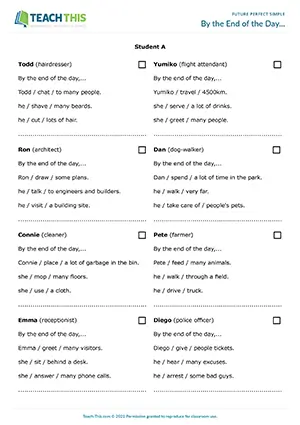
ESL Future Perfect Simple Game - Grammar and Speaking: Forming Sentences, Guessing, Asking Questions - Pair Work
In this free future perfect simple game, students give and guess job clues by saying what people will have done by the end of the day. First, students look at each person's job and future perfect clue prompts...
By This Time Next Year...
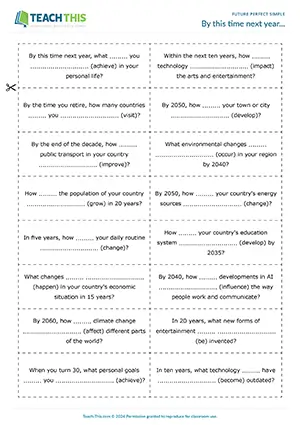
ESL Future Perfect Simple Activity - Grammar and Speaking: Completing, Asking and Answering Questions, Discussion, Freer and Communicative Practice - Pair Work
In this communicative future perfect simple activity, students complete question prompts with 'will have' + past participle and then ask, answer, and discuss...
Future Perfect Simple Practice
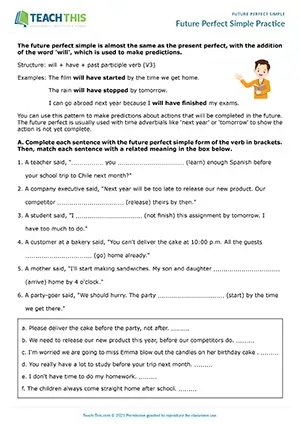
ESL Future Perfect Simple Worksheet - Grammar Exercises: Gap-fill, Matching, Sentence Completion
This insightful future perfect simple worksheet helps students learn how to make predictions about actions that will be completed in the future. Students begin by completing sentences with the future...
By the End of My Holiday...
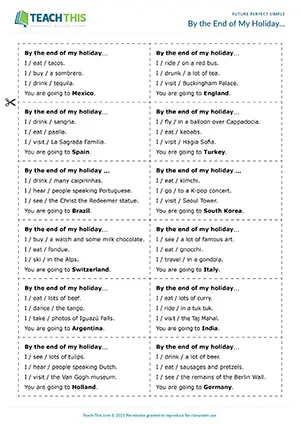
ESL Future Perfect Simple Game - Grammar and Speaking: Forming Sentences, Guessing, Freer Practice - Group Work
In this fun future perfect simple game, students practice forming future perfect sentences by giving travel-related clues about a mystery destination, while classmates guess the country. In groups, students...
Find Someone Who...
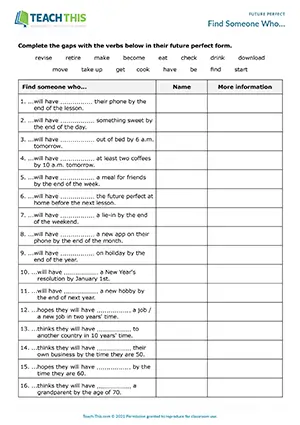
ESL Future Perfect Simple Activity - Grammar and Speaking: Asking and Answering Questions, Controlled Practice
In this engaging future perfect simple 'Find Someone Who' activity, students practice forming, asking and answering future perfect yes/no questions. First, students complete the 'Find someone who' prompts...
What's the Reason?
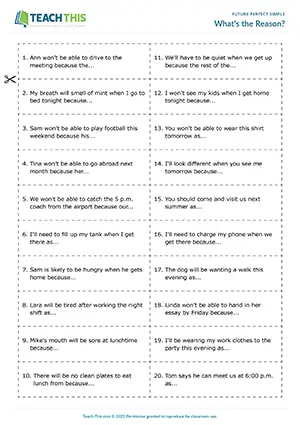
ESL Future Perfect Simple Activity - Grammar: Matching, Changing Verb Forms, Forming Sentences - Pair Work
In this productive future perfect simple activity, students race to match sentence beginnings with endings and complete them with 'will have' + past participle to explain future reasons and results...
Will That Have Happened?
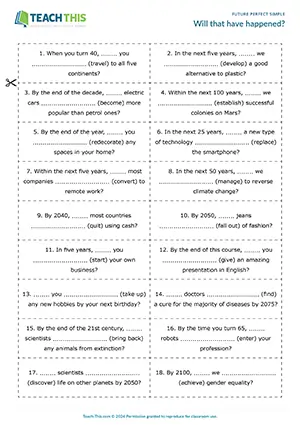
ESL Future Perfect Simple Activity - Grammar and Speaking: Gap-fill, Asking and Answering Questions - Group Work
In this enjoyable future perfect simple speaking activity, students practice using the future perfect by completing and asking question cards, then discussing predictions about actions that will...
Understanding the Future Perfect Simple
The future perfect simple uses 'will have' plus a past participle to describe an action that will be completed before a specific point in the future, as in 'By Friday, she will have finished the report.' When students use the simple future instead and say 'She will finish the report by Friday,' they lose the sense that the action reaches completion before that deadline, which matters in professional writing where the precise order of events needs to be clear.
This page covers the future perfect simple at B2 level with seven activities ranging from a controlled pair card race to a whole-class mingle, totaling around 185 minutes of practice, with one activity available as a free download.
The future perfect simple has five core structural forms that B2 students need to recognize and produce accurately.
| Form | Structure | Example |
|---|---|---|
| Affirmative | subject + will have + past participle | 'By midnight, she will have finished the project.' |
| Negative | subject + won't have + past participle | 'He won't have arrived by the time dinner starts.' |
| Yes/No Question | Will + subject + have + past participle + ? | 'Will you have eaten before the film starts?' |
| Wh- Question | Wh- word + will + subject + have + past participle + ? | 'What will they have decided by the end of the meeting?' |
| Short Answer | Yes, subject + will have. / No, subject + won't have. | Q: 'Will she have left?' A: 'Yes, she will have.' / 'No, she won't have.' |
When to Use the Future Perfect Simple
Giving Reassurance That Something Will Be Done in Time: When a speaker wants to reassure someone that a task will be complete before a specific moment arrives, the future perfect simple signals that commitment clearly and confidently, as in 'Don't worry, I will have sent the invoice before you get to the office.'
Speculating About the State of the World at a Future Point: When a writer or speaker wants to project forward and describe what will already be true at some future moment, the future perfect simple frames the prediction as a completed reality rather than a current intention, as in 'By 2050, scientists will have developed effective treatments for many diseases that are currently incurable.'
Expressing Exasperation About a Slow or Repeated Action: When a speaker wants to highlight how much of something will have accumulated by the time a moment arrives, often with an ironic or impatient tone, the future perfect simple captures that sense of build-up naturally, as in 'By the time he finally calls back, I will have left ten messages.'
3-Step Framework for Teaching the Future Perfect Simple
1. Anchor the Form with a Competitive Card Race: Before students speak freely, get them building accurate future perfect sentences under mild time pressure. A card-matching race works well here: students line up sentence-beginning cards in numerical order, find the correct ending card for each one, and then complete the sentence by writing the verb as 'will have' + past participle. The first pair to finish all their sentences correctly wins, which keeps the focus on accuracy without the activity feeling like a grammar drill.
2. Build Question Forms Through a Class Mingle: Once students can construct statements, shift the focus to forming and asking future perfect yes/no questions. A class mingle activity pushes students to complete question prompts using the past participle, then circulate and ask classmates questions like 'Will you have checked your phone by the end of the lesson?' When a classmate says 'Yes, I will,' the student writes that person's name and a follow-up answer in a 'More information' column, making the activity feel genuinely conversational rather than mechanical.
3. Open Up to Freer Discussion and Personal Prediction: Round off by moving students into open-ended future perfect conversation. A discussion card activity works well here: students complete a question prompt with 'will have' + past participle, such as 'By this time next year, what will you have achieved in your personal life?', then ask the group and listen to each answer in turn. The group votes for the most interesting response and writes the winning answer on the back of the card, giving the activity a genuine communicative purpose.
Common Mistakes with the Future Perfect Simple
Using the Present Perfect Instead of the Future Perfect: Students often drop 'will' and use the present perfect form 'have + past participle' instead of the full future perfect structure, possibly because both tenses share the auxiliary 'have.' Wrong: 'By next week, I have finished the course.' Correct: 'By next week, I will have finished the course.'
Using the Simple Past Instead of the Past Participle: Students often write the simple past form of the verb instead of the past participle after 'will have,' especially with irregular verbs where the two forms look different. Wrong: 'She will have wrote three reports by Thursday.' Correct: 'She will have written three reports by Thursday.'
Common Questions About Teaching the Future Perfect Simple
What is an engaging game for practicing the future perfect simple?
The game By the End of the Day is a free game where students give future perfect job clues, for example 'By the end of the day, she will have served a lot of drinks,' while a partner has one minute to guess the job. Yes/no questions are allowed for help. The student who guesses the most jobs wins.
What is a good worksheet for teaching the future perfect simple?
The worksheet Future Perfect Simple Practice works well for students who need structured practice. It opens with sentence completion using verbs in brackets, moves through matching each sentence with a related meaning from a box and matching sentences with suitable responses, and closes with students writing their own future perfect ideas.
What is a useful speaking activity for practicing the future perfect simple?
Students get a genuine reason to form and ask future perfect yes/no questions with the activity Find Someone Who. They complete question prompts using the past participle, then ask classmates questions like 'Will you have checked your phone by the end of the lesson?' and record names and follow-up details in a 'More information' column.
Become a Teach This Member
Get unlimited access to the full library, plus new resources added every week.
Unlimited Resource Access
Download from 3000+ worksheets, activities, and games.
Save 5+ Hours Weekly
Cut lesson prep time with ready-to-use resources, plus teacher notes and answer keys.
Trusted Professional Quality
Classroom-tested, editable resources created by experienced ESL professionals.
Fresh Content Weekly
Get 5 new resources added to the library each week.
Here's what our members are saying...


