Compound and Complex Sentences

Intermediate (B1) 45 minutes
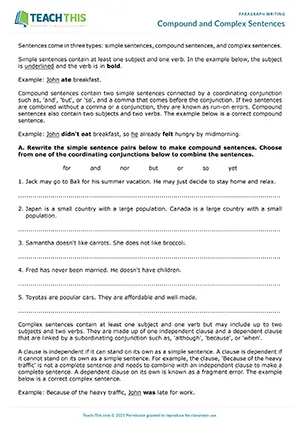
EAP compound and complex sentences worksheet preview for Intermediate (B1) showing rewriting, matching, identifying and error correction activities

EAP Compound and Complex Sentences Worksheet - Writing Exercises: Rewriting Sentences, Matching, Identifying, Error Correction

In this insightful compound and complex sentences worksheet, students review and practice sentence structure and sentence types. Students begin by...

EAP Compound and Complex Sentences Worksheet - Writing Exercises: Rewriting Sentences, Matching, Identifying, Error Correction In this insightful compound and complex sentences worksheet, students review and practice sentence structure and sentence types. Students begin by reading about the characteristics of simple and compound sentences. Students then rewrite pairs of simple sentences to make compound sentences with coordinating conjunctions. Next, students read information about complex sentences. Students then combine pairs of simple sentences to make complex sentences using subordinating conjunctions. In the last exercise, students read a paragraph to identify run-on and fragment errors and then rewrite the paragraph so that the sentences are correct.

Concluding Sentences

Intermediate (B1) 50 minutes
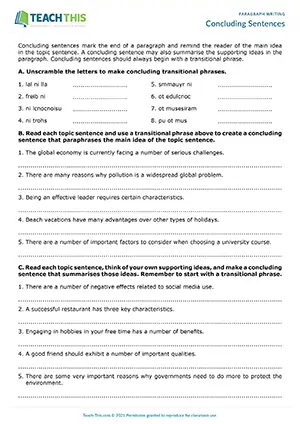
EAP concluding sentences worksheet preview for Intermediate (B1) showing unscrambling, paraphrasing, error correction, and summary activities

EAP Concluding Sentences Worksheet - Reading and Writing Exercises: Unscrambling, Paraphrasing, Writing Sentences, Identifying, Error Correction

In this concluding sentences worksheet, students practice writing concluding sentences by restating topic sentences and summarising supporting ideas...

EAP Concluding Sentences Worksheet - Reading and Writing Exercises: Unscrambling, Paraphrasing, Writing Sentences, Identifying, Error Correction In this handy concluding sentences worksheet, students practice writing concluding sentences by restating topic sentences and summarising supporting ideas. To start, students read about concluding sentences and unscramble letters to make concluding transitional phrases. Students then read each topic sentence shown and use a transitional phrase to create a concluding sentence that paraphrases the main idea of the topic sentence. Next, students read topic sentences, think of their own supporting ideas and use transitional phrases to make concluding sentences that summarise those ideas. After that, students read paragraphs and add a concluding sentence that either restates the topic sentence or summarises the supporting ideas. Finally, students read topic sentence and concluding sentence pairs, and try to identify any errors in the concluding sentences. If students find any errors, they highlight them and rewrite the concluding sentence to make it more suitable.

Paragraph Outlines

Intermediate (B1) 60 minutes
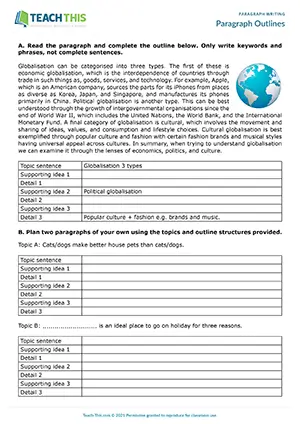
EAP paragraph outlines worksheet preview for Intermediate (B1) showing table completion, outlining, paragraph writing, and peer feedback

EAP Paragraph Outlines Worksheet - Reading and Writing Exercises: Table Completion, Creating an Outline, Writing a Paragraph, Peer Feedback

In this free paragraph outlines worksheet, students practice using outlines to structure and write paragraphs. To start, students read an example paragraph and...

EAP Paragraph Outlines Worksheet - Reading and Writing Exercises: Table Completion, Creating an Outline, Writing a Paragraph, Peer Feedback In this free paragraph outlines worksheet, students practice using outlines to structure and write paragraphs. To start, students read an example paragraph and complete a paragraph outline with the supporting ideas and details from the text. Next, students follow the example and plan two paragraphs of their own using the topics and outline structures provided. Students then choose one of the topics from the previous exercise and use the outline to write a paragraph. Finally, students do a peer review exercise where they swap paragraphs with a classmate and use a paragraph writing checklist to give each other feedback.

Paragraph Puzzle Sprint

Intermediate (B1) 25 minutes
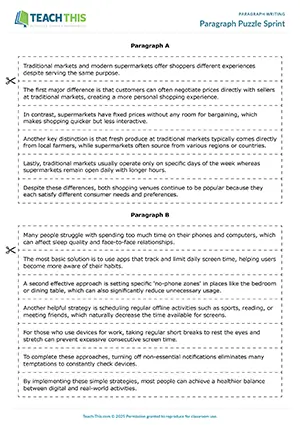
EAP paragraph coherence game preview for Intermediate (B1) showing ordering, question answering, and pair race activities

EAP Paragraph Coherence Game - Reading: Ordering, Answering Questions - Pair Work

In this enjoyable paragraph organisation game, students race to correctly order sentences into coherent paragraphs. When you say 'go', students turn over the first set of sentence strips and race to arrange them into the correct order to form a...

EAP Paragraph Coherence Game - Reading: Ordering, Answering Questions - Pair Work In this enjoyable paragraph organisation game, students race to correctly order sentences into coherent paragraphs. When you say 'go', students turn over the first set of sentence strips and race to arrange them into the correct order to form a paragraph with a clear topic sentence, supporting details, and conclusion. When a pair has finished, they raise their hands and read out their order. If the order is correct, the pair wins the round and scores two points. If it is incorrect, the pair is out of the round, and the other pairs continue to put the strips in order. After a pair has correctly ordered the paragraph, students race to answer a bonus question for one point. Students then move on to the second round using the next set of sentence strips. This process continues until four paragraphs have been ordered correctly. The pair with the most points at the end of the game wins.

Paragraph Unity and Coherence

Intermediate (B1) 40 minutes
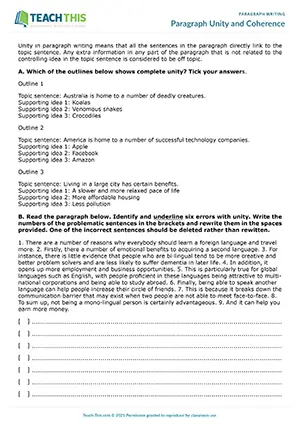
EAP paragraph unity and coherence worksheet preview for Intermediate (B1) showing identifying, rewriting, table completion, and gap-fill activities

EAP Paragraph Unity and Coherence Worksheet - Reading and Writing Exercises: Identifying, Rewriting Sentences, Gap-fill

In this paragraph unity and cohesion worksheet, students analyse and revise a paragraph with unity problems and complete another paragraph to improve its coherence with transition words and...

EAP Paragraph Unity and Coherence Worksheet - Reading and Writing Exercises: Identifying, Rewriting Sentences, Table Completion, Gap-fill In this comprehensive paragraph unity and cohesion worksheet, students analyse and revise a paragraph with unity problems and complete another paragraph to improve its coherence with transition words and phrases. Firstly, students read an explanation of unity in paragraph writing. Students then choose the outline that has complete unity. Next, students read a paragraph and identify six errors with unity. Students then rewrite the problematic sentences and choose the sentence that does not belong in the paragraph. After that, students read about coherence in paragraph writing. Students then add transition words and phrases to a table according to their function. Finally, students complete a paragraph by adding appropriate transition words and phrases to improve its coherence.

Paragraph Writing Review

Intermediate (B1) 50 minutes
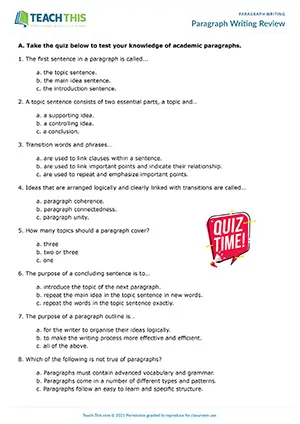
EAP paragraph writing review worksheet preview for Intermediate (B1) showing multiple choice, editing, revising, and error correction

EAP Paragraph Writing Review Worksheet - Reading and Writing Exercises: Multiple Choice, Writing Sentences, Identifying, Editing and Revising

In this useful paragraph writing review worksheet, students revise academic paragraph structure and writing. First, students complete a multiple...

EAP Paragraph Writing Review Worksheet - Reading and Writing Exercises: Multiple Choice, Writing Sentences, Identifying, Editing and Revising In this useful paragraph writing review worksheet, students revise academic paragraph structure and writing. First, students complete a multiple-choice quiz to test their knowledge of academic paragraphs. Students then complete missing parts of a paragraph with a suitable topic sentence, a supporting idea, and a concluding sentence. In the last exercise, students read a paragraph to find errors with unity and coherence. Students then rewrite the paragraph making the necessary improvements.

Supporting Sentences

Intermediate (B1) 45 minutes
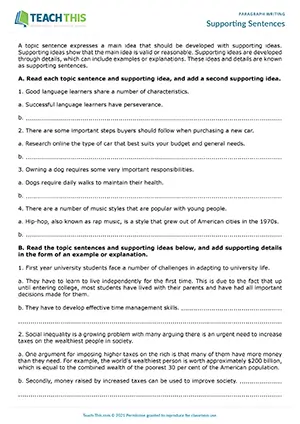
EAP supporting sentences worksheet preview for Intermediate (B1) showing writing supporting ideas, details, and examples

EAP Supporting Sentences Worksheet - Reading and Writing Exercises: Writing Sentences

In this in-depth supporting sentences worksheet, students practice developing a main idea expressed in a topic sentence through supporting ideas and details. First, students read about...

EAP Supporting Sentences Worksheet - Reading and Writing Exercises: Writing Sentences In this in-depth supporting sentences worksheet, students practice developing a main idea expressed in a topic sentence through supporting ideas and details. First, students read about supporting ideas and details. Students then read each topic sentence and supporting idea, and add a second supporting idea. Next, students read the topic sentences and supporting ideas provided, and add supporting details in the form of an example or explanation. Finally, students use the prompts provided to write a topic sentence, a supporting idea, and supporting details.

The Four Parts of a Paragraph

Intermediate (B1) 60 minutes
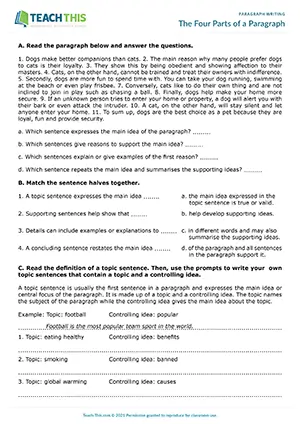
EAP paragraph structure worksheet preview for Intermediate (B1) showing matching, writing, paraphrasing, and structural analysis activities

EAP Paragraph Structure Worksheet - Reading and Writing Exercises: Matching, Writing Sentences, Paraphrasing

In this free paragraph structure worksheet, students review the four basic parts of an academic paragraph and practice writing topic sentences, supporting ideas, details, and concluding sentences...

EAP Paragraph Structure Worksheet - Reading and Writing Exercises: Short Answer Questions, Matching, Writing Sentences, Paraphrasing In this free paragraph structure worksheet, students review the four basic parts of an academic paragraph and practice writing topic sentences, supporting ideas, supporting details, and concluding sentences. Students begin by reading a paragraph to identify its basic structural components. Students then match sentence halves to reveal an explanation of each part of a paragraph. Next, students read a definition of a topic sentence and use prompts to write their own topic sentences that contain a topic and a controlling idea. After that, students use the topic sentences provided to write a supporting idea that is then developed further with either an example or an explanation. Finally, students paraphrase topic sentences in their own words to make concluding sentences using the transition phrases: In conclusion, In summary, or To sum up.

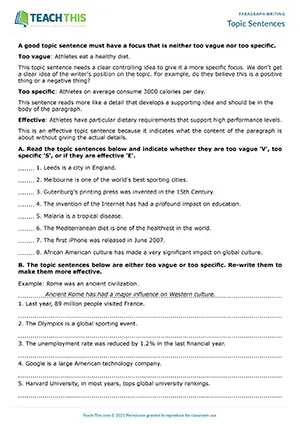
Topic Sentences

Intermediate (B1) 30 minutes
EAP topic sentences worksheet preview for Intermediate (B1) showing categorising, rewriting, and writing topic sentences

EAP Topic Sentences Worksheet - Reading and Writing Exercises: Categorising, Rewriting and Writing Sentences

In this productive topic sentences worksheet, students learn to identify and produce effective topic sentences. Students start by reading notes on ineffective versus effective topic sentences. Next...

EAP Topic Sentences Worksheet - Reading and Writing Exercises: Categorising, Rewriting and Writing Sentences In this productive topic sentences worksheet, students learn to identify and produce effective topic sentences. Students start by reading notes on ineffective versus effective topic sentences. Next, students categorize sample topic sentences as either being vague, specific, or effective. Students then examine more sample topic sentences that are either vague or specific and re-write them so that they are effective. Finally, students read paragraphs that are missing a topic sentence and write an effective topic sentence for each.

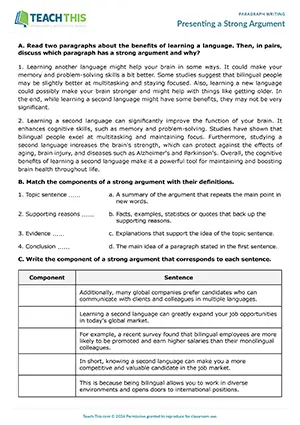
Presenting a Strong Argument

Upper-intermediate (B2) 30 minutes
EAP paragraph writing worksheet preview for Upper-intermediate (B2) showing identifying, matching, argument writing, and peer review

EAP Paragraph Writing Worksheet - Reading and Writing Exercises: Identifying, Matching, Paragraph Writing, Peer Review

In this useful paragraph writing worksheet, students learn and practice how to write a paragraph that presents a strong argument. First, students read two paragraphs and decide which has a strong...

EAP Paragraph Writing Worksheet - Reading and Writing Exercises: Identifying, Matching, Paragraph Writing, Peer Review In this useful paragraph writing worksheet, students learn and practice how to write a paragraph that presents a strong argument. First, students read two paragraphs and decide which has a strong argument and why. Students then match the four parts of a strong argument to their definitions. Next, students write the component of a strong argument that corresponds to each sentence. Afterwards, students choose a statement and use it to write a paragraph that presents a strong argument and includes a topic sentence that states the main idea, supporting reasons, evidence, and a conclusion. When the students have finished, they swap worksheets with a partner and peer review their partner's paragraph using a checklist. Finally, students listen to their partner's feedback and revise their paragraph accordingly.

Understanding Academic Paragraph Writing

Academic paragraph writing involves developing a focused point through related ideas, relevant details and clear connections between sentences. A paragraph needs both unity, so its content serves the same point, and coherence, so readers can follow how the ideas fit together.

This page contains ten resources across B1 and B2, including worksheets on topic sentences, supporting details, conclusions, sentence structure, paragraph organisation and argument development, alongside a paragraph-ordering game. Two worksheets are available as free downloads.

The table shows how parts of a paragraph can develop one point. These hypothetical examples illustrate a possible structure, not a fixed sentence count or a requirement that every paragraph ends with a summary.

ComponentPurposeExample
Topic sentence Introduce the point the paragraph will develop 'A clear group-work schedule can help students coordinate their tasks.'
Supporting idea Explain one aspect of that point 'It makes individual responsibilities visible to the whole group.'
Supporting detail Develop the supporting idea with an example or explanation 'For example, a shared timetable can show who will prepare each section and when it is due.'
Further explanation Show how the detail supports the point 'This allows members to check how their own work fits with the next person's task.'
Concluding sentence Bring the developed point together when the paragraph needs a closing statement 'The schedule therefore provides a shared reference for coordinating the work.'

How to Develop Academic Paragraph Writing Skills

Set a manageable focus: Ask students to state the paragraph's main point in one sentence before drafting. If they need several unrelated claims to explain it, help them narrow the focus or divide the material into separate paragraphs.

Check what each sentence adds: Have students identify the purpose of each sentence, such as introducing a point, giving an example or explaining a connection. A longer paragraph is not necessarily better developed if its sentences repeat the same idea.

Choose connections after checking the logic: Ask whether the next sentence adds information, gives a reason, contrasts an idea or shows a result. Select a connector that reflects that relationship, and check that pronouns clearly refer to the intended person or thing.

3-Step Framework for Teaching Paragraph Writing

Use this progression across B1 lessons to establish a clear focus, connect supporting content and revise a complete paragraph.

1. Establish the controlling idea: Students compare sample topic sentences, identify those that are vague or too narrowly specific and rewrite them to provide an effective paragraph focus. They then supply topic sentences for existing paragraphs. Ask them to explain how each sentence fits the supporting content, preparing them to judge relevance in their own writing.

2. Keep supporting content unified and coherent: Students choose a unified outline, identify unity problems in a paragraph and revise problematic sentences. They also identify a sentence that does not belong, classify transitions by function and complete a paragraph with suitable connectors. Use this work to distinguish choosing relevant ideas from showing the relationships between them.

3. Complete, evaluate and revise: Students review paragraph principles, supply missing topic, supporting and concluding sentences, then identify and correct unity and coherence problems in a complete paragraph. Ask them to apply these checks to a paragraph of their own and explain how one revision improves its focus or flow.

Common Mistakes with Academic Paragraph Writing

Repeating the main point instead of developing it: Restating a claim in different words does not provide support. In this hypothetical paragraph about planning, add a specific explanation rather than another general claim. Repetition: 'Planning is useful. It is helpful to make a plan.' Development: 'Planning is useful because an outline lets writers check the order of their points before drafting.'

Leaving a dependent clause as a complete sentence: A clause beginning with because needs a main clause to complete the idea in standard academic prose. Fragment: 'Because the timetable changed.' Complete sentence: 'The group revised its plan because the timetable changed.'

Common Questions About Teaching Paragraph Writing

What game helps students practice paragraph structure?

The game Paragraph Puzzle Sprint has pairs race to arrange sentence strips into a coherent paragraph with a topic sentence, supporting details and a conclusion. Correct ordering earns points, followed by a bonus question. Across four rounds, students examine how sentences fit together rather than treating paragraph structure as a list of labels.

What free worksheet helps teach paragraph planning?

The worksheet Paragraph Outlines starts with a model paragraph that students use to complete an outline. They then plan two paragraphs using the provided topics and structures, choose one and write it. Exchanging paragraphs and using a peer review checklist connects the planning stage with feedback on the finished writing.

What worksheet helps teach students to develop supporting details?

The worksheet Supporting Sentences guides students from a topic sentence to supporting ideas and then to examples or explanations. They add supporting ideas, develop supplied points with details and finally write a topic sentence with its support from prompts. This sequence makes the difference between naming a point and developing it concrete.

Become a Teach This Member

Get unlimited access to the full library, plus new resources added every week.

Unlimited Resource Access

Download from 3000+ worksheets, activities, and games.

Save 5+ Hours Weekly

Cut lesson prep time with ready-to-use resources, plus teacher notes and answer keys.

Trusted Professional Quality

Classroom-tested, editable resources created by experienced ESL professionals.

Fresh Content Weekly

Get 5 new resources added to the library each week.

Join Now Just $29.99 quarterly