
Critical Thinking EAP Worksheets, Games & Activities
Evidence Detectives
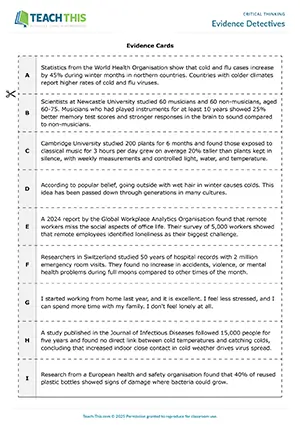
EAP Critical Thinking Game - Reading and Speaking: Matching, Discussion, Giving Reasons, Presenting, Communicative Practice - Group Work
In this rewarding critical thinking game, students evaluate the reliability of different types of evidence by matching evidence cards to claims, ranking...
Fact vs. Opinion
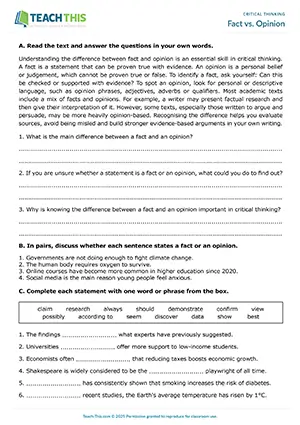
EAP Critical Thinking Worksheet - Reading and Writing Exercises:, Answering Questions - Speaking Activity: Discussion, Communicative Practice - Pair Work
In this free critical thinking worksheet, students learn the differences between facts and opinions and practice distinguishing between the two. First, students...
Identifying Logical Fallacies
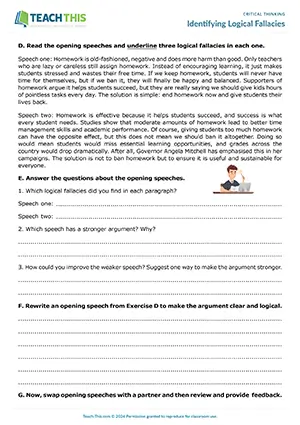
EAP Logical Fallacies Worksheet - Reading and Writing Exercises: Matching, Identifying, Rewriting a Speech - Speaking Activity: Discussion, Freer Practice - Pair Work
In this useful logical fallacies worksheet, students learn about common logical fallacies and practice identifying them. First, in pairs, students discuss three...
Critical Analysis Challenge
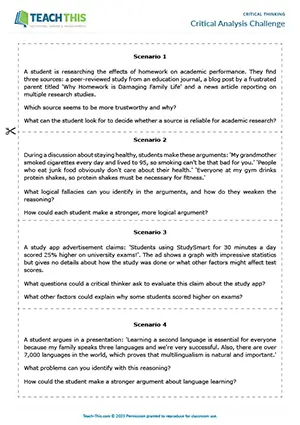
EAP Critical Thinking Activity - Speaking Activity: Discussion, Communicative Practice - Pair and Group Work
In this comprehensive critical thinking activity, students discuss realistic academic scenarios to practice key critical thinking skills, such as evaluating sources, identifying bias, and explaining logical fallacies...
Identifying Bias
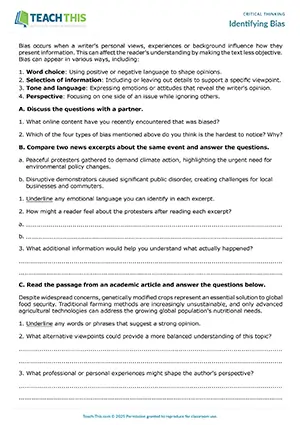
EAP Critical Thinking Worksheet- Reading Exercises: Identifying, Making Inferences - Speaking Activity: Discussion, Presenting, Freer Practice - Pair Work
In this identifying bias worksheet, students practice identifying bias through text analysis. First, students read a short introduction to bias. In pairs, students then...
Introduction to Critical Thinking
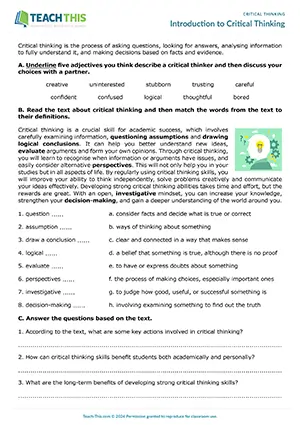
EAP Critical Thinking Worksheet- Reading and Writing Exercises: Paragraph Writing - Speaking Activity: Discussion, Freer Practice - Pair Work
In this critical thinking worksheet, students learn about critical thinking and examine a case study of the famous detective Sherlock Holmes, analysing how he uses...
Logical Fallacy Auction
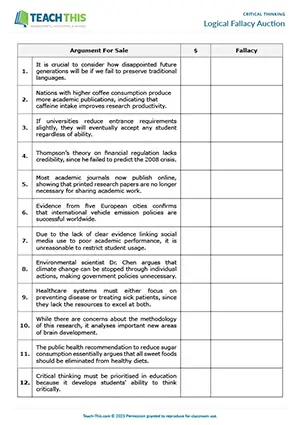
EAP Critical Thinking Game - Reading and Speaking: Identifying, Discussion, Giving Reasons - Group Work
In this entertaining logical fallacy game, students bid on arguments presented in an academic context and earn points by correctly identifying and explaining the logical fallacies they contain. Each team...
Logical Fallacy Bingo

EAP Critical Thinking Game - Listening and Speaking Game: Bingo, Identifying, Explaining, Communicative Practice - Group Work
In this intriguing critical thinking game, students play bingo by identifying and explaining common logical fallacies in arguments. In groups, the...
Logical Fallacy Detectives
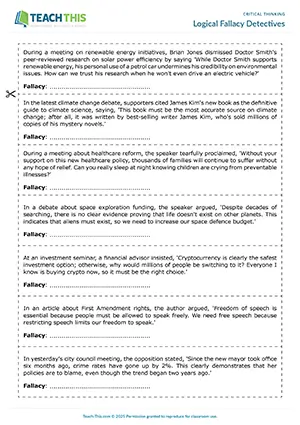
EAP Critical Thinking Game - Reading and Speaking: Identifying, Discussion, Giving Reasons, Communicative Practice - Group Work
This engaging critical thinking game helps students practice identifying and explaining logical fallacies in arguments. In groups, students read a logical fallacy...
Understanding Critical Thinking
Critical thinking involves examining claims, evidence and reasoning before reaching a judgement. In academic work, it helps students explain why a conclusion is justified, recognise limitations and reconsider an interpretation when better evidence becomes available.
This page contains nine resources from intermediate (B1) to upper-intermediate (B2), including one free worksheet. The materials cover evidence reliability, fact and opinion, logical fallacies, bias, academic scenarios and reasoned discussion.
Use the questions below to make the thinking process explicit. Students should explain their answers rather than simply attach a label to a statement or source.
| Focus | Question to ask | Practical check |
|---|---|---|
| Claims | What exactly is being asserted? | Restate the claim clearly, including its scope and any qualifying words. |
| Evidence | What supports this claim? | Check whether the evidence is relevant, reliable and sufficient for the conclusion. |
| Fact and opinion | Can this statement be checked, or does it express a judgement? | Verify factual claims and examine the reasons supporting opinions. A factual-sounding statement is not automatically true. |
| Assumptions | What is being taken for granted? | Identify an unstated belief the argument needs in order to work. |
| Bias | How might selection or wording shape the account? | Compare perspectives, supporting information and omissions before drawing conclusions. |
| Reasoning | Does the conclusion follow? | Explain the connection between the reasons and the conclusion, and consider plausible alternatives. |
How to Develop Critical Thinking
Make reasoning visible: Ask students to identify a claim, point to supporting information and explain the connection. Provide language such as 'This supports the claim because...' so limited confidence in English does not prevent them from expressing their reasoning.
Separate evaluation from agreement: Students may agree with a conclusion while finding its supporting argument weak. Ask them to assess the reasons given before sharing their own position, and encourage respectful questions about the argument rather than the person presenting it.
Allow uncertainty and revision: Invite students to say what remains unknown and what evidence could change their view. Critical thinking does not require rejecting every claim; it requires a judgement proportionate to the available information.
3-Step Framework for Teaching Critical Thinking
Across lessons, begin with explaining an interpretation, then examine flawed reasoning and evaluate how sources present an issue. Review the language and concepts needed at each stage, adapting the intermediate and upper-intermediate materials to the class.
1. Explain an interpretation: Students read about critical thinking and examine a detective case study. In pairs, they discuss fictional case notes, write a paragraph explaining what they think happened and share their reasoning. Ask them to distinguish the information supplied from the inferences they have made.
2. Identify and improve flawed reasoning: Students match examples with logical fallacies and locate problems in debate openings. They then rewrite one opening to strengthen its reasoning and exchange feedback. Require an explanation of the flaw and the revision, rather than treating a fallacy label as a complete answer.
3. Evaluate contrasting sources: Students compare news excerpts about the same event and analyse an academic extract. They then find two articles on a chosen topic, record their assessment using a bias checklist and present their findings. Discuss how specific evidence supports their evaluation and what limitations remain.
Common Mistakes with Critical Thinking
Treating a fallacy as proof that the conclusion is false: A flawed argument does not settle whether its conclusion is true. Faulty inference: 'That argument attacks the speaker, so its conclusion must be false.' Better reasoning: 'The personal attack does not support the conclusion. We need to assess the conclusion using relevant evidence.'
Confusing disagreement with bias: A source taking a different position is not enough to establish bias. Unsupported judgement: 'This article disagrees with me, so it is biased.' Better approach: Examine its wording, evidence selection, omissions and treatment of other perspectives, then explain any specific signs of bias.
Common Questions About Teaching Critical Thinking
What discussion activity helps students practice critical thinking?
The activity Critical Analysis Challenge uses academic scenarios to prompt discussion about sources, bias, research claims and arguments. Pairs consider questions on each card, then share a selected scenario with another pair. Reporting their discussion and considering how to apply the skills connects the activity with students' wider academic work.
What game helps students evaluate evidence?
The game Evidence Detectives asks teams to match evidence cards to claims and rank the evidence by reliability. Students record reasons for their rankings before exchanging work for marking. Points reward accurate matches and ordering, while an optional presentation lets students explain why they consider some evidence stronger than others.
What free worksheet helps teach fact and opinion?
The worksheet Fact vs. Opinion introduces the distinction through reading, questions and partner discussion. Students examine statements, categorise signal phrases and analyse opinions presented as facts. They then share a rewritten statement with a partner, who identifies its type and explains the decision, making the reasoning part of the task.
Become a Teach This Member
Get unlimited access to the full library, plus new resources added every week.
Unlimited Resource Access
Download from 3000+ worksheets, activities, and games.
Save 5+ Hours Weekly
Cut lesson prep time with ready-to-use resources, plus teacher notes and answer keys.
Trusted Professional Quality
Classroom-tested, editable resources created by experienced ESL professionals.
Fresh Content Weekly
Get 5 new resources added to the library each week.
Here's what our members are saying...


