
Business Email Openings, Closings & Etiquette Worksheets
Email Greetings and Opening Lines
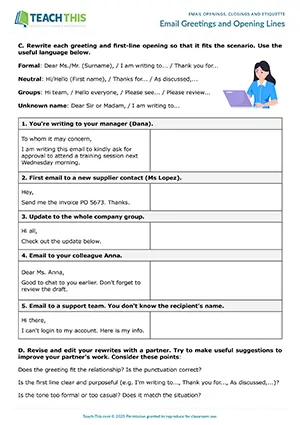
Business Email Openings Worksheet - Vocabulary and Writing Exercises: Categorising, Matching, Rewriting
In this business email openings worksheet, students practice greetings and first-line openings according to relationship and level of formality. Students begin by sorting greetings by levels of...
Email Greetings and Sign-offs
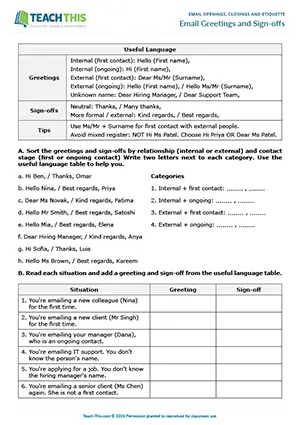
Business Email Closings Worksheet - Vocabulary and Writing Exercises: Categorising, Table Completion, Rewriting Sentences, Writing Sentences
In this email greetings and sign-offs worksheet, students practice choosing and writing appropriate email greetings and sign-offs for internal and external...
Email Subject Line Builder
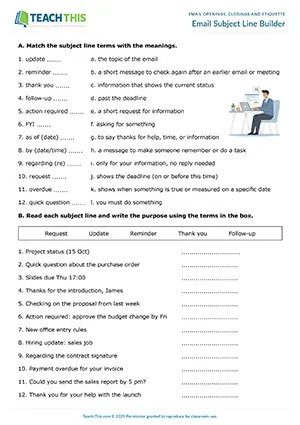
Business Email Subject Lines Worksheet - Vocabulary and Writing Exercises: Identifying, Gap-fill, Error Correction, Writing Subject Lines
In this business email subject lines worksheet, students practice recognising the purpose of a subject line and writing clear, concise subjects for common work...
Getting Your First Line Right
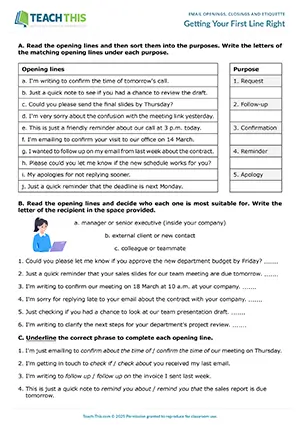
Business Email Openings Worksheet - Reading, Vocabulary and Writing Exercises: Categorising, Identifying, Gap‑fill, Sentence Writing - Pair Work
In this free email openings worksheet, students practice recognising and writing first‑line openings that clearly show the purpose of the email and...
Open Strong, Close Smart
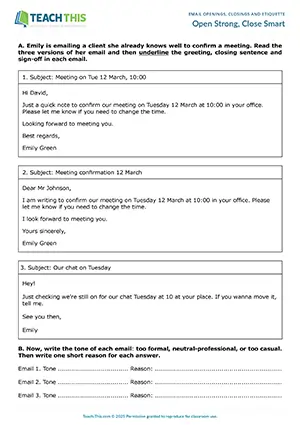
Business Email Openings and Closings Worksheet - Reading, Vocabulary and Writing Exercises: Categorising, Rewriting Sentences
In this useful worksheet on adjusting tone in email openings and closings, students learn to choose and use formal or neutral‑professional greetings and closings...
Professional Email Closing Lines
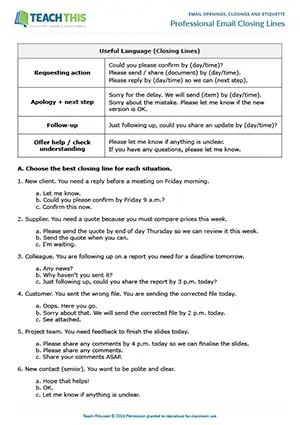
Business Email Openings and Closings Worksheet - Reading and Writing Exercises: Multiple Choice, Matching, Writing and Rewriting Sentences
In this email closing lines worksheet, students practice choosing and writing clear, polite closing lines that include a next step and a time frame. Students begin...
Smart Email Etiquette
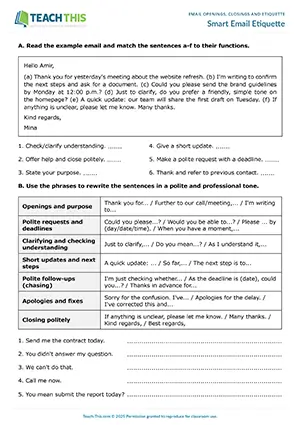
Business Email Etiquette Worksheet - Vocabulary and Writing Exercises: Matching, Rewriting Sentences, Gap‑fill, Identifying, Writing a Short Email
In this email openings, closings, and etiquette worksheet, students review useful phrases and practice writing clear, polite messages for professional contexts. First...
Business Email Structure
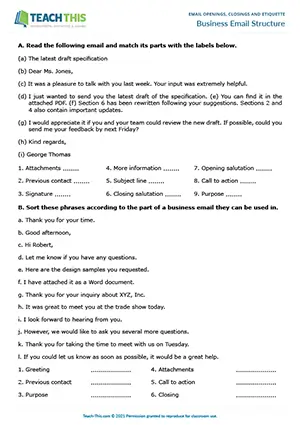
Business Email Structure Worksheet - Vocabulary and Writing Exercises: Matching, Categorising, Writing Emails
In this detailed business email structure worksheet, students review the structure of a typical business email and practice using it to write emails. Students start by reading an email and matching its parts...
Closings and Sign-offs
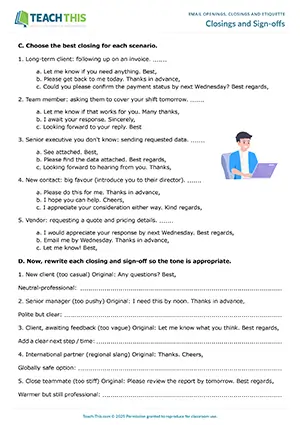
Business Email Closings and Sign-offs Worksheet - Vocabulary and Writing Exercises: Matching, Gap‑fill, Multiple Choice, Rewriting
In this email closings and sign-offs worksheet, students learn to select appropriate closings and sign-offs and adjust the tone for different recipients. First, students label...
First-Contact Emails
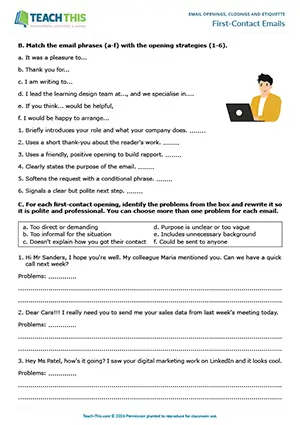
Business Email Openings Worksheet - Reading and Writing Exercises: Matching, Identifying, Rewriting Sentences, Writing Emails, Peer Feedback - Pair Work
In this business email openings worksheet, students practice writing strong, polite openings for first-contact emails by referencing context and...
Softening Bad News
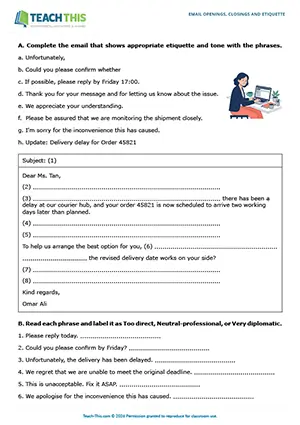
Business Email Etiquette Worksheet - Reading, Vocabulary and Writing Exercises: Sentence Completion, Rewriting Sentences, Writing Emails, Peer Feedback - Pair Work
In this business email etiquette and tone worksheet, students practice diplomatic language for handling complaints, delays, and apologies. Students begin by...
Business Email Openings, Closings and Etiquette
Business email openings establish the relationship and purpose of a message, while closings bring it to an appropriate end. Choosing suitable greetings, opening sentences, closing lines and sign-offs helps students communicate clearly without sounding unnecessarily formal or overly familiar.
This page contains eleven worksheets across B1 and B2, including one free worksheet, covering greetings, subject lines, openings, closings, structure and professional tone.
The table distinguishes the parts of an email and shows hypothetical examples. Choices should reflect the recipient, purpose and workplace context.
| Email element | Purpose | Example |
|---|---|---|
| Subject line | Help the reader identify the topic or required action. | 'Feedback requested: draft training schedule' |
| Greeting | Address the recipient in a way suited to the relationship. | 'Hello Maya,' for a professional contact where first names are established. |
| Opening sentence | Explain the purpose or connect with earlier contact. | 'Thank you for sending the draft schedule.' |
| Purpose statement | Make the reason for writing explicit when it is not already clear. | 'I'm writing to confirm the arrangements for Thursday's training.' |
| Closing sentence | Complete the message with thanks, a next step or another relevant closing thought. | 'Could you send your comments by Friday so we can finalise the schedule?' |
| Sign-off | End the email with a phrase suited to its tone. | 'Kind regards,' followed by the sender's name. |
How to Open and Close Business Emails
Consider the relationship and contact stage: A first message to an unfamiliar client may need more context than an ongoing exchange with a colleague. Choose the greeting and opening together rather than applying one fixed formula to every recipient.
Make the purpose easy to identify: Connect the opening sentence with the subject line and explain why the reader is receiving the message. Include relevant context without delaying the main point with unnecessary introductory phrases.
Close according to what the message needs: When action is required, state what is needed and include a justified time frame. An information-only email may simply close with thanks. Choose a sign-off that fits the overall tone rather than treating it as a substitute for a clear closing sentence.
3-Step Framework for Teaching Business Email Openings and Closings
The first two stages develop greetings, openings and sign-offs at B1. The final B2 stage extends this work into complete emails and peer revision, so the sequence can be used across lessons as learners progress.
1. Connect Openings with Situations: Students sort greetings by formality or relationship, match greetings and first-line openings to situations, and rewrite them for given scenarios. Partner review then checks whether the choices fit. This establishes that appropriate wording depends on the reader and context.
2. Make the Opening and Closing Consistent: Students compare three versions of an email, identify their greetings, closing sentences and sign-offs, and explain the tone of each. They then rewrite these elements to match a specified tone and choose suitable wording for scenarios. This develops consistency across the message rather than practising isolated phrases.
3. Apply the Choices in Complete Emails: Students label the parts of a model email and categorise phrases by where they belong. They write an email for a scenario, revise it with a partner using guiding questions, and repeat the process for a different scenario. This brings structure, purpose and appropriate wording together in a complete response.
Common Mistakes with Business Email Openings and Closings
Using a base verb after look forward to: In this expression, to is a preposition and is followed by a noun or an -ing form. Incorrect: 'I look forward to hear from you.' Correct: 'I look forward to hearing from you.'
Using an unclear closing request: Polite wording still needs to tell the reader what action is required. Vague: 'Please deal with this soon.' Clearer when the deadline is appropriate: 'Could you send your comments on the draft by Friday?'
Common Questions About Teaching Business Email Openings, Closings and Etiquette
What worksheet helps teach business email etiquette?
The worksheet Smart Email Etiquette uses a model email to connect phrases with their functions. Students rewrite direct sentences in a polite, professional tone, complete an email and identify opening purposes. They then write a short email for a chosen purpose, bringing the language and structure together in a complete message.
What free worksheet helps teach email openings?
The worksheet Getting Your First Line Right helps students write opening lines that communicate purpose and suit the recipient. Students categorise examples, consider their audience and complete language exercises before writing openings for four situations. This connects the first sentence with both what the email needs to achieve and who will read it.
What worksheet helps teach business email closings?
The worksheet Professional Email Closing Lines focuses on polite endings that include a next step and a time frame. Students choose suitable closings for situations, match sentence halves and rewrite lines to adjust their tone. They then write their own closing lines, making the requested action or follow-up clear to the reader.
Become a Teach This Member
Get unlimited access to the full library, plus new resources added every week.
Unlimited Resource Access
Download from 3000+ worksheets, activities, and games.
Save 5+ Hours Weekly
Cut lesson prep time with ready-to-use resources, plus teacher notes and answer keys.
Trusted Professional Quality
Classroom-tested, editable resources created by experienced ESL professionals.
Fresh Content Weekly
Get 5 new resources added to the library each week.
Here's what our members are saying...


